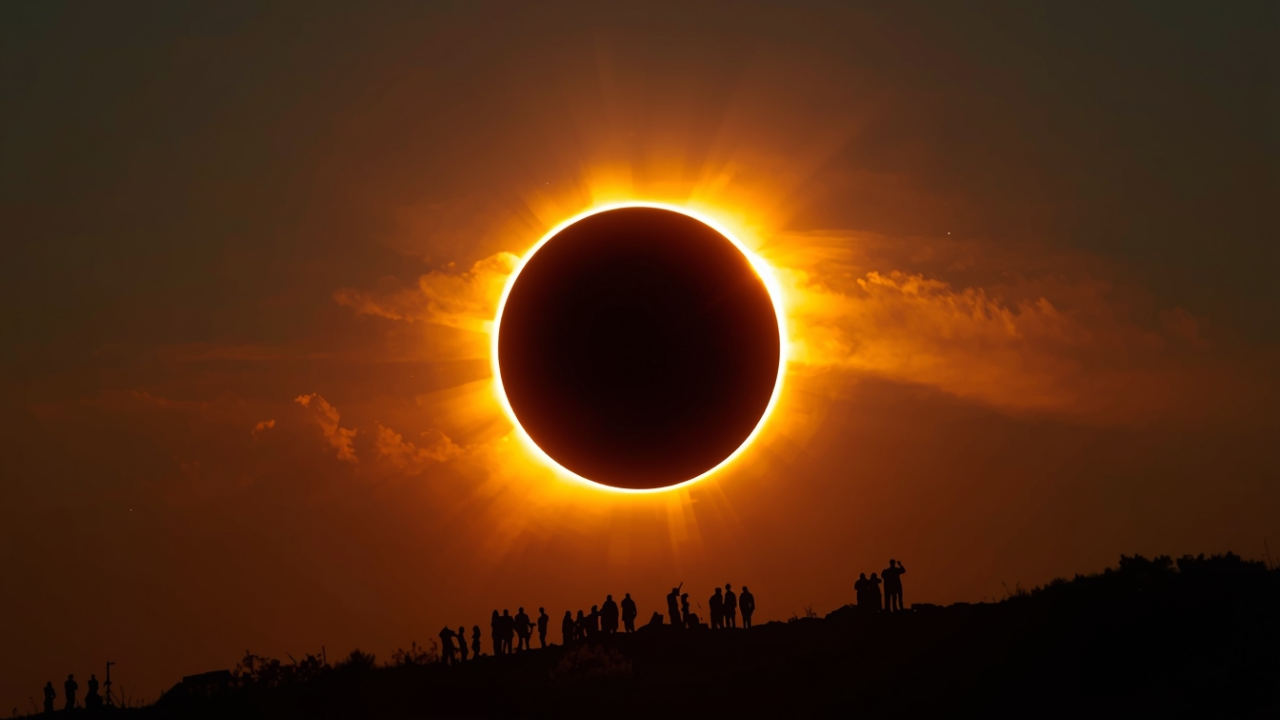
On an ordinary afternoon, life usually flows without interruption. People scroll through their phones, traffic moves with its usual rhythm, and children shout joyfully in playgrounds. But on one rare day, the sky itself will change the script. The longest total solar eclipse of the century is set to sweep across several regions of the world, turning daylight into an eerie twilight and leaving millions in silent awe.
Unlike dramatic natural events that arrive with thunder or warnings, a solar eclipse unfolds quietly. It begins with subtle changes that most people might not even notice at first. The sunlight doesn’t disappear instantly; instead, it transforms slowly, creating a surreal atmosphere that feels almost unreal. Colors lose their warmth, shadows sharpen unnaturally, and a strange stillness takes over the environment. The sky forgets what time it is, and for a few unforgettable minutes, day and night blur together.
A Rare Cosmic Alignment That Stops Time
A total solar eclipse occurs when the Moon moves perfectly between the Earth and the Sun, blocking the Sun’s light completely for a brief period. While solar eclipses happen every few years, this particular one is extraordinary because of its unusually long duration. Scientists have confirmed that the eclipse will stretch total darkness for several minutes in certain regions, making it one of the longest experiences of totality in the 21st century.
As the Moon’s shadow travels across the planet at incredible speed, observers positioned along the path of totality will witness the Sun shrinking into a glowing crescent before disappearing entirely. At that moment, the Sun’s corona — its mysterious outer atmosphere — becomes visible. The corona appears as delicate, silver-like flames surrounding the dark lunar disk, creating one of nature’s most breathtaking visual spectacles.
For people experiencing totality, the sudden transformation can feel deeply emotional. Many eclipse watchers describe the moment as surreal, almost spiritual. The brain struggles to process the sudden shift from daylight to near darkness, creating a sensation that feels both thrilling and slightly unsettling.
Cities and Countryside Prepare for the Celestial Show
Across regions expected to fall under the eclipse path, excitement has been building for months. Hotels in several popular viewing locations have already reported full bookings as eclipse enthusiasts, photographers, and scientists travel from around the world to secure the perfect viewing spot.
Local businesses are also preparing for the influx of visitors. Cafés are introducing eclipse-themed menus, souvenir shops are stocking solar glasses, and communities are organizing public viewing events. Schools are turning the eclipse into an educational opportunity, encouraging students to create pinhole projectors and learn about space science through hands-on activities.
Astronomers, however, are approaching the event with cautious anticipation. Despite years of preparation, weather conditions remain the biggest uncertainty. Even thin cloud cover can block the perfect view of totality. Many scientific teams are using weather tracking tools and backup viewing locations to increase their chances of capturing valuable data.
Why This Eclipse Matters to Science
Beyond its beauty, this solar eclipse holds significant scientific importance. The extended period of darkness allows researchers to study the Sun’s corona in greater detail. Scientists are particularly interested in understanding why the corona is significantly hotter than the Sun’s surface — a mystery that has puzzled astronomers for decades.
Additionally, researchers will monitor changes in temperature, atmospheric behavior, and wildlife responses during the eclipse. Studies from past eclipses have shown that birds often stop singing, nocturnal animals become active, and some species behave as if night has suddenly arrived. This eclipse offers a rare opportunity to observe these reactions more closely due to its longer duration.
For scientists, each eclipse acts as a natural laboratory, providing conditions that cannot be recreated artificially. The data collected during this event may contribute to advancements in solar physics and climate studies.
The Human Experience: Awe, Wonder, and Emotional Impact
For most people, the eclipse will not be about scientific research but about personal experience. Watching the sky darken in the middle of the day creates a moment that feels both humbling and unforgettable. Many people describe feeling goosebumps, excitement, or even emotional tears during totality.
Experts suggest that witnessing a total solar eclipse often leaves a lasting impression. The event reminds people of Earth’s place in the vast universe and highlights how rare and fragile such cosmic alignments truly are.
Solar physicists who have traveled across continents to chase eclipses often describe the experience as addictive. Once someone witnesses totality, they often want to experience it again in different parts of the world.
How to Prepare for the Eclipse
Preparation plays a key role in ensuring a safe and memorable viewing experience. Experts strongly emphasize the importance of using certified eclipse glasses or solar filters when observing the Sun. Regular sunglasses are not safe and can cause permanent eye damage.
Choosing a suitable viewing location is equally important. Open areas with clear horizons provide the best visibility. Observers are encouraged to scout their location in advance and consider backup spots in case of unexpected weather changes.
While capturing photographs can be exciting, experts advise viewers not to spend the entire eclipse behind a camera. Taking a few photos is fine, but experiencing the moment directly often creates stronger memories. Spending even one minute simply observing the eclipse without distractions can make the event more meaningful.
Parents watching with children are encouraged to explain the process beforehand. Understanding why the sky darkens and why animals behave differently can prevent fear and turn the event into an educational adventure.
The Moment After Totality
When the Moon slowly moves away from the Sun and daylight returns, the transition back to normalcy feels surprisingly calm. Birds begin singing again, temperatures rise gradually, and the world resumes its routine as if nothing unusual happened.
However, for those who witnessed totality, the experience often leaves a lasting emotional imprint. People tend to describe the event in poetic or spiritual terms, struggling to find words that fully capture the beauty and mystery they witnessed.
The Moon’s shadow will continue its journey across oceans and continents, creating shared memories among strangers who briefly stood under the same cosmic phenomenon.
A Once-in-a-Lifetime Celestial Event
The longest total solar eclipse of the century represents more than just an astronomical event. It serves as a reminder of the universe’s precision, beauty, and unpredictability. For scientists, it offers valuable research opportunities. For travelers and families, it creates unforgettable memories. And for millions of observers, it provides a rare chance to watch the universe perform one of its most spectacular shows.
As the sky darkens and the Sun disappears behind the Moon, the world pauses for a moment. Time seems to slow down, and humanity collectively looks upward, united by curiosity and wonder. Events like this remind us how small we are in the grand cosmic scale — and yet how fortunate we are to witness such extraordinary beauty.