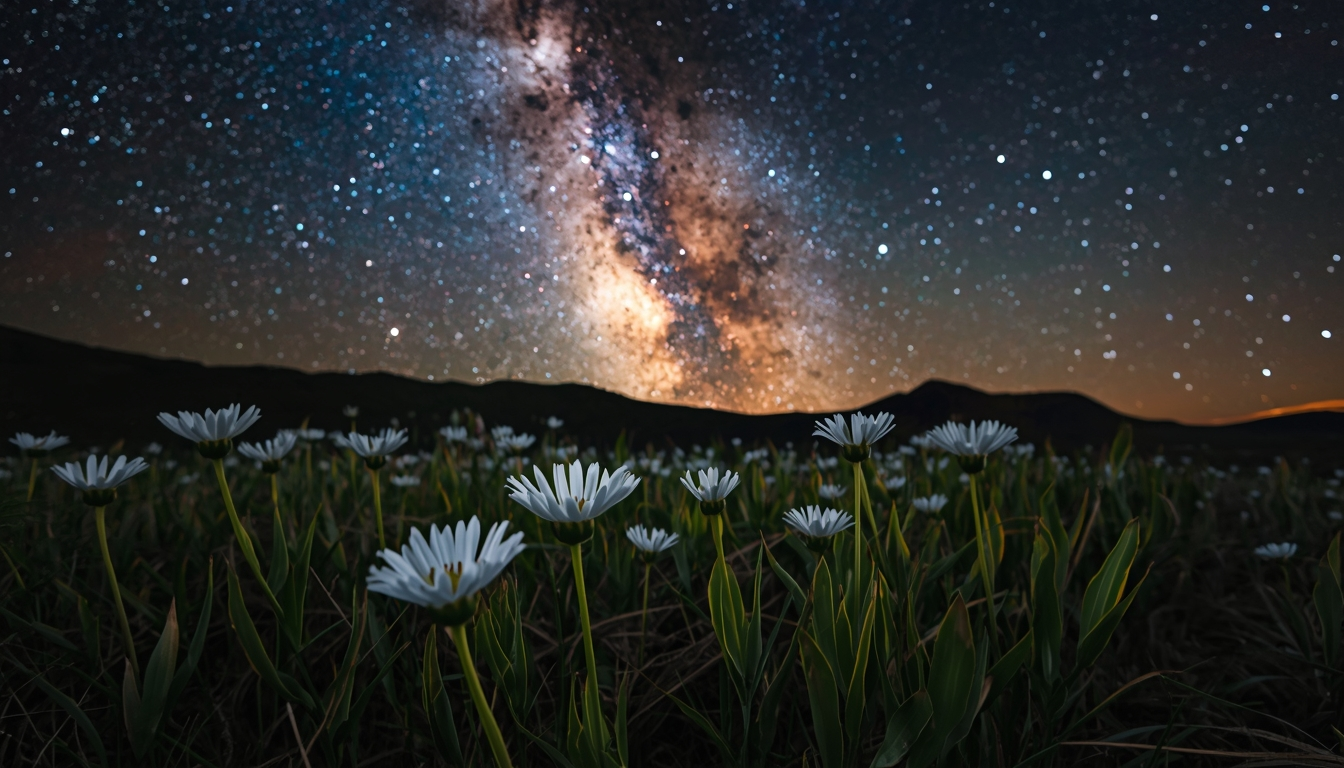
A single photograph can sometimes say more about our planet than pages of scientific reports. That is exactly the case with this striking image by Brazilian photographer Marcio Cabral, featured in the 2025 edition of National Geographic’s prestigious album The Photographs.
Selected among more than 250 standout images from the past decade, Cabral’s work stands out not only for its beauty, but for its scientific depth and environmental message.
Where Art Meets Scientific Precision
The photograph was captured in Chapada dos Veadeiros National Park, a remote protected area in Brazil known for its biodiversity and pristine night skies.
Far from light pollution, the Milky Way arcs across the darkness with astonishing clarity. Below it, a field of delicate “shower head” wildflowers — Paepalanthus — stretches toward the horizon. These plants were recently identified as belonging to a new genus, adding a layer of scientific relevance to an already mesmerizing scene.
In a single frame, Cabral unites:
- The vast cosmic scale of the galaxy
- The fragile beauty of endemic plant life
- A protected ecosystem under threat
- The disappearing darkness of natural night skies
The result is both poetic and precise — an image rooted in observation yet elevated by artistic vision.
A Lighting Technique Designed for Conservation
What makes the image technically remarkable is Cabral’s proprietary three-dimensional lighting technique. Rather than flooding the scene with artificial light, he carefully illuminated the foreground plants to add depth and texture — without overpowering the natural glow of the Milky Way.
The balance is intentional.
- The sky remains luminous but authentic.
- The flowers feel tangible and grounded.
- The landscape retains its integrity.
This approach reinforces the image’s core message: wonder and vulnerability coexist.
A Quiet Environmental Warning
The photograph does more than celebrate beauty. It highlights two growing environmental concerns:
1. Light Pollution
The natural night sky is vanishing worldwide as artificial lighting spreads. For many urban populations, the Milky Way is no longer visible.
2. Biodiversity Under Pressure
The Paepalanthus flowers — emblematic of the region — face threats from human activity, habitat disruption, and climate change.
By bringing cosmic immensity and delicate plant life into the same frame, Cabral invites viewers to reflect on what could be lost.
Recognized Beyond Photography
The scientific journal Nature praised the photograph for demonstrating “the balance between art and documentary rigour.” That rare combination is what elevates the image beyond aesthetic admiration.
It becomes evidence.
It becomes advocacy.
It becomes a call to care.
Why This Image Matters in 2026
At a time when environmental crises dominate headlines — from biodiversity collapse to climate disruption — imagery that connects emotion with evidence carries unusual power.
Cabral’s photograph reminds us that:
- Conservation is not abstract.
- Darkness is part of natural heritage.
- Scientific discovery still reveals unknown beauty.
- Protection begins with awareness.
Among hundreds of extraordinary images in The Photographs 2025, this one feels essential because it bridges two worlds — science and art — without compromising either.
The Enduring Power of Visual Storytelling
For decades, National Geographic’s archive has chronicled humanity, wildlife, exploration, and environmental change. From powerful portraits to deep-sea discoveries, each image preserves a fragment of our shared story.
Cabral’s contribution adds another luminous chapter — one where the Milky Way meets newly classified flora, and where beauty quietly urges responsibility.
Sometimes, the most powerful environmental message is not shouted.
It simply shines.