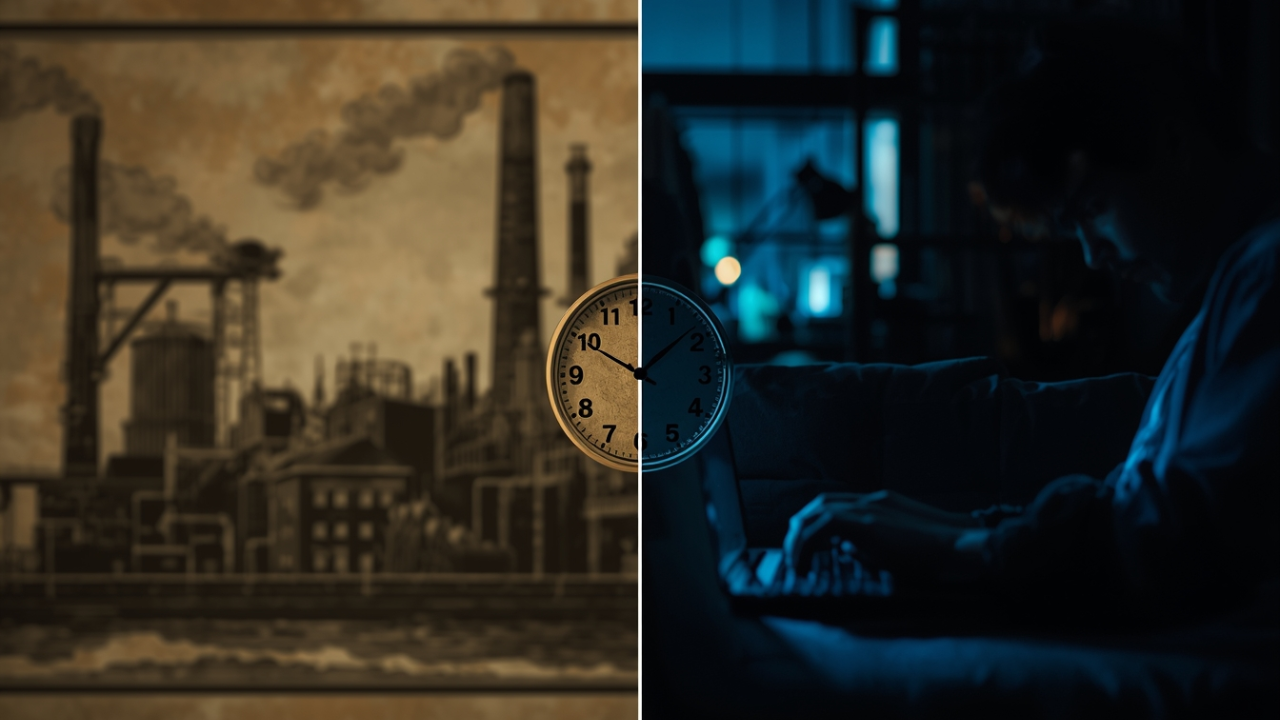
The laptop is still open. The day’s meetings are technically over, yet emails keep arriving, messages blink on the phone, and one last task quietly turns into three. Somewhere between the sofa and the kitchen table, work has followed you home — again.
What feels like a modern problem actually isn’t.
More than two centuries ago, at the height of the Industrial Revolution, one man saw the same pattern forming: work expanding endlessly, rest shrinking, and personal life slowly dissolving. His response was radical in its simplicity. And today, as burnout becomes a near-default state for many professionals, his idea is making an unexpected comeback.
That man was Robert Owen, and his rule was known as 8-8-8.
The rule that tried to civilise work
In the early 1800s, factory workers in Britain often laboured 14 to 16 hours a day. Accidents were common. Illness spread easily. Family life barely existed outside exhaustion. This wasn’t just cruel — it was inefficient.
Owen, a Welsh industrialist and social reformer, believed something revolutionary for his time:
humans were not machines, and overworking them destroyed both productivity and dignity.
His proposal was blunt, almost mathematical:
- 8 hours of work
- 8 hours of rest (sleep)
- 8 hours of leisure and personal life
A full day, evenly divided.
At the time, this idea sounded dangerously idealistic. Employers feared lost output. Politicians feared unrest. Yet Owen argued that a rested worker made fewer mistakes, learned faster, stayed healthier, and was less likely to revolt. Balance, he believed, was not charity — it was stability.
His slogan spread through labour movements across Europe and North America. By the early 20th century, the eight-hour workday became law in many countries, shaping what later turned into the 40-hour workweek.
The irony?
We kept the 8 hours of work — and quietly eroded the rest.
Why the 8-8-8 rule suddenly feels urgent again
Today, very few people work in factories for 15 hours straight. Yet many experience a different kind of overload: permanent availability.
Remote work, smartphones, messaging platforms, and global teams have removed the natural stop signs that once protected personal time. There is no factory whistle anymore. No office door to lock. No commute to signal that the workday is over.
Instead:
- Emails arrive at night
- Messages ping on weekends
- “Just one more thing” becomes a habit
Work no longer occupies a place. It occupies attention.
Studies across Europe and North America show rising levels of:
- Chronic stress
- Sleep disturbances
- Burnout symptoms
- Anxiety linked to constant connectivity
Women, in particular, report higher difficulty separating professional and personal life, often because paid work stacks on top of unpaid domestic labour rather than replacing it.
In this context, Owen’s old rule doesn’t feel nostalgic.
It feels diagnostic.
The real power of the 8-8-8 principle isn’t the math
Taken literally, the rule sounds unrealistic. Who truly gets eight uninterrupted hours of leisure every day?
But the strength of 8-8-8 lies in proportion, not precision.
It asks a simple but uncomfortable question:
Does work consistently consume more than one-third of your life — once sleep and personal time are counted?
If the answer is yes, the system is running at a deficit.
Psychologists today often describe time as a form of energy currency. Overspend in one category long enough, and the others collapse. Owen’s rule acts like a budget check for modern life.
Mapping a modern day onto the 8-8-8 framework
Here’s how a typical weekday often looks when examined honestly:
| Block | Intended role | What often happens |
|---|---|---|
| Work (8h) | Job tasks, meetings | Expands via email, chats, overtime |
| Rest (8h) | Sleep, recovery | Shrinks due to screens and stress |
| Leisure (8h) | Family, hobbies, health | Cannibalised by unfinished work |
When commuting, unpaid labour, and “soft work” (checking messages, thinking about tasks) are included, work can quietly consume 10–12 hours of the day.
The cost is rarely immediate. It accumulates:
- Shorter sleep
- Less patience
- Reduced creativity
- Weaker immune response
Burnout doesn’t arrive suddenly. It leaks in.
Why remote work made boundaries harder — not easier
Working from home removed friction. That was the promise. But friction had a function.
Without physical transitions:
- The brain doesn’t switch modes
- The nervous system stays alert
- Work bleeds into rest
Many people now work where they sleep, eat, relax, and parent — without clear psychological separation.
To counter this, some workers intentionally re-create boundaries that no longer exist naturally:
- A fixed shutdown hour treated like a meeting
- Separate devices or user profiles for work
- Notifications blocked after certain times
- Physical rituals: walking, changing clothes, closing the laptop
These aren’t productivity hacks.
They are nervous-system protections.
When the 8-8-8 rule collides with reality
Critics are right about one thing: the rule never applied cleanly to everyone.
- Shift workers
- Carers
- Freelancers
- Gig-economy workers
- Parents of young children
For many, leisure time looks like unpaid labour. Rest is fragmented. Schedules are irregular.
Yet even here, the rule remains useful — not as an instruction, but as a warning signal.
If paid work plus unpaid obligations regularly consume two-thirds or more of your day, something else will eventually pay the price: health, relationships, or long-term stability.
A smarter way to apply 8-8-8 today: averages, not perfection
Modern experts often suggest treating 8-8-8 as a weekly or monthly average, not a daily requirement.
Some professions involve intense bursts followed by recovery periods. Others have seasonal peaks. What matters is whether balance returns — or whether work permanently dominates.
Ask instead:
- Over a month, do I regularly reclaim rest?
- Over a year, do I have real leisure time?
- Or is work always borrowing from tomorrow?
Balance delayed indefinitely is balance denied.
What “rest” and “leisure” actually mean
Owen used the words rest and recreation. Today, research makes their roles clearer.
Rest
Not just sleep. It includes:
- Quiet, low-stimulation activities
- Gentle movement
- Time without performance or output
Rest lowers stress hormones and allows recovery.
Leisure
Chosen, meaningful activities:
- Time with family or friends
- Creative pursuits
- Exercise
- Volunteering
Leisure builds identity beyond work. When it disappears, jobs become the sole source of worth — a fragile foundation.
The cost of ignoring the three blocks
Medical research consistently links long working hours and poor sleep to:
- Cardiovascular disease
- Depression and anxiety
- Musculoskeletal pain
- Reduced cognitive performance
Socially, constant work presence often creates emotional absence. Children notice. Partners notice. Relationships become logistical rather than relational.
Economically, burnout leads to:
- Absenteeism
- Errors
- High staff turnover
The short-term gain of constant availability often produces long-term loss.
Why a 19th-century idea still works
Robert Owen lived in a world of steam engines and factory floors. He could not have imagined laptops, notifications, or global Slack channels.
Yet his core insight remains sharp:
A society that consumes all of its people’s time eventually consumes their health, trust, and creativity too.
The 8-8-8 rule doesn’t ask us to work less out of laziness.
It asks us to work within human limits.
In a world where work can follow us everywhere, that may be more radical now than it was in 1817.
Key takeaways
| Insight | What it means today |
|---|---|
| 8-8-8 is about proportion | Not strict hours, but balance |
| Boundaries protect health | Especially in remote work |
| Rest and leisure are different | Both are necessary |
| Burnout is gradual | Caused by constant overspending |
| Old ideas can solve new problems | If we take them seriously |