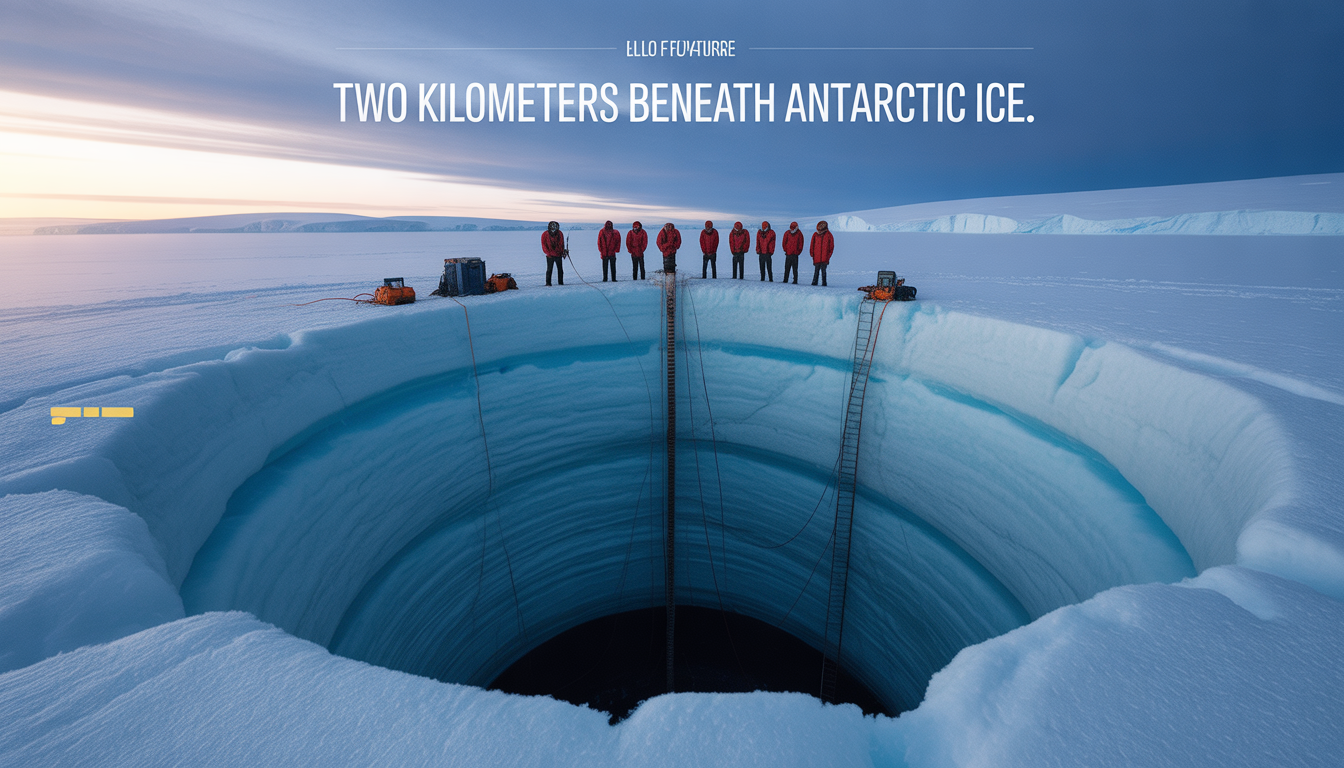
At minus 30°C, even sound seems to crystallize in midair. Around a narrow borehole carved into Antarctica’s vast white plateau, a small team of researchers waited in silence as a digital readout flickered toward a number that had taken years to reach: 2,000 meters.
Two kilometers of ancient ice.
Below that depth, sealed away since the Eocene–Oligocene transition, lay water untouched by the atmosphere for roughly 34 million years. When the drill reached its target, no one cheered. They understood what it meant.
They had opened a door into deep time.
And with that door came an argument that is already dividing science: will this discovery help protect the planet — or quietly set a precedent that puts its last untouched ecosystems at risk?
A Climate Time Capsule Beneath the Ice
Subglacial lakes beneath Antarctica are not myths. They are real bodies of liquid water trapped under immense pressure beneath kilometers of ice. Among the most famous is Lake Vostok, first penetrated by Russian scientists in 2012. The United States drilled into Subglacial Lake Whillans. The UK attempted access to Lake Ellsworth.
Each mission triggered the same mix of awe and anxiety.
This new borehole, however, pushes deeper into a basin believed to contain sediments and water dating back to a period when Earth transitioned from a greenhouse world to an ice-dominated one. Around 34 million years ago, atmospheric CO₂ levels shifted dramatically, and Antarctic ice sheets began forming in earnest.
That makes this lake more than a curiosity.
It is a climate archive.
Tiny gas bubbles, chemical traces in sediments, and dormant microbial life could reveal how quickly ice sheets form and collapse when carbon dioxide levels shift — information that directly feeds modern sea-level rise models.
Scientists aren’t just drilling for water.
They are interrogating Earth’s memory.
How You Drill Into a World That Has Never Met Us
The engineering challenge alone is staggering.
Instead of mechanical drill bits that would risk contamination, teams use hot-water drilling systems. Superheated, filtered water melts a shaft through the ice, recirculated continuously under sterile conditions. The borehole must remain uncontaminated from surface microbes — no easy feat when humans are operating generators, fuel depots, and camps nearby.
Protocols resemble surgical preparation:
- Equipment sterilized with hydrogen peroxide and UV light
- Nested “clean zones” inside lab tents
- Protective suits to limit microbial shedding
- Continuous monitoring of contamination indicators
One stray bacterium from a human glove could compromise the integrity of a pristine ecosystem sealed since before humans evolved.
The rules are strict for a reason: once contamination happens, it cannot be undone.
Why Scientists Are Willing to Take the Risk
The motivation is not spectacle.
Modern climate models rely on understanding how ice sheets behaved in past warm periods. The Eocene–Oligocene transition represents one of Earth’s most dramatic climate tipping points. If researchers can determine how rapidly Antarctic ice grew — or how fragile it proved under changing CO₂ — they gain better predictive power about our own century.
The stakes are global:
- Sea-level projections for coastal megacities
- Long-term Antarctic ice stability
- Ocean circulation patterns
- Carbon feedback loops
In other words, the data extracted from a 34-million-year-old lake could sharpen forecasts that shape trillions of dollars in infrastructure and adaptation planning.
Without hard geological evidence, predictions remain partly theoretical.
This lake offers ground truth.
The Other Temptation: Biology and Profit
Here is where the debate sharpens.
Subglacial lakes may host microorganisms that have evolved in isolation for millions of years. Such organisms could possess unique enzymes adapted to extreme cold, high pressure, and low nutrients.
To biotech industries, that possibility sparks imagination:
- Cold-active enzymes for industry
- Novel antibiotics
- Genetic sequences with commercial applications
And that is precisely what worries many researchers.
Antarctica is governed by the Antarctic Treaty System, which designates the continent as a scientific preserve devoted to peace and research. However, legal gray zones remain around genetic resources and bioprospecting.
If a breakthrough enzyme were discovered in ancient Antarctic microbes, who would own it?
The scientists? The sponsoring nation? Humanity?
Or a corporation?
The borehole that promises climate clarity could also open doors to patent claims.
Is There a Real Risk to the Planet?
Hollywood imagines a dormant “superbug” awakening from the ice. Experts are quick to temper that fear. A catastrophic pathogen emerging from a subglacial lake is highly unlikely.
The real risks are subtler:
- Introducing surface microbes into an isolated ecosystem
- Disrupting fragile microbial balances
- Setting precedents for less careful future drilling
- Expanding commercial exploitation under the banner of science
Environmental change rarely arrives in dramatic explosions. More often, it unfolds through incremental normalization.
Today it is climate research.
Tomorrow, it might be mineral exploration.
Precedent matters.
Lessons From Previous Antarctic Drilling
The penetration of Lake Vostok sparked controversy over drilling fluids and contamination. US efforts at Lake Whillans focused heavily on ultra-clean access and open scientific publication.
Each mission refined sterile techniques and transparency measures.
This new two-kilometer borehole incorporates those lessons — stricter filtration, greater international oversight, and clearer contamination monitoring.
Still, critics argue that even the cleanest drill represents a fundamental intrusion into one of Earth’s last untouched hydrological systems.
The debate is not about technical competence.
It is about principle.
The Ethical Fault Line
At its core, the argument divides into two camps:
Exploration Advocates
- Essential for improving climate models
- Conducted under strict sterile conditions
- Knowledge gained outweighs manageable risk
- Antarctica exists for peaceful science
Restraint Advocates
- Some ecosystems should remain untouched
- Drilling sets precedent for future exploitation
- Commercial interest could follow discovery
- Remote sensing might be sufficient
Both sides claim to be defending the planet.
One emphasizes understanding.
The other emphasizes preservation.
What This Means for the Future
If managed carefully — with full data transparency, strict bans on commercial patents tied to native organisms, and continued oversight under the Antarctic Treaty — this drilling could become a model for responsible exploration.
If not, it may normalize deeper interventions in extreme environments.
There is also a practical paradox:
To protect Antarctica from climate collapse, we must understand how it collapses.
To understand it, we must sometimes disturb it.
That tension will not disappear.
Key Points
| Key Point | Detail | Why It Matters |
|---|---|---|
| 2 km drilling breakthrough | Scientists reached a subglacial lake sealed ~34 million years | Access to a rare climate archive |
| Climate transition focus | Lake formed near Eocene–Oligocene shift | Direct insight into ice-sheet tipping points |
| Strict sterile protocols | Hot-water drilling and contamination control | Protects isolated ecosystems |
| Ethical debate intensifies | Concerns over bioprospecting and precedent | Shapes future Antarctic governance |
FAQ
What exactly did scientists reach beneath the ice?
A subglacial lake and ancient sediments isolated from the atmosphere for roughly 34 million years.
Could ancient microbes pose a pandemic threat?
Highly unlikely. The main concern is ecological disturbance, not a Hollywood-style outbreak.
Why drill instead of study remotely?
Direct samples provide chemical and biological data impossible to obtain via satellite or remote sensing alone.
Is commercial exploitation allowed in Antarctica?
The Antarctic Treaty prioritizes peaceful scientific research, but debates continue about genetic resources and patents.
Does this help climate science?
Yes. Understanding ancient ice-sheet responses improves predictions of modern sea-level rise and climate tipping points.