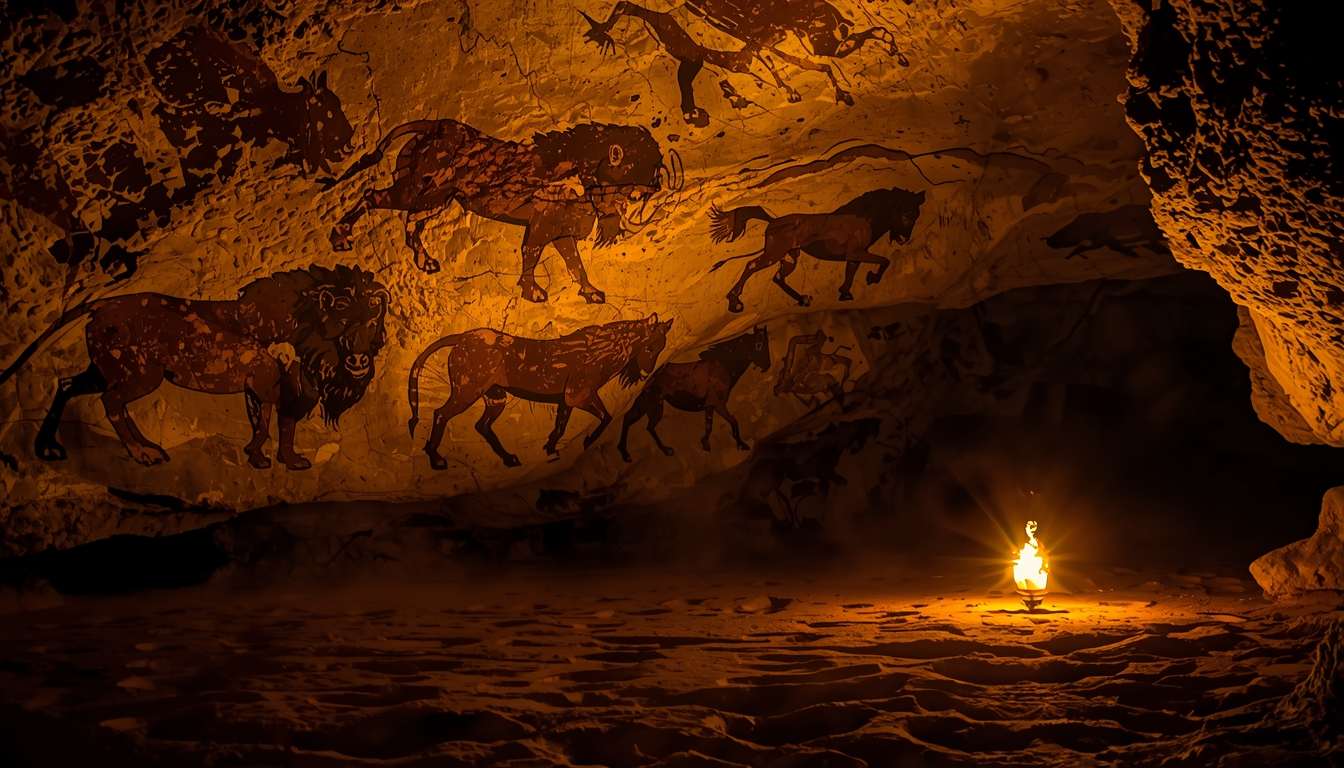
For more than two millennia of recorded history, and tens of thousands of years before that, a hidden chamber in southern France lay untouched — its entrance blocked by a massive rockfall. Behind that natural barrier survived some of the oldest known masterpieces ever created by human hands.
The site is the legendary Chauvet Cave, a place that fundamentally reshaped our understanding of early human creativity.
Discovered on December 18, 1994, by a team of speleologists led by Jean-Marie Chauvet, the cave revealed something no one expected: artwork of astonishing sophistication dating back more than 36,000 years.
A Discovery That Rewrote Prehistory
Hidden within the cliffs of the Ardèche region, the cave contains over 350 animal depictions — mammoths, woolly rhinoceroses, lions, horses, and bears — rendered with remarkable precision and movement.
The scale and quality of the paintings stunned researchers. Shading techniques create volume. Overlapping figures suggest motion. Perspective and composition demonstrate deliberate artistic planning.
Before this discovery, many scholars believed prehistoric art followed a slow evolutionary path, beginning with crude sketches that gradually improved over thousands of years. That view was strongly influenced by the work of André Leroi-Gourhan, whose 1965 book Prehistory of Western Art proposed a linear progression of artistic development.
Chauvet overturned that assumption.
From the very dawn of figurative expression, humans were already capable of producing art of extraordinary technical and symbolic complexity.
A Time Capsule of the Upper Paleolithic
Radiocarbon dating places the earliest artworks in Chauvet at around 36,000 years before present, during the Aurignacian period of the Upper Paleolithic.
What makes the site even more extraordinary is its preservation.
Around 19,500 BCE, a landslide sealed the cave entrance completely. For approximately 21,000 years, no human or large animal entered its chambers. The paintings were protected from moisture, light, wind, and human interference.
As a result, the charcoal lines remain crisp. The ochre pigments retain their depth. Even cave bear footprints and ancient hearth remains are still visible on the ground.
Few archaeological sites offer such an undisturbed snapshot of prehistoric life.
Recognized as a Global Treasure
Due to its unparalleled importance, Chauvet Cave was designated a UNESCO World Heritage Site by UNESCO in 2014.
To preserve the fragile environment, the original cave is closed to the public. Even minimal changes in humidity or carbon dioxide levels could damage the artworks — a lesson learned from earlier decorated caves such as Lascaux Cave, where tourism caused significant deterioration.
Instead, a meticulously crafted replica allows visitors to experience the site without endangering the original paintings.
Meanwhile, researchers continue to study the cave using advanced 3D mapping, topographic scanning, and geochemical analysis. Each technological breakthrough offers deeper insight into the lives of the hunter-gatherer groups who once roamed the region.
What Chauvet Reveals About Early Humanity
Beyond its artistic beauty, Chauvet challenges outdated assumptions about early human cognition.
The paintings demonstrate:
- Advanced observational skills
- Symbolic thinking
- Narrative composition
- Technical mastery of materials
These were not tentative first attempts at art. They were deliberate, expressive works created by people whose intellectual and cultural sophistication rivals our own.
Thirty years after its rediscovery, Chauvet Cave remains one of archaeology’s most profound reminders: creativity did not gradually awaken over time — it was already thriving at the dawn of our species’ history.
Sealed by stone, protected by chance, and revealed by curiosity, Chauvet stands as silent proof that the human impulse to create is far older than civilization itself.