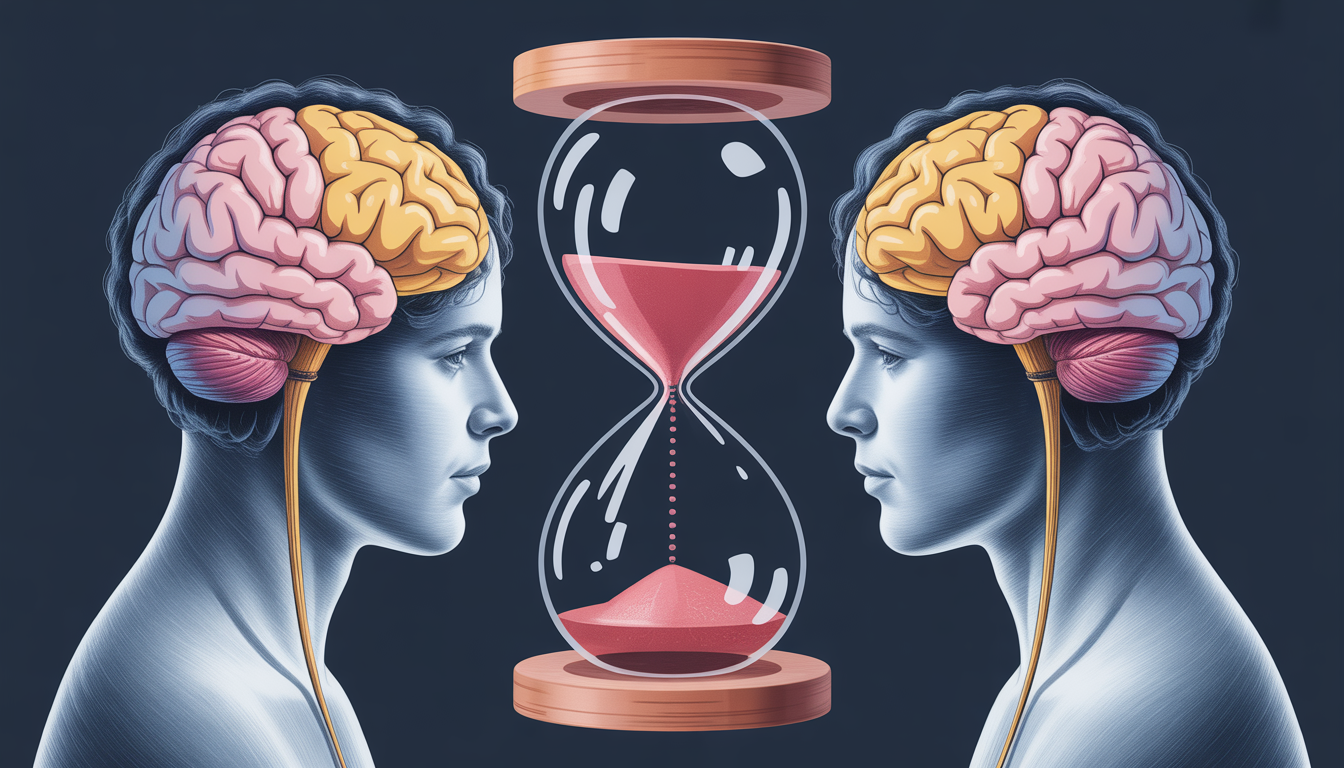
New research from the United States suggests that two key brain regions act together like an hourglass, quietly measuring time so we can speak, walk, clap or pause at exactly the right moment.
The findings, published in Nature, are raising new hope for treating movement disorders such as Parkinson’s disease and Huntington’s disease.
The Brain’s Invisible Stopwatch
We have senses for sight, sound and touch — but not for time.
Yet we constantly rely on precise timing:
- Pausing just long enough in conversation
- Catching a ball mid-air
- Stepping in rhythm while walking
- Playing music on beat
For decades, neuroscientists have debated how the brain tracks time so accurately.
A team at the Max Planck Florida Institute for Neuroscience has now provided striking evidence that two brain regions share timing duties:
- The motor cortex
- The striatum
Together, they function like the two bulbs of an hourglass.
Two Brain Regions, One Shared Timer
The motor cortex sits near the top of the brain and sends commands to muscles.
The striatum, located deeper inside the brain, helps initiate and fine-tune movement. It is also heavily affected in Parkinson’s and Huntington’s disease.
The Hourglass Model
Researchers found:
- The motor cortex produces a steady stream of activity.
- That activity accumulates in the striatum.
- When the signal reaches a threshold, movement is triggered.
Think of it like sand falling through an hourglass:
- The motor cortex = sand flowing from the top bulb.
- The striatum = sand collecting at the bottom.
- When enough sand gathers, action happens.
If the flow changes, timing shifts.
Teaching Mice to “Wait for It”
To test this idea, researchers trained mice to perform a timing task.
The mice:
- Heard a cue.
- Had to wait exactly one second.
- Licked a spout for a reward — but only at the right time.
This required internal timing, not reflex.
While the mice performed the task, scientists recorded thousands of neurons in both the motor cortex and the striatum.
They observed:
- Motor cortex activity ramped up gradually.
- Striatal activity accumulated in parallel.
- When the threshold was reached, the mouse acted.
The neural pattern mirrored the passage of time itself.
Freezing and Rewinding the Brain’s Clock
The researchers then used optogenetics — a technique that uses light to switch specific neurons on or off.
When the Motor Cortex Was Silenced
- The “flow of sand” stopped.
- The internal clock paused.
- Mice responded later than expected.
From the mouse’s perspective, time had frozen.
When the Striatum Was Silenced
The effect was different.
- The accumulated signal disappeared.
- The timer reset.
- Mice behaved as if they were starting from zero.
In other words:
- Motor cortex interruption = pause.
- Striatum interruption = rewind.
That difference strongly supports the hourglass model.
Why This Matters for Parkinson’s and Huntington’s
Both disorders involve the striatum and related motor circuits.
| Disorder | Key Region Affected | Timing Impact |
|---|---|---|
| Parkinson’s disease | Striatum and basal ganglia circuits | Slowness, rigidity, delayed movement |
| Huntington’s disease | Striatum | Uncontrolled, mistimed movements |
Movement disorders are not just about strength or coordination.
They are often disorders of timing.
If the brain’s hourglass runs too slowly, movements lag.
If it resets unpredictably, actions become jerky or involuntary.
Understanding this timing partnership could lead to:
- More precise deep brain stimulation
- Better-targeted medications
- Digital rehabilitation tools
Everyday Life Depends on This System
Although the study used mice, the implications extend to humans.
Consider daily tasks:
- Speaking clearly requires precise timing between syllables.
- Driving safely requires split-second braking decisions.
- Typing requires millisecond coordination between fingers.
- Dancing or playing music requires rhythmic precision.
All of these depend on the motor cortex and striatum working together.
Without accurate internal timing, life becomes disjointed.
Key Scientific Concepts
Motor Cortex
Controls voluntary movement by sending commands to muscles.
Striatum
Part of the basal ganglia network. Regulates movement initiation, reward and habit formation.
Optogenetics
A method allowing researchers to activate or silence specific neurons using light.
What Comes Next?
The findings are early — and based on animal models — but they suggest several future paths:
1. Smarter Brain Stimulation
Deep brain stimulation could be adjusted to restore timing precision, not just suppress tremor.
2. Targeted Training
Timing exercises — like rhythm tapping tasks — could be tailored to retrain damaged circuits.
3. Precision Medicine
Therapies might one day recalibrate how signals accumulate in the striatum.
However, caution is needed.
The striatum also affects motivation and reward.
Interfering with timing circuits could influence mood or decision-making.
Careful research will be essential.
The Bigger Picture
Movement feels automatic.
But beneath every gesture lies a silent measurement of time.
This study suggests that two small brain regions — working together like an hourglass — keep that internal flow running.
When the flow is disrupted, movement falters.
If scientists can learn to adjust this clock safely, they may not just improve motor control — they may reshape how we treat some of the most challenging neurological disorders of our time.
For now, one thing is clear:
Time in the brain is not abstract.
It is built, grain by grain, by neurons working together.