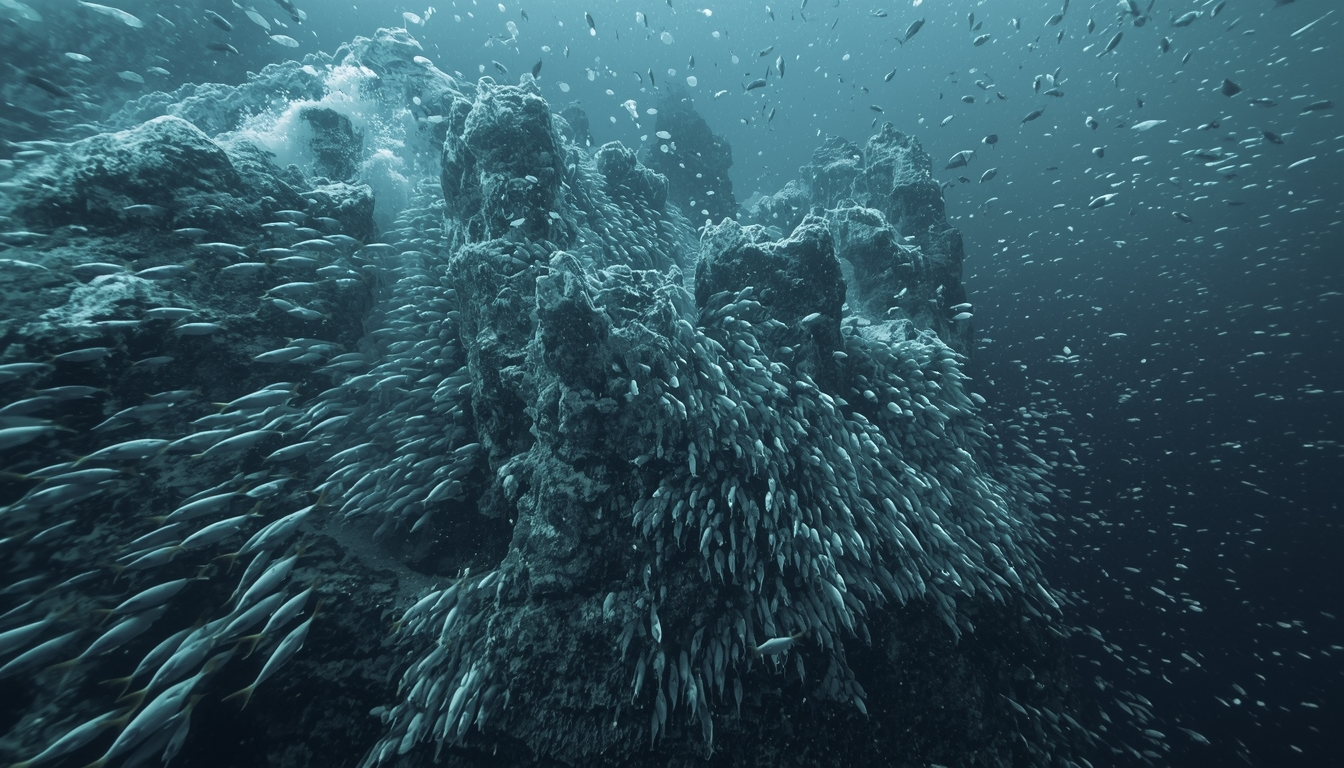
A routine research mission turned into one of the most extraordinary Antarctic discoveries of the century.
While mapping the seafloor beneath the ice-covered Weddell Sea, scientists uncovered something no one expected: a vast underwater breeding colony made up of millions of carefully constructed fish nests.
What they found changes how we understand life in one of Earth’s harshest environments.
A Routine Expedition Becomes Historic
In early 2021, researchers aboard the German icebreaker RV Polarstern were conducting standard deep-sea mapping operations.
Instead of a barren, muddy seafloor, cameras revealed thousands of perfectly circular depressions stretching as far as the lens could see. Each one contained:
- A ring of small stones
- A cluster of translucent eggs
- A pale adult icefish standing guard
As the camera continued its sweep, the circles didn’t stop.
Scientists soon realized they were looking at approximately 60 million fish nests spread across 240 square kilometers—an area comparable to a major city.
Lead researcher Dr. Autun Purser described it as unprecedented in marine science.
The Architects: Antarctic Icefish
The colony belongs to a species of Antarctic icefish, remarkable for their extreme adaptations.
These fish:
- Have transparent blood with no red blood cells
- Circulate oxygen directly through plasma
- Thrive in water temperatures near freezing
- Possess enlarged hearts to pump oxygen efficiently
Each nest is meticulously built.
Nest Specifications
| Feature | Measurement | Purpose |
|---|---|---|
| Diameter | 75 cm | Protects eggs |
| Depth | 16 cm | Shields from currents |
| Egg count | ~1,735 per nest | Maximizes survival |
| Guard time | 3–4 months | Predator protection |
Males guard the nests for months, rarely leaving to feed.
What’s even more fascinating is that the nests cluster around slightly warmer water zones caused by geothermal circulation beneath the seafloor—suggesting the fish are selecting optimal breeding conditions.
Why This Discovery Is So Important
For decades, scientists believed the Antarctic seafloor was relatively sparse in life due to:
- Extreme cold
- Permanent ice cover
- Limited sunlight
- Nutrient constraints
This discovery challenges that assumption entirely.
The total biomass of fish in this colony is estimated at 60,000 tons—roughly the weight of 30,000 cars.
Implications for Science
- Antarctic carbon cycling models may need revision
- Polar food web complexity is greater than assumed
- Marine biodiversity in polar regions is underestimated
- Climate impact projections require reassessment
The scale of this ecosystem forces researchers to rethink long-standing theories about life under permanent ice.
Conservation Questions
The Weddell Sea has been under discussion for potential marine protected area (MPA) status.
Now, protecting tens of millions of active fish nests becomes a much more urgent conversation.
If warming trends continue, even slight temperature shifts could disrupt:
- Nest construction behavior
- Egg development
- Food availability
- Geothermal current balance
Understanding how this breeding “city” functions is now a scientific priority.
What Happens Next?
Researchers plan to return with advanced imaging and sampling tools to determine:
- How long the colony has existed
- Whether similar colonies exist elsewhere
- How fish coordinate nest spacing
- How climate change may affect survival
Early sonar data from nearby regions suggests this may not be the only hidden colony beneath Antarctic ice.
A Reminder of How Much We Don’t Know
Despite satellites mapping distant galaxies, 60 million fish nests remained undiscovered beneath Earth’s own ice shelves until 2021.
The oceans—especially polar ones—remain largely unexplored.
Beneath layers of ice, these icefish built an underwater metropolis that survived for generations, hidden from human view.
It’s a powerful reminder: even in the coldest, darkest corners of our planet, life finds a way—not just to survive, but to organize, build, and thrive.
FAQs
How deep are these nests?
They sit roughly 500 meters below the surface, beneath permanent Antarctic ice shelves.
How long do icefish guard their nests?
Typically 3–4 months, remaining near the eggs to protect them from predators.
Are other Antarctic fish known to build nests?
Some species create simple spawning areas, but this large-scale, stone-bordered construction appears unique to these icefish.
Could more colonies exist?
Yes. Sonar scans suggest other circular formations may indicate additional breeding sites.
Why wasn’t this discovered earlier?
The remoteness of the region, thick ice cover, and limited deep-sea mapping beneath Antarctic shelves delayed detection.
What is the biggest threat?
Climate change. Even small shifts in temperature or current patterns could disrupt the delicate breeding environment.
The Antarctic still holds vast mysteries beneath its ice.
This time, it revealed a city built not by humans—but by fish.