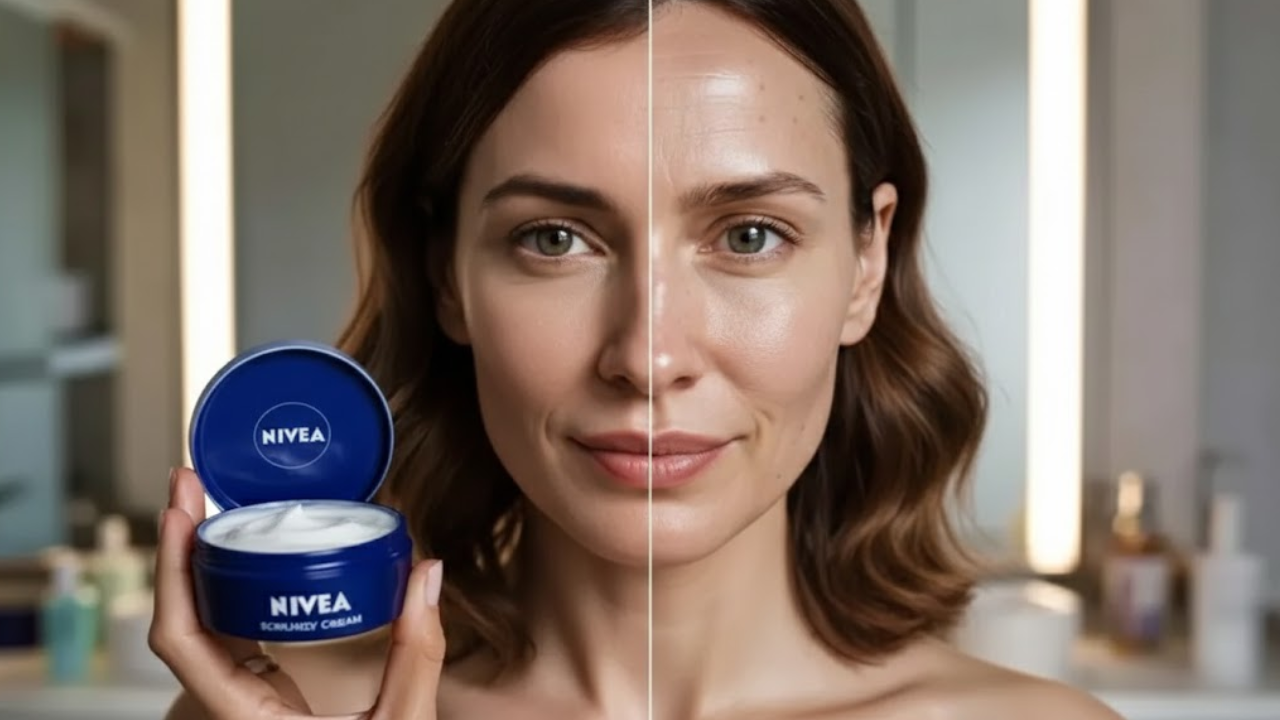
For years, the little blue tin of Nivea cream lived in the background of skincare conversations. It was always there—on pharmacy shelves, in childhood memories, on vanities belonging to mothers and grandmothers—but rarely taken seriously in modern routines dominated by serums, acids, and actives with scientific-sounding names.
I never expected it to surprise me.
Yet one quiet week, armed with curiosity and a slightly mischievous idea, I decided to test Nivea Blue Cream in the simplest, most honest way possible: I applied it to only one side of my face for seven days and left the other side with my usual routine. No filters. No excuses. Just observation.
What happened wasn’t dramatic. It was subtler—and in some ways, more convincing.
The Split-Face Experiment: What I Actually Did
The plan was deliberately simple. For one week:
- Left side of my face: Usual skincare routine plus a thin layer of Nivea Blue Cream as the final step at night.
- Right side of my face: Usual skincare routine only.
Every evening, I cleansed, applied my regular serum and light moisturizer, then sealed only the left side with a pea-sized amount of the thick, white cream. I avoided crossover like a lab technician, patting carefully around the nose bridge and jawline.
At first touch, the texture felt old-school—dense, almost waxy, and unapologetically rich. It didn’t disappear instantly like gel creams. It sat there, creating a faint sheen. I went to bed mildly skeptical.
Day-by-Day: When the Differences Started to Appear
Day 1–2: Nothing dramatic, just comfort
The first two days brought no visible changes. But I noticed something subtle: the Nivea side felt more comfortable by morning. Less tight. Less thirsty.
Day 3: The first “wait… is that real?” moment
By the third morning, the difference became harder to dismiss. The treated side looked softer and slightly plumper, especially around my cheek and under-eye area. The faint dehydration lines that usually greet me in the mirror seemed blurred, as if someone had lightly smoothed them with a finger.
No glow-from-within miracle. Just… better skin.
Day 5: Texture tells the truth
By day five, touch told the story even more than sight. When I gently pressed my fingers into each cheek, the Nivea side felt more elastic, slower to crease, almost cushioned. The untreated side looked fine—but comparatively flatter and a bit duller.
Makeup application made the contrast obvious. Concealer sat more smoothly on the hydrated side, while the other side needed extra blending to avoid catching on dry patches.
Day 7: The verdict
After a full week, the left side of my face consistently looked:
- More hydrated
- More even in texture
- Slightly brighter in a “well-rested” way
The right side wasn’t bad—but it looked like skin that hadn’t slept as well.
What Nivea Blue Cream Is (and Isn’t) Doing to Your Skin
To understand why this happened, you have to forget the idea of skincare magic and look at function.
Nivea Blue Cream is built around occlusives—ingredients like petrolatum and mineral oil. These don’t penetrate deeply or stimulate collagen. Instead, they do something far less glamorous but incredibly effective:
They lock in moisture.
Think of it as putting a warm coat over your skin. Whatever hydration you already have—whether from your moisturizer, serum, or natural water content—gets sealed inside instead of evaporating overnight.
This is why:
- Fine dehydration lines soften
- Skin looks plumper by morning
- Texture feels smoother
It’s not changing your skin biology. It’s optimizing the environment on the surface, and that alone can dramatically improve appearance.
Why the Results Feel Bigger Than the Formula
Modern skincare often focuses on adding more: more actives, more steps, more stimulation. Nivea does the opposite. It prevents loss.
And dehydration, especially overnight, is one of the biggest reasons skin looks tired, lined, and uneven—regardless of age.
By simply stopping water from escaping, the cream creates visible benefits that feel disproportionate to its simplicity.
This explains why:
- Makeup looks better
- Skin feels calmer
- The face appears “rested” even without actives
How to Use Nivea Blue Cream Without Ruining Your Skin
This cream is powerful—but only when used correctly.
Best practices:
- Use very little. A pea-sized amount is enough for half your face.
- Always apply last. Think of it as a seal, not your main moisturizer.
- Target dry zones. Cheeks, under-eyes, and around the mouth benefit most.
- Limit frequency. Two to three nights per week is ideal for most skin types.
Be careful if:
- You have oily or acne-prone skin
- You’re prone to congestion around the forehead or chin
In those cases, keep it away from pore-dense areas and avoid nightly use.
Who Will Benefit Most From This Cream?
Nivea Blue Cream shines for:
- Dry or dehydrated skin
- Winter or air-conditioned environments
- Skin using actives like retinoids or acids
- Anyone whose skin feels tight by morning
It’s especially useful as a recovery product, not a daily all-over solution for everyone.
What This Experiment Taught Me
After seven days, my conclusion was refreshingly grounded:
Nivea Blue Cream is not a miracle anti-aging product.
It will not erase wrinkles or replace advanced treatments.
But it will:
- Improve hydration fast
- Smooth surface texture
- Make skin look healthier with minimal effort
Sometimes, skincare doesn’t need to be smarter. It just needs to be kinder to the skin barrier.
Key Takeaways
- Visible hydration boost: Plumper, smoother skin in just one week
- Surface-level improvement: Ideal for dehydration, not deep aging concerns
- Best used as a seal: Final step, thin layer, limited nights
- Old-school but effective: Proof that simple formulas still work