The first thing everyone noticed wasn’t the boat.
It wasn’t the gulls circling overhead, or the steady creak of the research vessel drifting off the coast of Nova Scotia. It was the shadow — vast, deliberate, sliding beneath the surface like a slow-moving submarine.
For a moment, no one spoke.
Then someone on deck finally whispered what everyone else was thinking:
“That can’t be one fish.”
But it was.
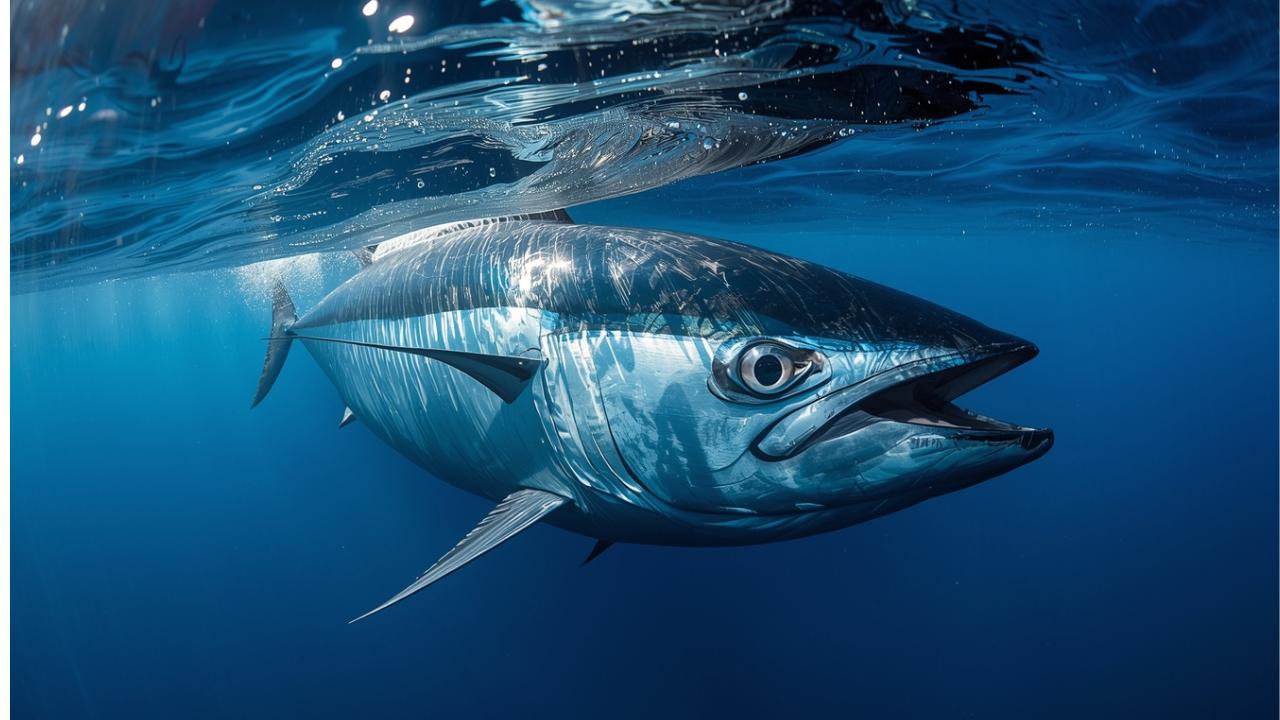
Just beneath the glassy Atlantic water, an Atlantic bluefin tuna moved in a wide, controlled circle. Massive. Calm. Unmistakably alive — and far larger than anything the team had encountered during weeks of tagging work.
Phones came out, but not for social media.
This time, the scientists were chasing something far more valuable: verifiable proof.
When a legend swims under your boat
The Canadian fisheries research team had been tagging bluefin tuna for weeks. They were exhausted, sunburned, and operating on cold coffee and routine — until the moment the giant appeared.
As the tuna rolled near the surface, its metallic blue back flashed in the sunlight. The mood on deck shifted instantly.
One scientist laughed, half in disbelief. Another swore under their breath.
For professionals who spend their lives studying large marine species, this fish crossed a mental boundary — from “exceptional specimen” to “this could rewrite assumptions.”
Measuring a giant — without exaggeration
Big fish stories are easy to tell.
Big fish data is harder.
This time, there would be no guesses, no arm-span estimates, no fisherman’s folklore. The team followed strict, peer-reviewed scientific protocols designed to withstand scrutiny in any international journal.
The tuna was carefully secured alongside the vessel using a sling system engineered to reduce stress and injury. Continuous water flow kept oxygen moving over its gills throughout the process.
Three researchers worked independently:
- Measuring fork length from the tip of the snout to the fork of the tail using a rigid metric tape
- Recording girth at the widest point
- Repeating each measurement three times, cross-checking every number aloud
Every detail was logged: GPS coordinates, water temperature, sea state, handling time, and high-resolution video.
No room for error. No room for myth.
The numbers that stopped the deck cold
When the data was finalized, even the most experienced hands paused.
The bluefin measured over three meters in length, with a girth that seemed almost unreal when viewed in profile.
Using the ICCAT-standard length–weight equation, scientists estimated the fish’s mass at well over 600 kilograms.
That isn’t just large for a bluefin tuna — it’s extraordinary.
Stories of “granders” (tuna exceeding 1,000 pounds) circulate widely in fishing communities, but rigorously documented individuals of this size are exceptionally rare.
This one won’t live on as a dockside rumor.
It now exists as a verified data point.
Why protocols matter more than photos
Behind every viral image of a massive animal lies something far less glamorous: procedure.
Marine biologists rely on standardized measurement systems so that a bluefin measured in Canada can be accurately compared to one measured in Spain or Japan.
A common mistake — even among experienced observers — is confusing total length with fork length. That small difference can distort weight estimates by dozens of kilograms, which then cascades into flawed population models and fishing quotas.
That’s why the team documented everything:
- Rigid fork-length measurements (not body curves)
- Triplicate readings averaged for accuracy
- Environmental conditions fully logged
- Photo and video records archived for verification
As lead researcher Dr. Léa Fontaine later wrote to the team:
“Everyone wants to talk about the size. But what makes this fish extraordinary is that we can trust every centimeter of it.”
One fish, bigger implications
This bluefin isn’t just a headline.
It feeds directly into the mathematical models that determine how many fish can be harvested without collapsing populations. Verified evidence of exceptionally large, old individuals suggests that some bluefin are surviving long enough to reach full biological maturity.
That matters.
Older fish often mean stronger genetics, healthier spawning grounds, and ecosystems that may be more resilient than previously assumed.
At the same time, scientists are careful not to over-romanticize a single encounter. One giant fish doesn’t erase decades of pressure from industrial fishing.
But it does recalibrate expectations.
Was this tuna a rare anomaly — or proof that protected areas and improved management are quietly working?
Where stories meet science
From Nova Scotia docks to the Basque coast, bluefin tuna are more than a species — they’re cultural icons.
Older fishers still trade stories of giants from decades past. Younger ones now follow scientific updates alongside weather reports, knowing that verified data can determine whether a season stays open or shuts down early.
In research labs and policy meetings, even one well-documented outlier can shift the conversation.
Not because it’s sensational — but because it’s provable.
A quiet reminder from the deep
Long after the boat returned to shore, the image of that massive bluefin lingered.
Not just because of its size — but because it challenged a quiet assumption many people carry: that the age of ocean giants is already over.
This fish suggests otherwise.
Somewhere beyond the shoreline and phone signals, life is still reaching its full potential — if we’re careful enough to notice, and disciplined enough to measure it honestly.
Key Takeaways
| Point | Detail | Why It Matters |
|---|---|---|
| Verified giant bluefin | Over 3 meters long, estimated 600+ kg | Separates science from exaggeration |
| Strict measurement methods | Standardized fork length, triplicate readings | Ensures global data reliability |
| Conservation insight | Confirms survival of very old individuals | Informs quotas and long-term policy |
FAQ
How big was the confirmed bluefin tuna?
It measured over three meters in fork length, with an estimated weight exceeding 600 kilograms based on internationally accepted equations.
Were proper scientific protocols followed?
Yes. Measurements were repeated, documented, filmed, and recorded with full environmental data to withstand peer review.
Was the fish harmed?
No. The tuna was measured alongside the vessel while oxygenated, tagged, and released as part of a catch-and-release program.
Why does one fish matter?
Exceptionally large individuals refine our understanding of maximum size, age, and population health.
Are such tuna common?
No. They are rare, which is why verified records draw significant scientific attention.