In a modest house on the edge of town, the lights don’t stay on because of a cutting-edge home battery sold in a glossy box. They stay on because hundreds of old laptop batteries—devices most of us discard without a second thought—have been carefully rescued, tested, and wired into a working energy system.
For nearly ten years, a technically minded homeowner has powered much of his daily life using second-hand lithium-ion cells salvaged from scrapped laptops. What began as a curiosity has grown into a robust, carefully managed battery bank that stores solar energy and dramatically reduces reliance on the grid.
It’s not a blueprint for everyone—but it’s a compelling case study in reuse, patience, and the hidden value inside e-waste.
From Scrap Pile to Power Source
The idea took shape in late 2016. At the time, the homeowner was already experimenting with energy independence, combining a small solar array with an aging forklift battery. Storage was the weak link. Commercial lithium batteries were effective—but far beyond his budget.
So he turned to something he understood well: laptops.
Most modern laptops rely on lithium-ion cells. When a laptop is scrapped, the battery pack is often labeled “dead” because one or two cells have failed. Inside, however, several cells frequently remain healthy. Multiply that by thousands of discarded machines, and the potential becomes obvious.
He began collecting used laptop batteries from recycling centres, repair shops, and online listings. Slowly at first, then steadily, the collection grew.
“I started collecting them and now I have more than 650,” he says. “At some point, I realised I’d basically built my own power bank for the house.”
Over time, more than a thousand battery packs passed through his hands. Many were dismantled, tested, and given a second life storing solar energy instead of heading to landfill.
A Battery Farm—Carefully Kept at a Distance
The system’s core doesn’t sit inside the home. Instead, it lives in a dedicated shed about 50 metres away. That separation is deliberate.
Lithium-ion batteries can fail violently if abused—overheated, short-circuited, or poorly wired. Keeping the installation well away from bedrooms and living areas adds an important safety buffer.
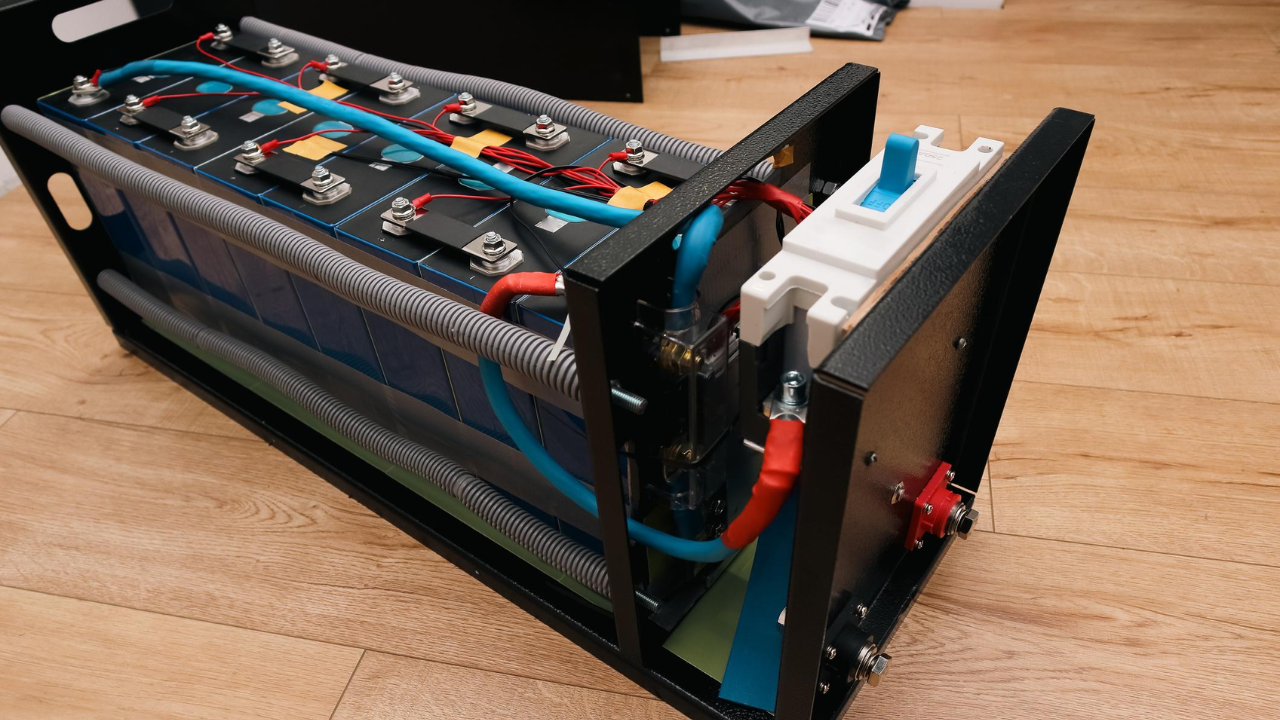
Inside the shed, shelves hold dozens of battery packs assembled from salvaged cells. Solar panels on the house and shed feed charge controllers, which direct energy into these packs. An inverter then converts stored direct current (DC) into alternating current (AC) suitable for everyday appliances.
Each pack is modest in size—around 100 ampere-hours (Ah)—but together they form a substantial energy reservoir. Heavy copper cables handle current flow. Fuses and disconnects allow individual packs to be isolated if something goes wrong.
The system has now run for almost a decade without fires or swollen batteries. The owner credits that record to conservative settings and relentless sorting.
How the System Is Put Together
At a high level, the setup works like this:
- Solar panels capture energy during the day
- Charge controllers regulate power flowing into the batteries
- Repurposed laptop cells, grouped into 100 Ah packs, store the energy
- Copper cabling links packs into a larger battery bank
- An inverter supplies standard household AC power
- Monitoring equipment tracks voltage, temperature, and charge levels
To an outsider, it might look improvised. In practice, every pack is labeled, fused, and documented. Failures do occur—cells age, capacities drift—but the modular design allows individual packs to be swapped without shutting everything down.
The Hidden Value Inside “Dead” Laptop Batteries
A laptop battery pack usually contains several cylindrical lithium-ion cells. When a pack fails, it’s often because one cell has degraded faster than the others. The entire pack is discarded—even though most cells still work.
Recovering them is slow, methodical work. Each cell must be removed, charged, discharged, and tested for stability.
Here’s how he sorts them:
| Cell condition | Outcome |
|---|---|
| Good capacity, stable voltage | Added to house battery packs |
| Reduced capacity, but safe | Used for low-demand projects or backup lighting |
| Unstable, swollen, or damaged | Sent to certified recycling |
The key is restraint. Cells are never pushed to their technical limits. Charging and discharging stays within a comfortable range, trading maximum capacity for longevity and safety.
Ten Years of Daily Life on Second-Hand Power
Today, much of the home’s electricity flows from that shed. Sunlight charges the batteries during the day. Evenings draw from stored energy. Lights, computers, and many household devices run normally.
The grid connection remains—partly as backup, partly for extended bad weather—but electricity bills have fallen sharply. Price spikes and energy market swings matter far less when most power is generated and stored on site.
For the system’s creator, the project is more than a technical exercise. It’s a quiet statement against waste—and a way to stretch the useful life of materials that still have plenty to give.
Each battery has already lived one life inside a laptop. Stacked in the shed, they begin a second life measured not in months, but in years.
Costs, Time, and Realistic Limits
The system isn’t free. Solar panels, inverters, charge controllers, fuses, monitoring gear, and thick copper cabling all cost money. Some batteries were free; others came from bulk “faulty” lots bought cheaply.
The biggest investment, though, is time.
Testing hundreds of cells, assembling packs, labeling wiring, and monitoring performance demands patience and basic electronics skills. This isn’t a plug-and-play weekend project.
The homeowner is clear about that. He doesn’t present his setup as a universal solution—only as proof that another path exists if you’re willing to learn, test, and proceed carefully.
Safety, Regulations, and the Real Risks
Lithium-ion cells deserve respect. Poor wiring, short circuits, or overheating can trigger fires. The system reduces risk through spacing, ventilation, conservative charging, and generous use of fuses.
The shed location limits consequences if something fails. Sensors watch temperatures and voltages. Packs showing unusual behaviour are removed early rather than “pushed through.”
There’s also a regulatory side. In some regions, home-built battery systems exist in a grey zone of electrical codes and insurance rules. If a fire occurred, investigators would likely examine whether the installation met recognised standards.
That uncertainty alone is reason enough for many people to choose certified commercial batteries instead.
Second-Life Batteries: A Growing Movement
This home project reflects a broader trend. Electric vehicle batteries, for example, often lose capacity before they’re truly unusable. While no longer ideal for cars, they’re well suited for stationary storage.
Energy companies and carmakers are already testing “second-life” battery systems that stabilise local grids or store solar power for buildings. The shed full of laptop cells sits at the same conceptual point—just scaled down and intensely personal.
What This Means for Ordinary Homes
Most households will never collect 650 batteries. But the story highlights changes that do affect everyday life:
- Energy storage is becoming central as rooftop solar spreads
- Reuse and circular economy thinking are gaining momentum
- Certified home batteries rely on the same chemistry as laptop cells—just packaged more safely
As prices fall, more people will pair solar panels with storage, even if they never dismantle a battery pack themselves.
The project also prompts useful questions:
- Where does old electronics waste really go?
- Could community repair spaces handle reuse more safely?
- How should rules balance innovation with safety?
Key Concepts Behind the System
A few technical ideas help explain why it works:
- Ampere-hour (Ah): Measures how much charge a battery can deliver over time
- Inverter: Converts battery DC power into household AC electricity
- Depth of discharge: Limiting how deeply batteries are drained extends lifespan
By cycling batteries gently—say between 20% and 80% charge—the system sacrifices peak capacity but gains years of reliability.
A Small Story in a Bigger Energy Shift
Between the shelves of repurposed cells, the hum of the inverter, and the solar panels outside, this home tells a quiet story about decentralised power and reuse.
It’s not a call for everyone to build a battery shed. It’s a reminder that innovation doesn’t always arrive shrink-wrapped. Sometimes it’s pieced together slowly, cell by cell, from what the rest of the world throws away—and it still keeps the lights on.