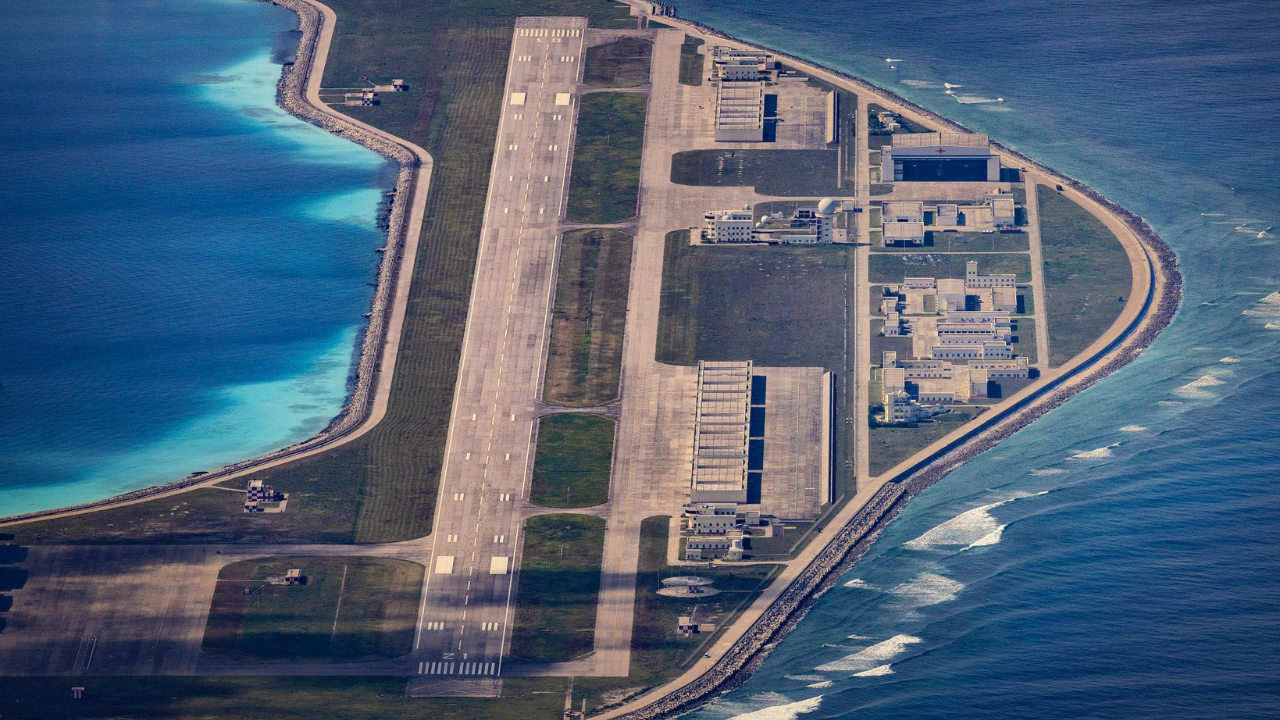
From Coral Reefs to Strategic Military Bases
In recent years, China has undertaken one of the most ambitious geopolitical engineering projects in modern history—transforming remote coral reefs into fortified military bases across the South China Sea. Through large-scale dredging, land reclamation, and massive concrete construction, previously submerged reefs have become operational outposts equipped with airstrips, radar installations, and missile systems.
These artificial islands are primarily located in the contested Spratly Islands and Paracel Islands, regions claimed by multiple Southeast Asian nations. While China describes these developments as defensive and humanitarian infrastructure, many global observers see them as a major strategic expansion.
How the Transformation Actually Happens
China’s island-building process involves advanced dredging and engineering techniques. Massive dredgers extract sand, coral, and sediment from the seabed and deposit them onto reefs, gradually building land above sea level. The newly formed land is then reinforced with concrete and stabilized for construction.
Key Construction Steps
- Seafloor dredging: Sand and coral are extracted and pumped onto reefs.
- Land stabilization: Concrete and structural materials reinforce the artificial terrain.
- Infrastructure development: Airstrips, naval docks, and military installations are built.
- Technology deployment: Radar systems, surveillance networks, and missile defense systems are installed.
One of the most significant examples is Fiery Cross Reef, which now hosts a 3,000-meter runway, surveillance systems, and advanced military infrastructure.
Why These Reefs Matter Strategically
The South China Sea is one of the most important maritime corridors in the world.
Strategic Importance
- Handles roughly 30% of global shipping trade
- Connects Asian markets with Europe, Africa, and the Middle East
- Contains significant oil and natural gas reserves
- Supports fisheries feeding millions of people
Control over reef territories can influence shipping routes, military logistics, and resource extraction. These outposts extend China’s naval reach far beyond its mainland coastline.
Legal Controversy and Maritime Law
Under the United Nations maritime framework known as United Nations Convention on the Law of the Sea (UNCLOS), natural land formations can generate Exclusive Economic Zones (EEZs), granting countries rights over resources and fishing.
However, international courts ruled in 2016 that artificial islands do not qualify for territorial or economic claims. Despite this ruling, China continues to assert historical rights using its controversial “Nine-Dash Line,” covering much of the South China Sea.
Environmental Damage: A Hidden Cost
Marine scientists warn that reef reclamation has caused extensive environmental destruction. Coral reefs take centuries to form and serve as biodiversity hotspots supporting marine ecosystems.
Environmental Consequences
- Destruction of coral habitats
- Loss of marine biodiversity
- Disruption of regional fishing economies
- Increased pollution from construction and military traffic
These ecosystems are essential for countries such as the Philippines, Vietnam, and Malaysia, whose coastal communities rely heavily on fishing and marine resources.
Military Expansion and Regional Security Tensions
The newly constructed islands provide China with advanced military capabilities, including:
- Long-range radar surveillance
- Air bases capable of hosting fighter jets
- Naval refueling and logistics hubs
- Missile defense systems
In response, the United States conducts freedom-of-navigation patrols near disputed waters. Countries such as Japan, Australia, and India are also increasing military cooperation with Southeast Asian nations to counterbalance China’s expansion.
Although direct military conflict has not occurred, naval standoffs and territorial disputes continue to intensify.
Technology Behind the Artificial Islands
China’s construction efforts rely heavily on cutting-edge engineering technology.
Key Technologies Used
- High-capacity dredgers capable of moving thousands of cubic meters daily
- Modular military construction systems
- Artificial intelligence monitoring maritime movement
- Satellite-based surveillance and communication networks
These technologies allow China to build and fortify islands at unprecedented speed, effectively creating strategic terrain where none existed before.
Winners and Losers in the Geopolitical Shift
Winners
- China’s military and strategic influence
- Chinese fishing and commercial expansion
- Domestic construction and dredging industries
Losers
- Marine ecosystems and biodiversity
- Southeast Asian nations with weaker naval capabilities
- Global maritime legal norms and UNCLOS authority
China’s Official Narrative vs Global Perception
China maintains that the islands serve peaceful purposes, including:
- Typhoon shelters
- Search-and-rescue centers
- Navigation support facilities
However, the presence of military aircraft, missile shelters, and enforcement zones suggests a strong strategic military objective. Critics argue these installations reshape power dynamics throughout the Indo-Pacific region.
Global Trade and Economic Implications
The militarization of the South China Sea has significant economic consequences:
- Increased shipping insurance costs
- Potential disruptions to global trade routes
- Rising geopolitical risk affecting international markets
- Growing regional military spending
Because the South China Sea connects major global supply chains, instability in this region affects economies worldwide.
Frequently Asked Questions
Why is China building artificial islands?
To strengthen military positioning, secure maritime routes, and expand strategic control over contested waters.
Are artificial islands recognized as sovereign territory?
No. International law does not grant territorial rights to man-made islands.
How serious is the environmental impact?
Extremely severe. Coral ecosystems and marine biodiversity have suffered long-term damage.
Can other countries stop the construction?
Diplomatic and legal efforts have largely failed to halt China’s activities so far.
Could this lead to military conflict?
While direct conflict remains unlikely, tensions and naval confrontations continue to rise.
Conclusion
China’s transformation of coral reefs into fortified military bases represents a new form of geopolitical strategy—one built not through treaties or negotiations, but through engineering and infrastructure. These artificial islands have reshaped territorial disputes, disrupted marine ecosystems, and altered global maritime power balances.
As the South China Sea remains one of the world’s most vital trade routes, the long-term consequences of these developments will likely influence international relations, environmental protection, and military strategy for decades to come.