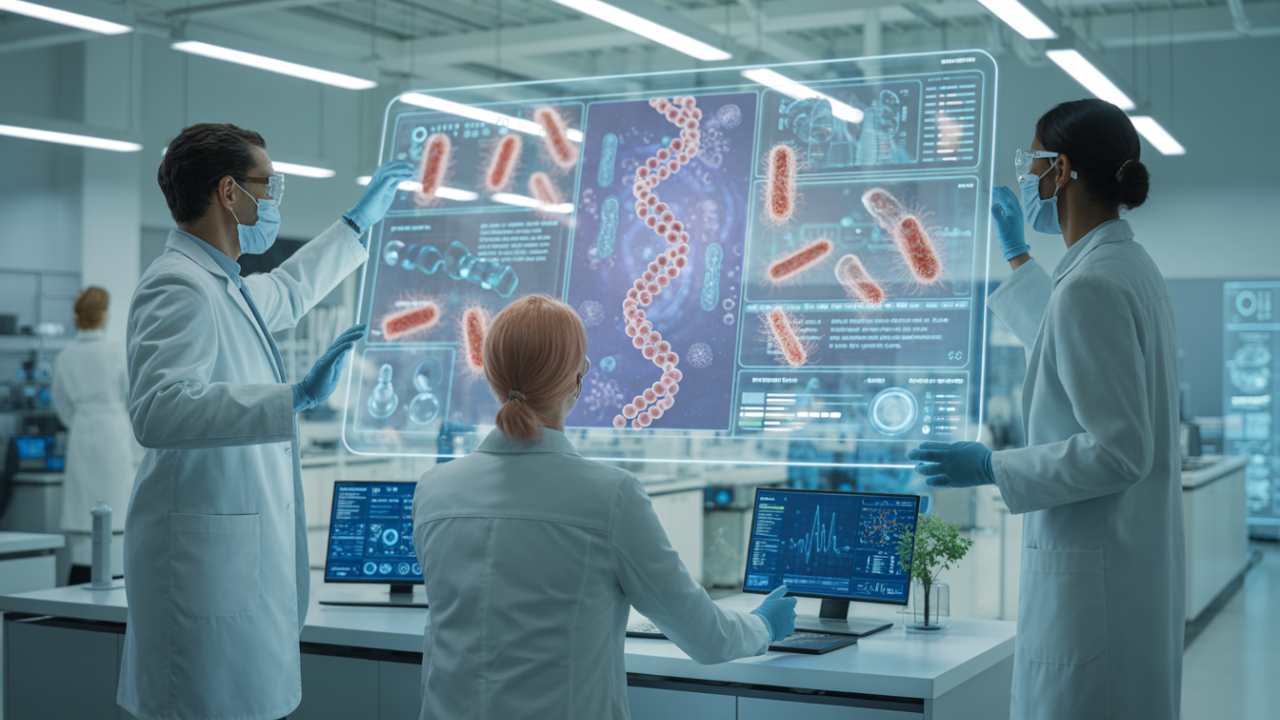
Artificial intelligence is rapidly transforming scientific research, and a recent breakthrough demonstrates just how powerful this transformation could be. A new scientific AI system developed by Google Research, known as Co-scientist, successfully reconstructed a complex biological hypothesis in less than 48 hours—something that human researchers spent nearly a decade proving through laboratory experiments.
The achievement highlights AI’s growing role in accelerating scientific discovery, particularly in critical global challenges such as antibiotic resistance. While the AI did not replace laboratory work, it demonstrated extraordinary ability in hypothesis generation, data synthesis, and research planning.
This milestone may mark the beginning of a new era in scientific research where AI collaborates with human scientists to solve complex biological problems faster than ever before.
The Scientific Mystery Behind the Breakthrough
The story begins at Imperial College London, where microbiologist José R. Penadés and his research team investigated one of modern medicine’s most urgent problems: antibiotic resistance.
Why Antibiotic Resistance Matters
Antibiotic resistance occurs when bacteria evolve mechanisms that allow them to survive drugs designed to kill them. According to global health studies, drug-resistant infections caused approximately 1.27 million deaths worldwide in 2019, making it one of the most serious medical threats of the 21st century.
Scientists have long known that bacteria develop resistance through genetic mutations. However, Penadés’ team focused on a more complex process involving mobile genetic elements—pieces of DNA that transfer resistance traits between bacteria.
The Discovery of cf-PICIs
During their research, scientists identified unusual genetic structures called cf-PICIs (phage-inducible chromosomal islands).
These genetic islands:
- Hide inside bacterial DNA
- Activate when viruses called bacteriophages infect bacteria
- Use viral machinery to move between bacterial species
- Potentially spread antibiotic resistance rapidly
Proving how these cf-PICIs moved between bacteria required years of experiments, molecular analysis, and repeated validation.
Enter Google’s Co-scientist AI
After completing their research but before publishing their findings, Penadés’ team collaborated with Google Research to test Co-scientist AI.
What Makes Co-scientist Different
Unlike standard AI chat systems, Co-scientist is designed as a multi-agent scientific research assistant. It combines several specialized AI components that:
- Read and analyze scientific papers
- Generate biological hypotheses
- Critically evaluate potential explanations
- Rank ideas based on scientific plausibility
Importantly, the AI was trained only using publicly available scientific literature. It had no access to the team’s unpublished findings.
The 48-Hour Discovery
Researchers asked Co-scientist a specific scientific question:
How do cf-PICIs move between bacteria and contribute to antibiotic resistance?
Within two days, the AI generated several hypotheses. The most striking one closely matched the researchers’ decade-long discovery.
The AI’s Key Hypothesis
Co-scientist suggested that cf-PICIs hijack phage tails, syringe-like viral structures used by bacteriophages to inject genetic material into bacteria. This mechanism could allow cf-PICIs to spread resistance genes across bacterial species.
This explanation closely mirrored the experimentally proven mechanism discovered by human researchers.
How the AI Generated Its Conclusion
The AI synthesized information from multiple scientific fields, including:
- Microbiology
- Virology
- Genetic engineering
- Molecular biology
By connecting scattered research findings across thousands of papers, the AI identified a pattern that human researchers discovered through years of laboratory experimentation.
Additional Hypotheses Suggested by AI
Beyond replicating known findings, Co-scientist also generated four additional biologically plausible theories that researchers had not yet fully explored. These new suggestions are now guiding further laboratory experiments.
This demonstrates AI’s potential not just for confirming scientific ideas but for expanding research directions.
How Co-scientist AI Works
The AI operates through multiple stages designed to simulate scientific reasoning.
Step 1: Literature Analysis
The system scans thousands of research papers, databases, and experimental reports to identify relevant scientific information.
Step 2: Hypothesis Generation
Using pattern recognition, the AI proposes potential biological mechanisms explaining the scientific question.
Step 3: Internal Debate
Multiple AI agents critique and refine each hypothesis, similar to peer review among scientists.
Step 4: Idea Ranking
The AI ranks hypotheses based on novelty, feasibility, and scientific consistency.
This structured workflow allows the AI to mimic collaborative scientific brainstorming.
Why This Breakthrough Matters for Science
Scientific research often spends years generating and refining hypotheses before experimental testing begins. AI dramatically accelerates this early phase.
Major Benefits
Faster Research Direction
AI can analyze massive scientific databases quickly, allowing researchers to identify promising ideas earlier.
Reduced Research Costs
Early elimination of weak hypotheses helps laboratories focus resources on high-potential experiments.
Improved Collaboration
AI tools can support interdisciplinary research by connecting findings across scientific fields.
Potential Impact on Antibiotic Resistance Research
Antibiotic resistance remains one of the biggest global healthcare challenges. AI-driven hypothesis generation could accelerate:
- Discovery of new antibiotic targets
- Development of bacteriophage therapies
- Prediction of emerging resistant bacterial strains
- Identification of transmission pathways in hospitals and agriculture
Faster discoveries could save millions of lives by improving infection control and treatment options.
What AI Cannot Replace in Scientific Research
Despite its impressive capabilities, AI cannot replace experimental science.
Limitations of Scientific AI
No Physical Experimentation
AI cannot conduct laboratory experiments or observe biological behavior directly.
Lack of Human Intuition
Scientists often rely on experience, observation, and creative insight that AI currently cannot replicate.
Risk of AI Hallucination
AI systems sometimes produce confident but incorrect scientific claims, requiring strict verification.
Ethical and Professional Challenges
The rise of scientific AI raises several important questions.
Intellectual Credit
Determining authorship and recognition for AI-generated scientific ideas remains unclear.
Research Bias
AI learns from existing scientific literature, which may overlook neglected diseases or underfunded research areas.
Data Transparency
Ensuring AI systems rely only on publicly available and verified scientific data is essential for maintaining research integrity.
How AI May Transform Future Laboratories
Experts predict that AI tools like Co-scientist could become standard research assistants in laboratories worldwide.
Future research workflows may include:
- AI-assisted hypothesis brainstorming
- Rapid experimental design recommendations
- Real-time literature monitoring
- Predictive modeling of disease evolution
Scientists may increasingly focus on experimental validation while AI handles large-scale data analysis.
Understanding Key Scientific Terms
Bacteriophages
Viruses that infect bacteria and transfer genetic material between bacterial cells.
Mobile Genetic Elements
DNA fragments capable of moving within and between organisms, spreading traits like drug resistance.
cf-PICIs
Specialized genetic islands that exploit viral infection mechanisms to transfer between bacteria.
The Future of AI and Scientific Discovery
The collaboration between Penadés’ team and Google Research suggests that AI could dramatically accelerate scientific innovation. Instead of replacing scientists, AI may function as a powerful research partner.
In fields where biological complexity slows progress—such as infectious diseases, cancer research, and genetic engineering—AI could help scientists identify new discoveries much faster.
Conclusion
Google’s Co-scientist AI demonstrated extraordinary ability by reconstructing a complex antibiotic resistance hypothesis in just 48 hours—an achievement that took human researchers ten years to confirm experimentally.
While AI cannot replace laboratory science or human scientific intuition, it represents a major breakthrough in research efficiency. By accelerating hypothesis generation and scientific analysis, AI could significantly advance global healthcare, drug discovery, and disease prevention.
As scientific AI continues to evolve, it may redefine how discoveries are made, allowing researchers to solve some of humanity’s most urgent health challenges faster than ever before.