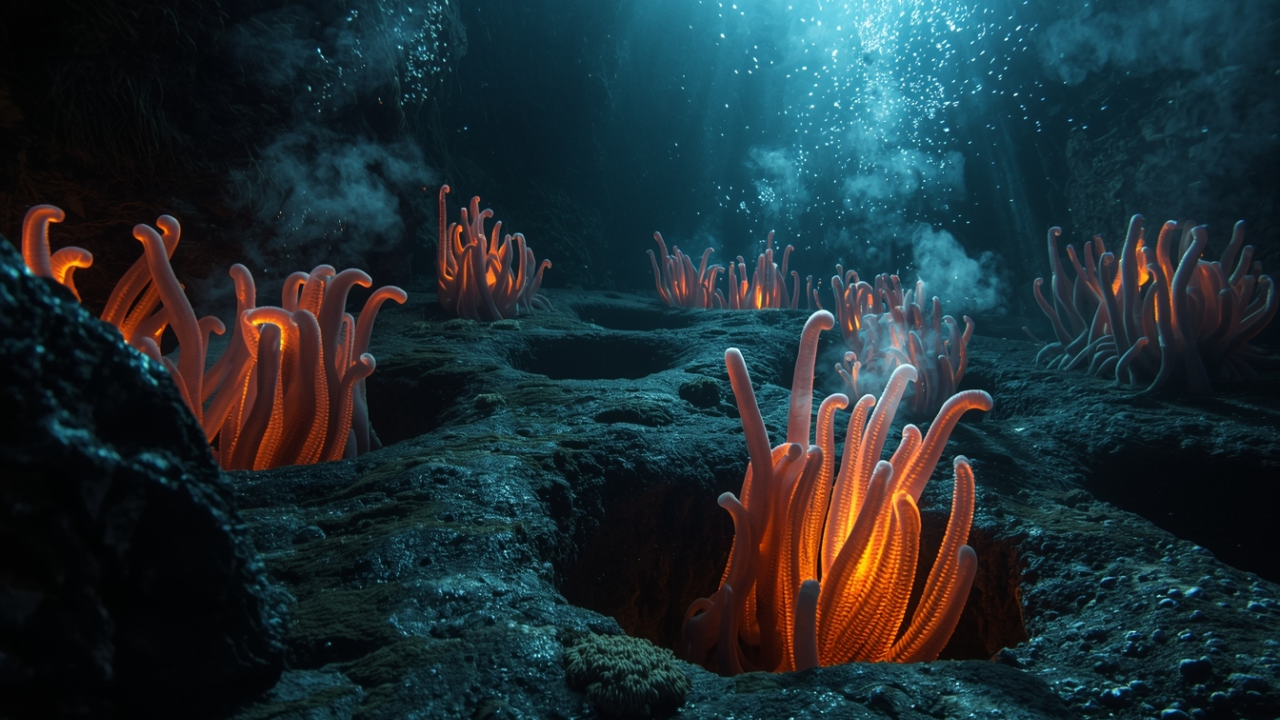
Far beneath the ocean’s surface, where sunlight has never reached and crushing pressure can bend metal, scientists have uncovered a discovery that is rewriting what we know about life on Earth. In a region once believed to contain little more than volcanic rock and superheated fluids, researchers have found giant worms living not only around hydrothermal vents but buried deep inside the oceanic crust itself.
The discovery reveals a hidden ecosystem thriving beneath the seabed — one that may reshape scientific understanding of marine biodiversity and even influence how scientists search for life beyond Earth.
A World of Life in the Deepest Darkness
Hydrothermal vents have fascinated scientists since their discovery in the late twentieth century. These underwater cracks in the seafloor release mineral-rich, superheated water, creating environments where life survives without sunlight. Strange communities of tubeworms, shrimp, and crabs cluster around these vents, feeding on chemical energy instead of solar energy.
Until recently, most research focused on the life forms living around these vents. The new findings reveal something far more surprising. Scientists now believe that entire communities of animals exist beneath the seabed, living inside cracks and cavities within the volcanic crust.
Instead of sterile rock, the subseafloor appears to contain a dense and complex living network. Scientists describe it as a hidden biomass zone — a three-dimensional habitat extending several meters below the ocean floor.
How Do Worms Survive Underground?
One of the biggest scientific mysteries surrounding this discovery is understanding how these worms reach such extreme underground environments.
Researchers believe the answer lies in the larval stage of marine animals. Many deep-sea organisms begin life as microscopic larvae that drift through ocean currents searching for suitable habitats.
Scientists suspect that some larvae are pulled into hydrothermal vent systems by fluid circulation. These fluids flow through cracks in the crust, carrying larvae into underground spaces where they settle and grow into adult worms.
This process creates a connection between three layers of the deep ocean environment: the open ocean where larvae drift, the seafloor where vents form, and the subseafloor crust where underground ecosystems develop.
The discovery suggests that these layers are not separate habitats but part of a single interconnected system shaped by fluid movement, chemical reactions, and biological activity.
The Hidden Biosphere Beneath the Seafloor
For years, scientists have known that microbes such as bacteria and archaea live inside rock pores beneath the ocean floor. These microorganisms survive by feeding on chemical reactions rather than sunlight.
The new discovery expands this understanding dramatically. Finding large animals like worms living within the crust suggests that subseafloor life is far more complex than previously believed.
Scientists are now referring to this underground habitat as the subseafloor biosphere. Early research suggests it may contain enormous amounts of living organisms, potentially rivaling or exceeding biomass levels found in some surface ecosystems.
Many species in this environment remain unidentified, and researchers still do not fully understand their role in global environmental processes such as nutrient cycling and carbon storage.
The Role of Symbiotic Microbes
The giant worms discovered beneath the seabed are believed to be related to well-known vent species such as Riftia tubeworms, which can grow over two meters long. These worms survive through partnerships with specialized bacteria living inside their bodies.
These bacteria use chemicals like hydrogen sulfide and methane found in vent fluids to produce energy through chemosynthesis. In return, the worms provide shelter and access to nutrients.
Scientists believe similar relationships exist within subseafloor environments. Worms and other animals likely live inside rock fractures where hot, mineral-rich fluids circulate. The microbes convert chemical energy into food, allowing the animals to survive in total darkness.
This type of ecosystem demonstrates that life does not always require sunlight. Instead, it can rely entirely on chemical reactions fueled by geological activity.
A Threat from Deep-Sea Mining
While scientists are only beginning to understand subseafloor ecosystems, industrial interest in deep-sea mining is growing rapidly. Hydrothermal vent regions contain valuable minerals such as copper, zinc, and rare metals used in electronics and renewable energy technologies.
Many mining proposals target areas close to hydrothermal systems. Extracting minerals from these regions could damage vent chimneys and the fracture networks beneath them.
Researchers warn that such activities could destroy fragile ecosystems before scientists fully understand them. Because subseafloor habitats are connected to the surrounding ocean environment, disturbances could affect both deep-sea species and microbial communities essential for maintaining ocean chemistry.
Recovery in deep-sea environments can take centuries, making any damage potentially irreversible within a human lifetime.
Implications for Life Beyond Earth
The discovery of complex life inside Earth’s oceanic crust has important implications for astrobiology. Several icy moons in our solar system, such as Europa, are believed to contain vast oceans beneath frozen surfaces. These oceans may also contain hydrothermal activity at their seafloors.
Conditions on these moons resemble Earth’s hydrothermal vent environments — a combination of water, rock, heat, and chemical energy. If complex organisms can survive beneath Earth’s ocean floor under extreme pressure and darkness, similar life forms might exist in extraterrestrial oceans.
Upcoming space missions, including NASA’s Europa Clipper, aim to study these environments. Scientists hope that understanding Earth’s subseafloor ecosystems will help identify potential habitats for alien life.
Rethinking Ocean Biodiversity
The discovery of giant worms beneath the ocean floor challenges long-standing assumptions about where life can exist. It suggests that large portions of Earth’s biodiversity may remain hidden underground or underwater in environments previously thought to be lifeless.
Future research will focus on mapping these ecosystems, identifying species, and understanding how they interact with global environmental systems. Scientists plan to use advanced drilling technologies, remotely operated underwater vehicles, and chemical monitoring sensors to explore deeper sections of the ocean crust.
A Reminder of Earth’s Hidden Mysteries
For the public, the idea of giant worms living beneath volcanic rock deep under the ocean floor may sound like science fiction. However, it highlights how little humanity still knows about its own planet.
The discovery reminds scientists and policymakers that Earth contains vast unexplored habitats at a time when human activity is expanding into deeper and more remote environments. Understanding these hidden ecosystems is essential for protecting them and preserving the delicate balance of life in our oceans.
As researchers continue exploring the deep sea, each discovery reveals new layers of biodiversity and challenges assumptions about life’s limits. The subseafloor biosphere stands as one of the planet’s final frontiers — a dark, pressurized world filled with organisms that survived undetected for millions of years.
Key Takeaways
Life Exists Beneath the Seafloor
Scientists discovered giant worms living inside cracks within the oceanic crust.
Subseafloor Ecosystems Are Complex
These habitats connect surface oceans, seafloor vents, and underground biological systems.
Deep-Sea Mining Could Threaten Unknown Species
Industrial exploration risks damaging fragile ecosystems before they are fully studied.
FAQ
Where were the giant worms discovered?
They were found inside fractured volcanic rock beneath hydrothermal vent systems on the ocean floor.
How do these worms survive without sunlight?
They rely on symbiotic bacteria that convert chemical energy from vent fluids into food.
Why is this discovery important?
It expands scientific understanding of biodiversity and reveals hidden ecosystems beneath the seabed.
Are these ecosystems endangered?
Yes, deep-sea mining and industrial exploration could disrupt these fragile habitats.
Could similar life exist on other planets?
Scientists believe similar ecosystems may exist on ocean-bearing moons such as Europa.