The first time the Sun disappears in the middle of the day, people don’t stay calm.
Dogs howl. Birds go quiet. Streetlights flicker on as if confused. Even technology seems to hesitate for a moment, unsure whether it’s day or night. That same ancient, disorienting feeling is about to return — but this time, astronomers know exactly when it will begin, when it will end, and how long the darkness will last.
In a rare and almost perfect cosmic alignment, day will briefly turn to night during what scientists have confirmed will be the longest solar eclipse of the 21st century.
For some, it will be a reason to cross oceans.
For others, it will interrupt an ordinary workday with something quietly unforgettable.
And whether people realise it or not, this moment has been decades in the making.
When the Sun steps off stage
The eclipse won’t arrive like a sudden blackout.
Instead, the light will drain slowly from the world, as if someone were turning down a dimmer switch on the sky. Colours flatten. Shadows sharpen. The air cools just enough for you to feel it on bare skin.
Birdsong fades into a confused silence. The horizon takes on the strange glow of late twilight — except it’s midday.
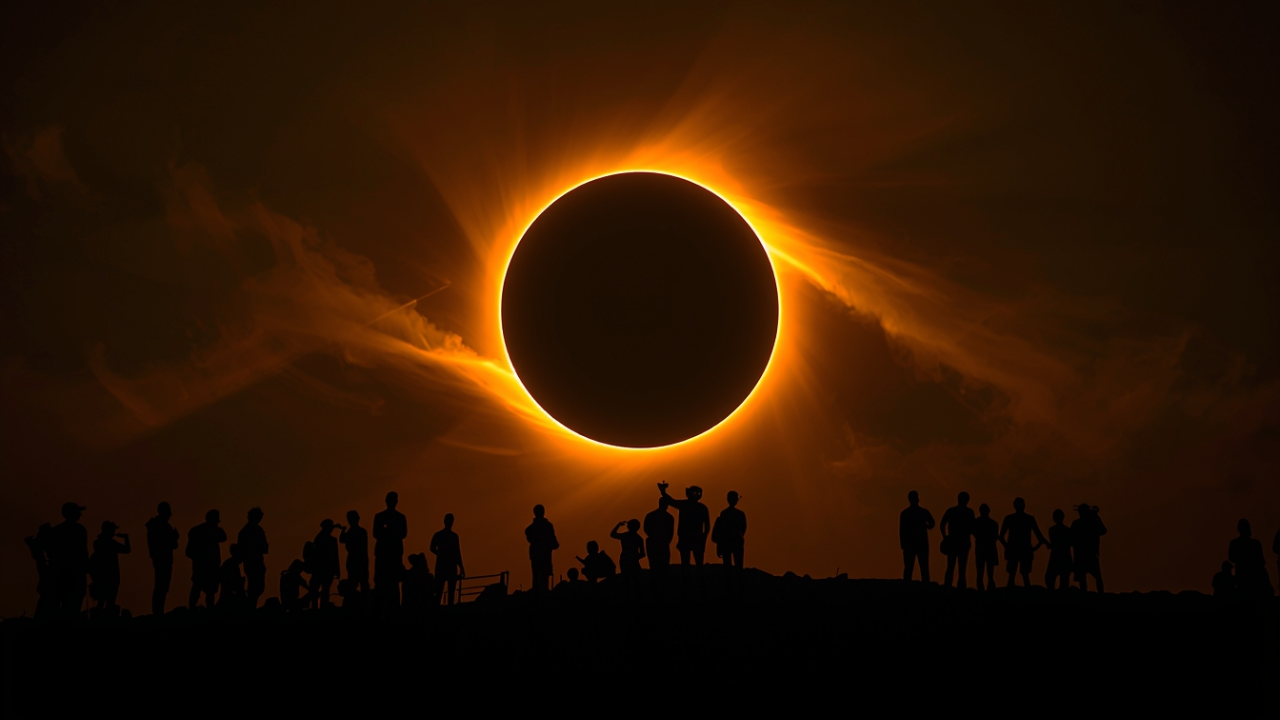
Then, for more than six full minutes, the Moon will cover the Sun almost entirely. In astronomical terms, that duration is extraordinary. In human terms, it’s long enough for awe to replace surprise.
Astronomers have marked the date carefully. Eclipse chasers are already planning routes. Because anyone who has stood inside the path of totality will tell you the same thing:
No video ever captures what it feels like.
Why this eclipse is different
Solar eclipses happen because the Moon passes directly between Earth and the Sun, casting a narrow shadow across the planet. Most eclipses are brief — totality often lasts just one to three minutes.
This one is different because of geometry so precise it feels designed.
The Moon will be unusually close to Earth, appearing larger in the sky. Earth itself will be positioned in its orbit so that the Moon’s shadow stretches longer and moves more slowly across the surface. The result is the longest total solar eclipse of the century, with maximum darkness lasting just over six minutes in some locations.
You couldn’t script it better if you tried.
What people experienced last time — and why this will feel bigger
During the 2017 total solar eclipse across the United States, traffic stopped on highways. People stepped out of offices and gas stations and simply stared upward, mouths open. Temperatures dropped noticeably. Some cried without quite knowing why.
This time, the darkness will linger longer.
Several regions — from dense cities to quiet rural areas — will sit beneath the Moon’s shadow for minutes that stretch and stretch, long enough for the brain to stop trying to explain what’s happening and simply accept it.
For a child seeing their first eclipse, six minutes is almost a lifetime.
Seeing it properly: the difference between “watching” and experiencing
There’s a crucial distinction most people don’t realise until it’s too late:
Seeing a partial eclipse is interesting.
Standing in totality is transformative.
Only inside the narrow path of totality does the sky truly darken and the Sun’s corona burst into view — a pale, ghostly halo stretching outward like something painted onto the void.
If you want that experience, a little planning matters:
- Check whether your location lies in the path of totality or only partial coverage
- Note the exact local time of maximum eclipse — down to the minute
- Have a backup viewing spot in case of clouds
- Decide whether you’re willing to travel a few hours if needed
Planning sounds boring. Missing it because you didn’t plan is worse.
Eye safety is not optional
There are two common reactions to eclipses: ignoring them entirely, or staring at the Sun without protection. Both are understandable. Neither is ideal.
You must use certified eclipse glasses (ISO 12312-2) whenever any part of the Sun is visible. Sunglasses are not enough. Phone screens are not filters. Homemade hacks are not worth the risk.
Only during the brief moment of full totality — when the Sun is completely covered — is it safe to look with the naked eye. The moment even a sliver of sunlight returns, protection goes back on.
Your eyes do not get a second chance.
A moment humanity tends to share, quietly
After the Sun reappears and daylight flows back into the sky, something subtle happens.
People look at one another — strangers in parking lots, on rooftops, in empty fields — with a shared, unspoken understanding. For a few minutes, millions of people stood under the same shadow.
That feeling doesn’t come from livestreams or notifications. It comes from knowing a cosmic event unfolded over you, on schedule, indifferent to your calendar.
During a past European eclipse, an astronomer once said,
“For a few minutes, an entire continent held its breath.”
That’s what lingers.
Why this eclipse matters beyond the spectacle
When the light returns, normal life resumes quickly. Emails pile up. Traffic restarts. Meetings continue.
But many people carry something small away with them: a reminder that our routines float on top of vast, precise movements we rarely notice. That the universe is not a background image, but an active stage we’re standing on.
This eclipse will end like all eclipses do — with ordinary daylight.
Yet for anyone who steps outside, looks up safely, and gives the sky their full attention, ordinary may feel just a little more fragile… and a little more precious afterward.
Key Takeaways
| Point | Detail | Why it matters |
|---|---|---|
| Longest eclipse of the century | Over six minutes of near-midday darkness in parts of the path | A genuinely rare event worth planning for |
| Path and timing are critical | Totality depends on location down to kilometres and minutes | Helps you decide whether to travel |
| Simple preparation changes everything | Glasses, timing, and a clear view | Turns curiosity into a lasting memory |
FAQ
Where will the longest totality be visible?
Only along a narrow central path. Areas outside it will see a deep partial eclipse but not full darkness.
Do I really need eclipse glasses?
Yes. Any direct view of the Sun outside totality can damage your eyes permanently.
Can I photograph it with my phone?
You can, but phones struggle with contrast. If aiming directly at the Sun, use a proper solar filter.
What if it’s cloudy where I live?
Clouds are the wildcard. Some people travel on the day using live weather maps to find clearer skies.
Is it worth traveling for just a few minutes?
For many who’ve done it, absolutely. Those minutes often feel like stepping outside normal time.