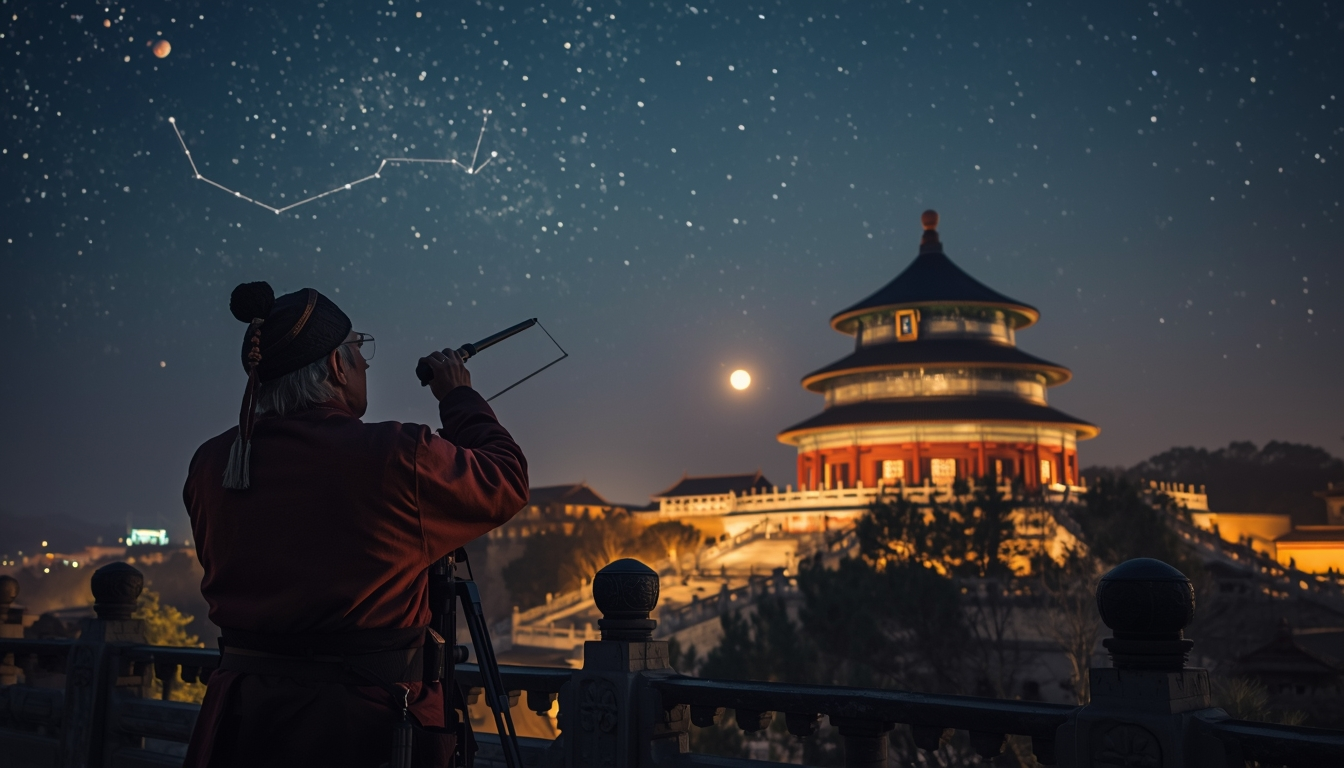
Chinese New Year is often seen today as a cultural and festive event. But for centuries, the Chinese calendar was far more than a way to mark time. It was a tool of governance, a scientific achievement, and a powerful symbol of cosmic legitimacy.
In imperial China, predicting eclipses and calculating planetary motions were not merely scholarly exercises — they were matters of state authority. Observing the sky meant maintaining political order. If celestial events failed to match official predictions, it was not just an astronomical error. It was a crisis of power.
Astronomy at the Heart of Imperial Authority
Chinese astronomical traditions date back more than 4,000 years, with early records from the first dynasties documenting eclipses and planetary movements.
Unlike many civilizations where astronomy primarily supported agriculture, in China it became a central instrument of political legitimacy. The emperor was seen as the intermediary between Heaven and Earth. Cosmic harmony reflected moral governance. Any celestial anomaly could be interpreted as a sign of divine displeasure.
Institutions dedicated to sky observation flourished under stable dynasties. Over centuries, China compiled one of the most extensive astronomical archives in the pre-modern world — detailed records of comets, eclipses, planetary positions, and even supernovae.
The Calendar: A Political Instrument
The Chinese year consisted of twelve lunar months of 29 or 30 days. To keep the calendar aligned with the seasons, intercalary months were regularly added — a system comparable to the Metonic cycle, first described in Greece in the 5th century BCE.
But the Chinese calendar went beyond date-keeping.
It included ephemerides — predictive tables of celestial events involving:
- The Moon
- The Sun
- The visible planets
These predictions determined the timing of:
- Religious ceremonies
- Agricultural activities
- Political decisions
- Imperial rituals
Time itself was governed by the sky.
Precision as a Sign of Power
In imperial ideology, the harmony between Heaven and Earth reflected the virtue of the emperor.
If an eclipse occurred unexpectedly, or planetary motion diverged from calculations, responsibility had to be assigned. Either:
- The emperor had lost moral authority, or
- The astronomers had failed in their duty
Both scenarios carried severe consequences. Accuracy was not optional — it was existential.
The prayer hall of the Temple of Heaven, built during the Ming dynasty, symbolized this union between celestial order and earthly governance.
Arithmetic Over Geometry: A Unique Scientific Approach
Unlike Greek astronomy, which relied heavily on geometric models, Chinese astronomy was fundamentally arithmetic.
Inspired in part by Mesopotamian traditions, Chinese astronomers assumed that certain celestial values were:
- Constant within defined intervals, or
- Varied linearly over time
For example, the length of the day was first calculated using linear interpolation between solstices. Initially divided into two segments, the model was later refined into 24 intervals for greater precision.
Planetary motion was handled similarly. The calendar of 7 BCE divided Mars’ motion into six zones (direct motion, stationary points, retrograde phases). By the 7th century, more advanced systems divided planetary paths into ten zones with linearly varying speeds.
This incremental refinement gradually increased predictive accuracy.
Major Astronomical Discoveries
Through systematic comparison of observation and prediction, Chinese astronomers identified several key celestial phenomena:
- Lunar irregularities (Han dynasty, 1st–2nd centuries)
- Axial precession (4th century)
- Solar and planetary inequalities (6th century, attributed to Zhang Zixin)
- The Saros cycle (11th century)
They also pioneered advanced interpolation techniques. Around 600 CE, Liu Zhuo introduced second-order interpolations, later refined by Yi Xing in 727. Similar mathematical ideas would not emerge in Europe until the work of Isaac Newton and James Gregory in the 17th century.
By the 11th century, Chinese calendars were as precise as European models of the 16th century.
Reforming the Calendar: A Political Risk
Improving astronomical models was not merely a scientific matter. The emperor himself was responsible for the official calendar. Changing it implied admitting that previous calculations — and therefore previous governance — had been flawed.
As a result, major calendar reforms often occurred:
- At the beginning of a new reign
- During a dynastic transition
Scientific progress had to align with political stability.
The Sky as Archive
China’s astronomical legacy includes some of the oldest surviving star maps, such as those discovered in Dunhuang. These detailed atlases charted constellations with remarkable precision.
Chinese observers also recorded what modern astronomers identify as the supernova of 1054 — the event that created the Crab Nebula. Their meticulous documentation remains invaluable to astrophysics today.
In this sense, ancient Chinese astronomy bridged past and future. What began as a political necessity evolved into a scientific treasure.
Chinese New Year: A Cosmic Renewal
Chinese New Year marks not just a seasonal change but a recalibration of cosmic time. It reflects an ancient worldview in which:
- Heaven structured society
- The calendar maintained harmony
- Astronomy validated authority
Today, the festival is cultural and symbolic. But its roots lie in millennia of precise celestial observation, mathematical innovation, and political strategy.
Predicting the stars was never only about science.
It was about ensuring that Heaven and Earth remained in balance — and that the emperor’s mandate endured.