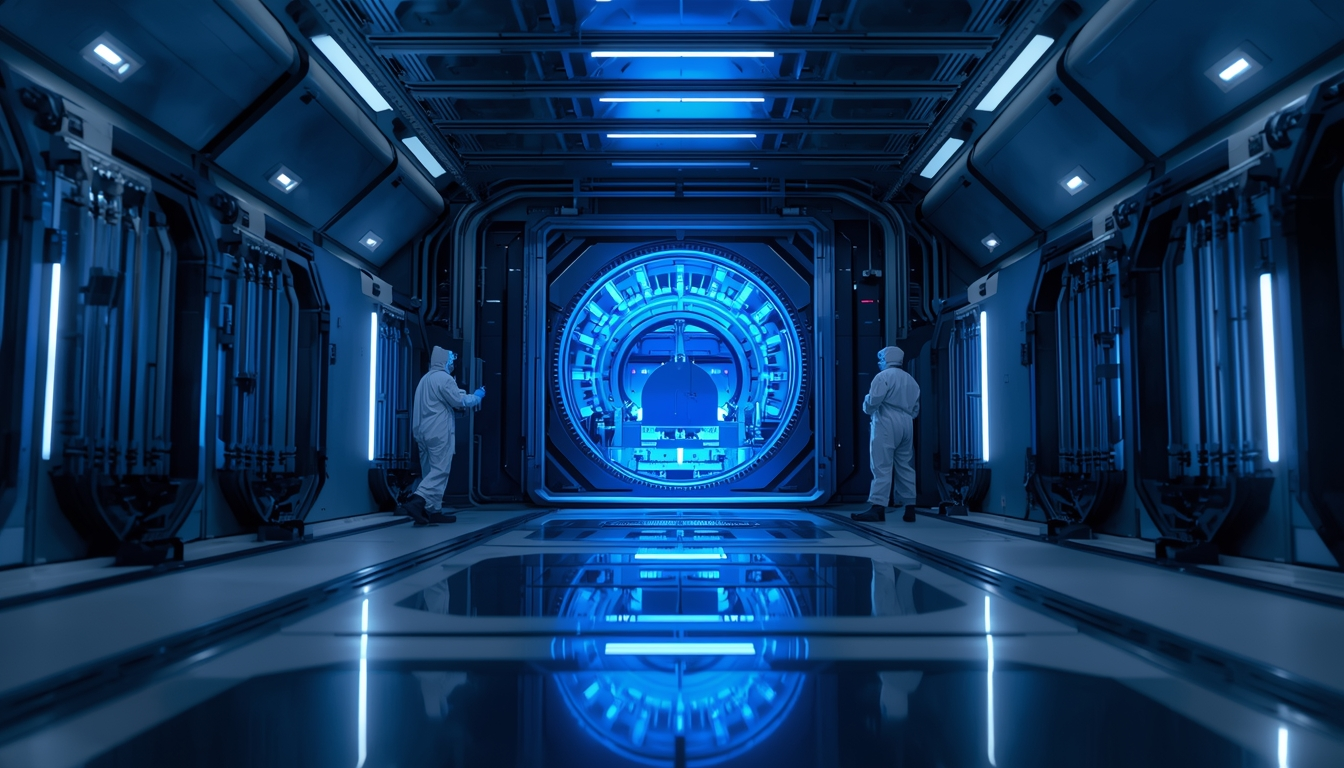
China has officially connected the world’s first industrial-scale supercritical CO₂ power generators to its electricity grid — a milestone led by the China National Nuclear Corporation (CNNC).
The innovation doesn’t remove carbon dioxide from the atmosphere, nor does it burn it for fuel. Instead, it uses supercritical CO₂ as a highly efficient heat-transfer fluid to convert industrial waste heat into electricity — without generating additional emissions.
This development could reshape how heavy industries recover energy and improve efficiency worldwide.
What Is Supercritical CO₂ — and Why Is It Important?
When carbon dioxide is subjected to extremely high pressure and temperature, it enters a supercritical state — meaning it behaves both like a liquid and a gas.
In this form, CO₂:
- Flows easily like a gas
- Transfers heat efficiently like a liquid
- Requires smaller, more compact turbines
- Achieves significantly higher energy conversion efficiency
Compared to traditional steam turbines, supercritical CO₂ systems can potentially deliver up to twice the efficiency, while reducing equipment size and mechanical complexity.
Where Is This Technology Operating?
The installation is located in Liupanshui, in China’s Guizhou province. Instead of generating new heat, the system captures waste thermal emissions from steel manufacturing and converts them into usable electricity.
Key Specifications:
- Two generating units
- 15 megawatts each (30 MW total capacity)
- Fully operational and grid-connected
- Closed-loop CO₂ circulation system
- No additional emissions during electricity production
Importantly, the CO₂ is not consumed. It circulates continuously in a sealed system and is not released into the atmosphere.
How the Supercritical CO₂ Generator Works
- Waste heat from steel production is captured.
- CO₂ is pressurized and heated into a supercritical state.
- The dense fluid spins a turbine.
- Electricity is generated.
- The CO₂ cools and recirculates in a closed loop.
Unlike fossil-fuel systems, the generator burns nothing. It improves industrial efficiency by turning wasted energy into power.
A Concept Born in the 1960s — Finally Realized
The idea of using supercritical CO₂ in power cycles dates back to the late 1960s, when engineers in Italy and the United States theorized about compact, high-efficiency thermodynamic systems.
However, earlier efforts faced major challenges:
- Materials could not withstand extreme pressures
- Turbine technology was insufficient
- Industrial scalability remained elusive
Advances in metallurgy, turbine design, and thermal engineering over the past two decades have finally made commercial deployment possible.
China’s successful implementation represents a turning point in bringing this decades-old concept into practical operation.
Why This Matters for Global Energy
This breakthrough could have wide-reaching implications:
1. Industrial Decarbonization
Steel plants, cement factories, and refineries generate enormous amounts of waste heat. Supercritical CO₂ systems allow that energy to be reused instead of lost.
2. Smaller, More Efficient Power Plants
Because the turbines are compact, facilities require less space and infrastructure.
3. Potential Nuclear Applications
Researchers are exploring integration into next-generation nuclear reactors for improved thermal efficiency.
4. Future Space and Mobile Energy Systems
Due to its compact design, the technology may eventually support mobile generators or even space-based energy platforms.
What This Innovation Does — and Does Not Do
It does:
- Increase energy efficiency
- Recover industrial waste heat
- Avoid additional carbon emissions
- Operate in a closed-loop system
It does not:
- Remove atmospheric CO₂
- Eliminate industrial carbon emissions
- Serve as a carbon capture system
It is a performance and efficiency breakthrough — not a carbon removal solution.
The Bigger Picture
As industries worldwide face pressure to cut emissions and improve efficiency, technologies like supercritical CO₂ generators offer a pragmatic solution: produce more electricity from energy that is already being wasted.
While large-scale global deployment remains a challenge, China’s operational units demonstrate that the technology has moved beyond theory.
In the right conditions, even carbon dioxide — long viewed as the villain of climate change — can become part of a cleaner energy equation.