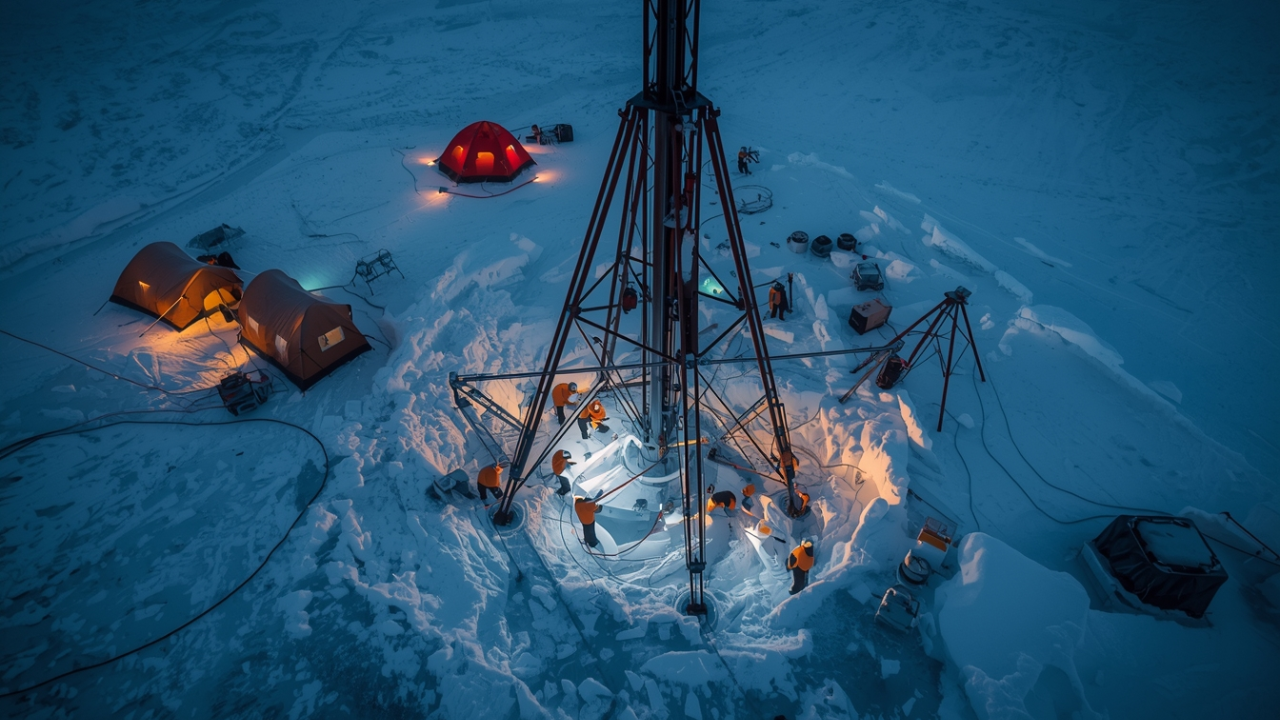
The drilling tent rattles violently in the Antarctic wind, a lone burst of orange in an endless ocean of white. Inside, scientists lean over glowing monitors, their breath turning into fog as they wait for a signal traveling upward from somewhere unimaginable — nearly two kilometers beneath their boots.
Then it happens.
The diamond-tipped drill breaks through into darkness — into a pressurized pocket that hasn’t touched air or sunlight for tens of millions of years.
When the first frost-covered sample tubes arrive, the room falls silent. The murky water and ancient sediment inside don’t just look old.
They look like history itself.
Scientists quickly realize they aren’t simply collecting ice. They’ve uncovered a lost prehistoric world sealed beneath Antarctica for 34 million years.
A Hidden World Beneath Antarctica’s Frozen Surface
Standing on Antarctica today feels like standing on a frozen desert. Snow stretches endlessly to the horizon. The air is so dry it stings the lungs. The continent appears lifeless.
But beneath the ice lies a layered archive of Earth’s climate history — snowfalls compressed into ice over millions of years.
When researchers drilled deep enough, they struck something extraordinary:
- Ancient sediment
- Trapped subglacial water
- Fossil traces of long-extinct ecosystems
- Microscopic pollen from prehistoric forests
These samples date back approximately 34 million years, when Antarctica looked nothing like it does today.
Instead of an icy wilderness, it was once a green continent filled with rivers, forests, and warm coastal waters. Scientists have even found pollen grains suggesting ancient beech forests once thrived where glaciers now dominate.
The Moment Earth Changed Forever
The discovery provides rare insight into one of the most important climate turning points in planetary history.
Around 34 million years ago, Earth transitioned from a warm “greenhouse climate” to a cooler “icehouse climate.”
This shift triggered massive environmental transformations:
- Carbon dioxide levels dropped
- Ocean currents reorganized
- Antarctica developed permanent ice sheets
- Global sea levels dramatically changed
Researchers are studying sediment layers to understand how quickly this transformation happened.
Was it gradual? Or sudden?
Evidence suggests that climate tipping points can occur faster than previously believed — a discovery with enormous relevance today.
How Scientists Drill Into a World That Predates Humans
Drilling into ancient Antarctic environments requires extraordinary precision.
The process involves:
1. Deep Ice Penetration
Engineers use mechanical drills or hot-water systems to melt shafts through thousands of meters of ice.
2. Contamination Prevention
As drilling nears subglacial lakes or sediment pockets, operations slow dramatically. Scientists must prevent modern microbes from entering untouched ecosystems.
3. Sample Retrieval and Analysis
Core samples are transported to sterile laboratories where researchers slice them into sections and examine:
- Fossilized microorganisms
- Mineral deposits
- Ancient atmospheric gases trapped in ice bubbles
- Organic material from prehistoric ecosystems
Under microscopes, scientists often find microscopic marine fossils called diatoms — proof that Antarctica once hosted warmer ocean environments.
Antarctica’s Lost World Could Help Predict Earth’s Future
This discovery isn’t simply about understanding the distant past. It may help scientists forecast climate change in the coming centuries.
Ancient sediment layers reveal how sensitive ice sheets are to environmental changes.
Key insights include:
Ice Sheet Stability
Historical records show that once climate crosses certain thresholds, ice sheets can grow or collapse rapidly.
Sea Level Predictions
Past Antarctic transformations caused sea levels to rise or fall by tens of meters — changes that would dramatically reshape modern coastlines.
Carbon Dioxide Impact
Ancient climate shifts closely correlate with atmospheric CO₂ changes, offering valuable comparisons to today’s rising emissions.
Scientists describe these findings as a planetary warning system.
Why This Discovery Matters for Humanity Today
It’s easy to view Antarctica as remote and disconnected from everyday life. But its frozen archives directly influence the future of global cities and ecosystems.
If Antarctic ice melts significantly, consequences could include:
- Rising sea levels threatening coastal cities
- Disruption of ocean circulation systems
- Major biodiversity changes worldwide
- Increased extreme weather patterns
Researchers repeatedly emphasize that the past doesn’t predict the future perfectly — but it provides the clearest evidence of how Earth responds to climate tipping points.
Antarctica: A Natural Time Machine
Deep ice drilling represents one of science’s closest versions of time travel. Each sediment layer records environmental conditions from specific periods in Earth’s history.
These techniques also serve as preparation for future exploration beyond Earth.
The drilling and contamination-control methods used in Antarctica may eventually help scientists explore:
- Ice on Mars
- Europa, Jupiter’s icy moon
- Enceladus, Saturn’s ocean-covered moon
Studying ancient Antarctic ecosystems helps researchers understand how life could survive in extreme extraterrestrial environments.
The Unsettling Truth Hidden Beneath the Ice
The most surprising part of the discovery isn’t simply that Antarctica once supported forests and warm oceans.
It’s that such drastic planetary changes happened before — and could happen again.
The frozen continent serves as Earth’s memory archive, preserving evidence that climate systems can shift dramatically when certain environmental thresholds are crossed.
Scientists often summarize the lesson simply:
“The past is not a prediction — but it is our most reliable warning.”
Key Takeaways
- Scientists drilled nearly 2 kilometers beneath Antarctic ice to uncover ancient ecosystems
- The samples date back 34 million years, when Antarctica supported forests and warm seas
- The discovery helps explain how global climate systems dramatically shifted in the past
- Ancient sediment layers provide clues about modern climate change risks
- Antarctic drilling techniques may assist future space exploration research
Frequently Asked Questions
What exactly did scientists discover under Antarctic ice?
They uncovered ancient sediment, fossil traces, and trapped water revealing ecosystems that existed before Antarctica froze.
Why is 34 million years significant?
It marks the transition when Earth shifted from a warm climate to a permanent ice-dominated polar system.
Could Antarctica become ice-free again?
Complete melting would take thousands of years, but warming trends could cause significant ice loss and sea level rise.
How deep did researchers drill?
Scientists drilled approximately 2 kilometers through ice to reach prehistoric sediment layers.
Can similar research be done on other planets?
Yes. Antarctic drilling techniques are considered prototypes for studying ice environments on Mars and icy moons.