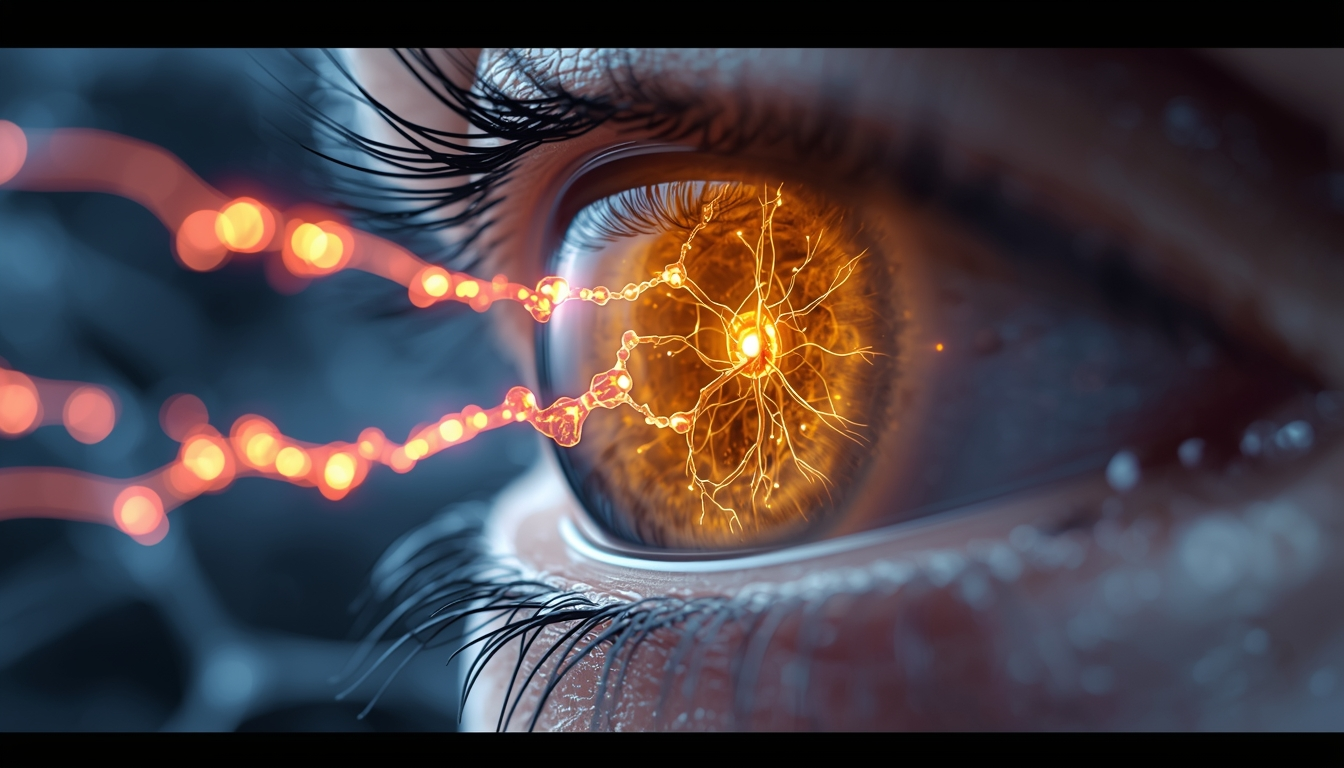
For decades, scientists believed that blindness caused by retinal degeneration was permanent in mammals. Unlike zebrafish — which can naturally regenerate damaged retinal tissue — humans and other mammals lose photoreceptor cells permanently once they die.
Now, researchers at the Korea Advanced Institute of Science and Technology (KAIST) may have uncovered why.
A study published in Nature Communications reveals that a protein known as PROX1 actively suppresses retinal regeneration in mammals. By blocking this protein, scientists were able to trigger significant retinal repair in mice — a discovery that could reshape the future of vision restoration therapies.
Why Humans Can’t Regrow Retinas — But Zebrafish Can
More than 300 million people worldwide live with retinal diseases such as:
- Retinitis pigmentosa
- Age-related macular degeneration
These conditions destroy photoreceptors — the light-sensitive cells essential for vision. Once lost, they do not naturally regenerate in humans.
In contrast, zebrafish can restore damaged retinal tissue thanks to specialized support cells called Müller glia. After injury, these cells reprogram themselves into neurons and replace lost photoreceptors.
In mammals, Müller glia exist but remain inactive following damage. Until now, researchers did not fully understand why.
The Role of PROX1 in Blocking Regeneration
The KAIST team, led by Professor Jin Woo Kim, discovered that the regenerative potential of mammalian Müller glia is not absent — it is suppressed.
The key suppressor is the PROX1 protein.
Here’s how it works:
- In a healthy retina, PROX1 regulates neuron development.
- After injury, neighboring neurons release PROX1 into surrounding tissue.
- Müller glia absorb the excess protein.
- Once inside the glial cells, PROX1 prevents them from reprogramming into regenerative cells.
Crucially, Müller glia do not produce PROX1 themselves. The protein originates externally, meaning it can potentially be intercepted before blocking regeneration.
A Gene Therapy Approach to Neutralize PROX1
To test this theory, researchers partnered with Celliaz Inc., a biotech startup emerging from the KAIST laboratory. They developed an antibody therapy delivered via adeno-associated virus (AAV) to capture extracellular PROX1 before it enters Müller glia.
In mouse models of retinitis pigmentosa, the treatment achieved:
- Sustained retinal regeneration
- Measurable vision recovery
- Effects lasting over six months
According to the authors, this represents the first successful induction of long-term neural regeneration in the mammalian retina.
What Still Needs to Happen
While the results are promising, several steps remain before human treatment becomes viable:
- Mouse models do not fully replicate human retinal disease
- Blocking PROX1 alone may not match the regenerative capacity seen in zebrafish
- Additional molecular pathways likely require activation
- Clinical trials are projected to begin around 2028
Conflicts of interest are also noted, as several researchers are affiliated with Celliaz Inc., which aims to commercialize anti-PROX1 therapies.
Other Experimental Vision Restoration Approaches
The KAIST discovery joins a growing field of innovative treatments targeting blindness. Other strategies include:
- Gold nanoparticle injections activated by laser stimulation
- Retinal implants and bioelectronic devices
- Gene editing techniques
- Stem cell therapies
While some approaches bypass damaged photoreceptors, the PROX1 strategy attempts something more fundamental: restoring the retina’s natural regenerative capacity.
A Shift in Scientific Perspective
Perhaps the most significant implication of this research is conceptual. For years, the mammalian retina was believed incapable of regeneration. The KAIST findings suggest otherwise.
The ability was there all along — it was simply being suppressed.
Identifying and neutralizing PROX1 reframes the biology of retinal disease. If confirmed in humans, this discovery could mark a turning point in regenerative medicine and ophthalmology.
Blindness may not be irreversible forever.