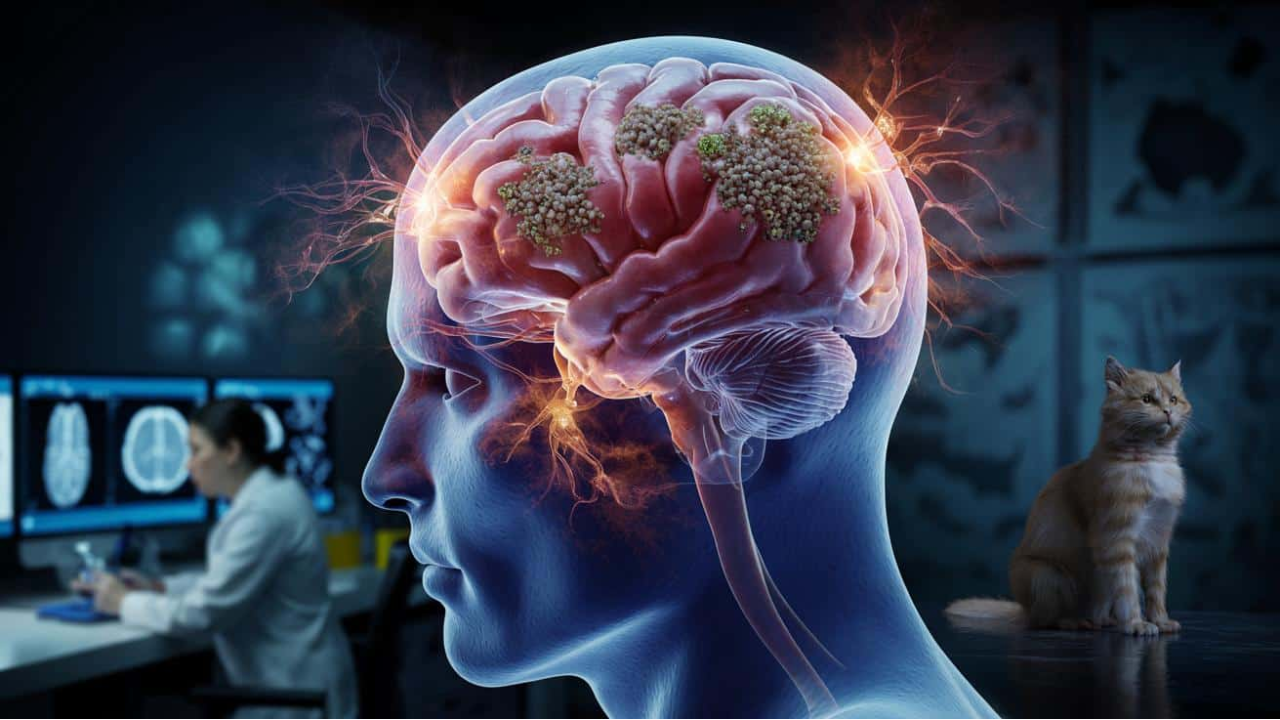
For decades, a tiny brain parasite carried by nearly one-third of the world’s population was largely dismissed as harmless once the initial infection passed. Doctors, scientists, and health agencies treated it as biological background noise—present, but inactive.
Now, a growing body of research suggests that assumption may be dangerously incomplete.
New findings indicate that this common parasite, Toxoplasma gondii, may remain subtly active in the brain long after infection, quietly influencing brain cells, immune responses, and possibly even behaviour. While it does not cause dramatic illness in most healthy people, its low-level activity could have far-reaching implications when multiplied across billions of hosts.
A Parasite Hiding in Plain Sight
Toxoplasma gondii is one of the most successful parasites on Earth. It infects humans through several everyday routes: eating undercooked meat, handling contaminated soil, or coming into contact with cat faeces. Cats play a crucial role in its life cycle, acting as the parasite’s definitive host where it reproduces.
Most people who become infected never realise it. After a short acute phase—often so mild it goes unnoticed—the parasite forms microscopic cysts in tissues such as muscles, eyes, and most notably, the brain.
For years, medical consensus held that once these cysts formed, the parasite entered a dormant, lifelong state. Chronic infection was considered biologically silent, requiring no treatment or follow-up in healthy individuals.
That tidy picture is now being challenged.
From Dormant Passenger to Subtle Influencer
Recent studies using advanced imaging, molecular tracking, and animal models paint a more complicated story. Instead of inert cysts quietly sitting in brain tissue, researchers are observing signs of ongoing biological activity.
Long after the initial infection resolves, scientists have detected:
- Persistent low-level inflammation in brain tissue
- Altered communication between neurons
- Continued immune system engagement
- Occasional reactivation of parasite cysts
The parasite appears to keep interacting with its host—sending molecular signals, influencing immune responses, and subtly shaping neural environments.
This activity is not intense enough to cause obvious disease in most people. But it is also not nothing.
What Is the Parasite Actually Doing in the Brain?
The biggest concern is not acute illness, but cumulative influence over time.
Laboratory experiments show that dormant cysts can occasionally release parasite proteins, triggering immune responses and interfering with how brain cells communicate. These interactions may slightly alter neurotransmitter pathways, inflammation levels, and stress responses.
In animals, the effects are dramatic and well-documented. Infected rodents famously lose their instinctive fear of cat odour, making them easier prey and helping the parasite complete its life cycle. This behavioural manipulation is one of the clearest examples of a parasite altering host behaviour.
In humans, any effects appear far more subtle and variable—but potentially meaningful at scale.
Emerging Links to Mental and Physical Health
While no single study proves cause and effect, multiple lines of evidence point in the same direction. Chronic toxoplasma infection has been associated with:
- Higher rates of schizophrenia and bipolar disorder
- Subtle changes in reaction time and risk-taking behaviour
- Increased likelihood of traffic accidents in some populations
- Possible contribution to long-term inflammation linked to heart disease
Large population studies comparing blood samples have found that people carrying antibodies to toxoplasma tend, on average, to show slightly higher rates of certain psychiatric conditions and self-harm—even after adjusting for social and economic factors.
Scientists stress caution. Correlation does not equal causation. But repeated associations across countries and datasets are making it harder to dismiss the parasite as completely harmless.
Why Scientists Once Thought It Was Benign
The earlier assumption of harmlessness was not unreasonable. Most infected people live normal lives. The immune system suppresses the parasite effectively, and severe disease is rare outside high-risk groups.
Diagnostic limitations also played a role. Standard blood tests detect antibodies indicating past exposure, not ongoing brain activity. Brain scans capable of visualising cysts are rarely performed outside severe cases. With no obvious damage and no symptoms, chronic infection was labeled “latent” and ignored.
Modern tools are changing that view. Instead of a clean divide between acute and chronic phases, researchers now describe a simmering state—quiet, but biologically engaged.
Who Faces the Greatest Risk?
For most healthy adults, toxoplasma is unlikely to cause noticeable harm. Even if it nudges brain function, the effect appears modest at an individual level.
Risk rises sharply in certain groups:
| Group | Main Concern |
|---|---|
| Pregnant women (new infection) | Transmission to the fetus, leading to miscarriage, eye damage, or developmental delays |
| People with weakened immunity | Reactivation of brain cysts, causing seizures, confusion, and encephalitis |
| Organ transplant recipients | Parasite activation when immune suppression begins |
For these groups, toxoplasma has never been considered harmless, which is why screening and preventive measures already exist in many healthcare systems.
The new debate centres on everyone else.
Public Health Questions Now Emerging
If up to one-third of humanity carries a brain parasite that remains biologically active, even subtly, public health assumptions may need revisiting.
Experts highlight several priorities:
- Stronger food safety standards, especially thorough cooking of meat
- Clearer guidance for cat owners, particularly during pregnancy
- Long-term studies tracking mental health and neurological outcomes
- Development of drugs that can target cyst stages safely
Even small effects, when spread across hundreds of millions of people, could influence population-level outcomes such as accident rates, mental health burdens, or healthcare costs.
There is also an equity issue. Toxoplasma infection is more common in regions with weaker food hygiene and veterinary control, meaning any risk is unevenly distributed.
Practical Advice for Cat Owners and Families
News about a brain parasite often triggers fear, especially among cat owners. Health authorities emphasise that cats and humans can coexist safely with sensible precautions.
Recommended steps include:
- Washing hands after cleaning litter trays or gardening
- Changing cat litter daily before parasite eggs become infectious
- Avoiding raw or undercooked meat for both humans and cats
- Keeping cats indoors to reduce hunting and exposure
- Pregnant individuals avoiding litter cleaning or using gloves and masks
It is also worth remembering that many infections come from food, not cats. Proper kitchen hygiene remains one of the most effective protections.
Key Concepts Behind the Research
Three ideas help frame the current debate:
Latency – A state where a pathogen remains in the body without obvious symptoms. Toxoplasma was long assumed to fit neatly here.
Low-grade inflammation – A persistent, mild immune response linked to depression, cognitive decline, and cardiovascular disease.
Correlation vs causation – While toxoplasma is associated with certain conditions, proving it directly causes them is far more difficult.
Researchers increasingly suspect the parasite may amplify existing vulnerabilities rather than create disease from scratch.
What This Could Mean in Real Life
Imagine two people with similar genetic risk for depression. One carries toxoplasma cysts; the other does not. If the parasite slightly heightens stress responses or inflammation, the infected person may be more likely to develop symptoms under pressure.
No single case would point clearly to a parasite. But across populations, those small nudges could shape broader trends.
A Shift, Not a Panic
Scientists are careful to strike a balanced tone. The new evidence does not suggest a hidden catastrophe, nor does it justify panic or drastic public health interventions. But it does challenge the long-held idea that chronic toxoplasma infection is biologically irrelevant.
Rather than a silent passenger, the parasite appears more like a long-term negotiator—constantly interacting with the immune system and brain cells in subtle ways.
Understanding that relationship more clearly may reshape how we think about infection, mental health, and the invisible forces quietly shaping human biology.