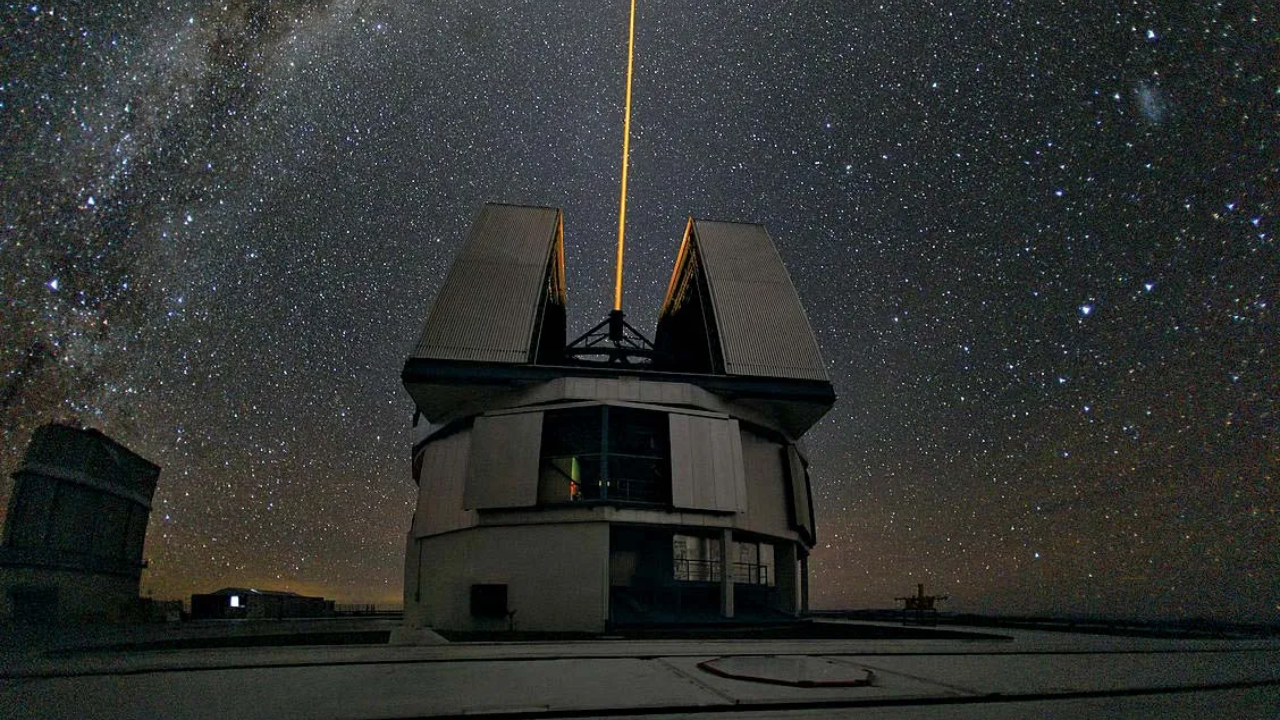
The image loads slowly on the screen, line by line, as if the universe itself is hesitating before revealing its secret. At first, it’s nothing special — a faint blur floating in a sea of black. Then the details sharpen. A thin, ghostly tail stretches outward, twisted and uneven, glowing softly against the stars.
This is no ordinary comet.
This is 3I ATLAS, an icy traveler from another star system — and it was never meant to stay.
Somewhere high on a mountain, long before sunrise, an astronomer watches the same object drift across a monitor, coffee cooling beside the keyboard. Around the world, dozens of others are doing the same thing. Different skies. Different telescopes. One shared moment of discovery.
A visitor that doesn’t belong here
Unlike typical comets born in our Solar System, 3I ATLAS is moving far too fast. Its path is wide, open, and unmistakably hyperbolic — the cosmic equivalent of a one-way street. It entered our neighborhood, briefly lit up our instruments, and will soon vanish back into interstellar darkness.
Only two such visitors have ever been confirmed before. That rarity is written into every image astronomers have captured.
From Hawaii’s Mauna Kea to Chile’s Atacama Desert and the Canary Islands, major observatories rushed to track the faint intruder. Each telescope added its own layer: sharp detail, subtle color, motion over time. Together, they created a portrait no single observatory could have produced alone.
A quiet moment at the telescope
At the Very Large Telescope in Chile, the control room reportedly fell silent as a new exposure appeared. Instead of a smooth, textbook comet, 3I ATLAS looked chaotic — jets of material fanning out unevenly, like wisps of smoke torn apart by wind.
One astronomer leaned closer and murmured that it looked more like a storm cloud than a comet.
For a few seconds, no one spoke.
These images are more than beautiful
What looks like cosmic art is, in fact, dense scientific data.
Every pixel records brightness, color, and motion. By comparing images taken hours and days apart, astronomers can watch how the comet changes as it races past the Sun.
- Brightness reveals how rapidly ice is vaporizing
- Color hints at the mix of gases and dust
- Tail shape maps invisible solar winds
- Jets suggest rotation and surface activity
Piece by piece, researchers are decoding the chemistry of an object formed around a completely different star.
It’s the closest thing we’ve ever had to a physical sample of another planetary system — delivered for free.
Learning from past interstellar visitors
When the first interstellar object, 1I/‘Oumuamua, streaked through the Solar System in 2017, astronomers barely had time to react. Debates raged about its shape and nature long after it disappeared.
Then came 2I/Borisov, a more familiar-looking comet, but still fleeting.
This time, scientists were ready.
Automated survey telescopes flagged 3I ATLAS early. Larger observatories rearranged schedules. Amateur astronomers contributed brightness measurements from backyard setups. The response was global, coordinated, and fast — and it shows in the quality of the new images now circulating online.
Why photographing it is so hard
Capturing a comet like 3I ATLAS sounds simple. It isn’t.
Long exposures reveal faint structures but blur motion. Short exposures freeze movement but miss detail. Each observatory solves this puzzle differently — adjusting tracking speeds, filters, and timing.
When all those approaches are combined, hidden features emerge:
faint streamers peeling from the main tail, color gradients from gas to dust, even hints of rotating jets.
The final images look effortless. They are anything but.
How to “read” a comet image like an astronomer
Next time a photo of 3I ATLAS scrolls past your feed, slow down and look closer.
- The bright center is the coma — a cloud of gas and dust around the hidden nucleus
- An off-center glow suggests uneven activity or chaotic rotation
- Straight tails usually mean gas pushed by solar wind
- Curved, wider tails trace heavier dust lagging behind
- Streaked stars mean the telescope tracked the comet’s motion
Even processing choices matter. A slight tweak can hide or exaggerate a jet. That’s why multiple teams observing the same object are essential — their biases cancel out.
A shared moment under one sky
There’s something quietly powerful about this event.
Graduate students losing sleep over tracking errors. Engineers adjusting mirrors in freezing air. Amateur astronomers celebrating when their fuzzy frames match professional data. Millions of strangers staring at the same speck from different corners of Earth.
An interstellar comet has a way of making us feel small — and strangely connected.
3I ATLAS will fade soon, slipping back into the deep space between stars, never to return. But its images will linger, reshaping how we imagine the vastness between stellar systems.
The void isn’t empty. It’s full of wanderers.
And for a brief moment, one of them let us look.
Key Takeaways
| Key Point | What It Means | Why It Matters |
|---|---|---|
| Interstellar origin | Hyperbolic orbit proves it came from beyond our Solar System | Rare glimpse into alien planetary systems |
| Global observations | Multiple observatories worked together | More accurate, detailed images |
| Scientific value | Dust, gas, and jets reveal composition | Helps compare other star systems to our own |
| Public impact | Images shared worldwide | Turns complex science into shared wonder |
FAQ
Is 3I ATLAS dangerous to Earth?
No. Its trajectory keeps it far from our planet and poses no impact risk.
Why is it called “3I ATLAS”?
“3I” means the third confirmed interstellar object. “ATLAS” refers to the survey system that discovered it.
Can I see it with the naked eye?
Unlikely. It’s too faint, though amateur telescopes under dark skies may detect it as a fuzzy spot.
Why are these images special?
They combine data from multiple observatories, filters, and times — revealing details one telescope alone would miss.
Will we ever send a spacecraft to one?
Not this one. But space agencies are planning rapid-response missions for future interstellar visitors.