In 2025, astronomers detected one of the most unusual high-energy events ever recorded: a powerful cosmic signal that lasted nearly seven hours. Unlike typical space explosions that fade within seconds or minutes, this event continued emitting radiation far longer than expected, leaving scientists searching for answers.
Now, researchers believe they may have uncovered the cause behind this extraordinary phenomenon, officially designated GRB 250702B.
What Are Gamma-Ray Bursts?
The mysterious signal belongs to a category of extreme cosmic events known as gamma-ray bursts (GRBs). These are intense flashes of high-energy radiation that originate far beyond our galaxy. In fact, GRBs are among the most energetic explosions in the universe, sometimes releasing more energy in seconds than the Sun will emit over its entire lifetime.
Gamma-ray bursts were first discovered in the 1960s by military satellites monitoring nuclear activity. Instead of detecting explosions on Earth, they picked up powerful gamma radiation coming from deep space. Since then, astronomers have linked GRBs to catastrophic stellar events involving black holes and neutron stars.
How Scientists Detect Gamma-Ray Bursts
Modern GRBs are detected using advanced space-based observatories designed to monitor large portions of the sky simultaneously. One of the most important instruments in this field is the Gamma-ray Burst Monitor aboard Fermi Space Telescope.
This telescope continuously scans the universe for sudden spikes in gamma radiation. When a potential burst is detected, scientists analyze the data and notify the global astronomy community.
That is exactly what happened when GRB 250702B was first identified.
Why GRB 250702B Shocked Astronomers
At first, the signal appeared to be a typical burst. However, researchers quickly noticed something unusual: instead of a single flash, the data showed multiple waves of gamma radiation coming from the same region of the sky.
After combining observations from five different high-energy space observatories, scientists confirmed the astonishing duration of the event.
GRB 250702B lasted approximately 25,000 seconds — nearly seven hours.
To understand how extraordinary that is, most gamma-ray bursts last anywhere from a fraction of a second to a few minutes. Even the longest previously recorded burst extended only to about 15,000 seconds. This new event shattered that record.
Its extreme duration immediately raised questions about whether a new type of cosmic process was responsible.
The Usual Explanations Didn’t Fit
Astronomers generally classify gamma-ray bursts into two primary categories:
1. Collapsing Massive Stars
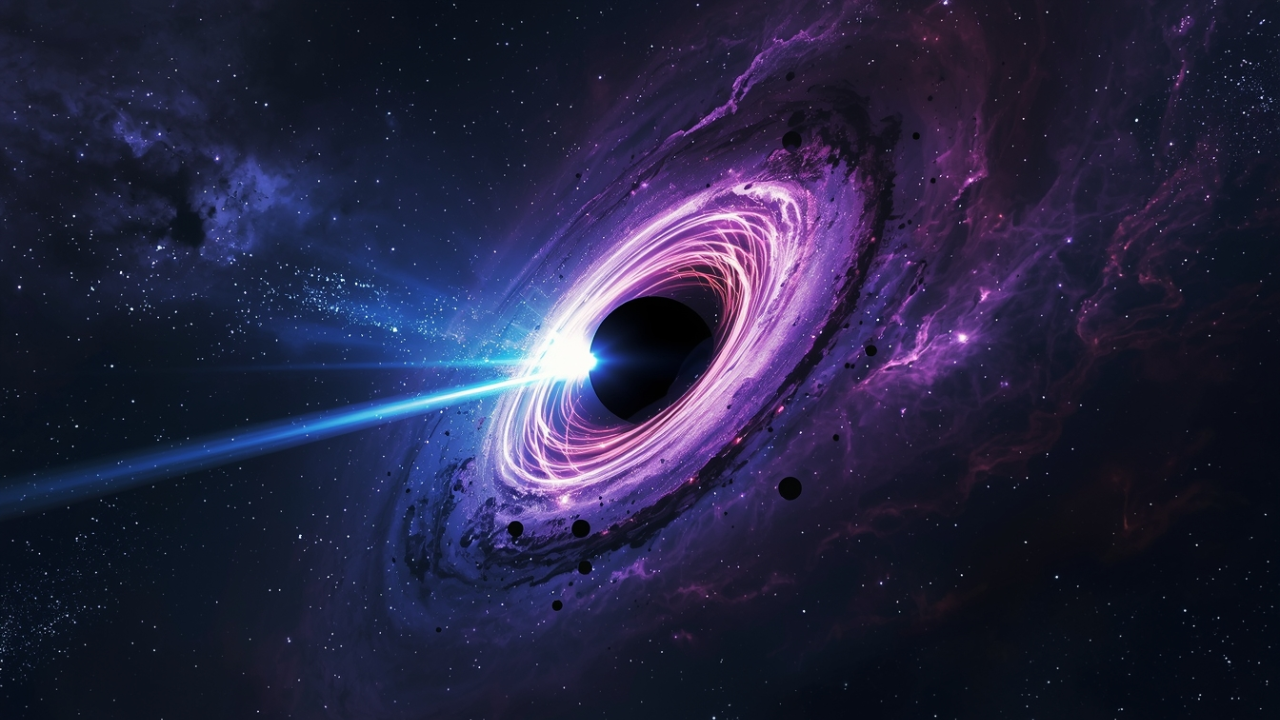
When a massive star exhausts its nuclear fuel, it collapses under its own gravity, often forming a black hole. As material falls inward, powerful jets of energy can shoot outward at nearly the speed of light. If one of these jets points toward Earth, we detect it as a gamma-ray burst.
2. Merging Neutron Stars
Another common source of GRBs occurs when two neutron stars orbit each other and eventually collide. This violent merger can also produce intense energy jets visible across vast cosmic distances.
However, neither of these scenarios easily explains a burst that remains active for seven hours. Typical collapses and mergers simply do not sustain energy release for that long.
A Rare Helium Merger May Be the Answer
Researchers now suggest that GRB 250702B may have been caused by a rare astrophysical event known as a helium merger.
In this scenario, a black hole roughly the mass of a star orbits a helium star — a stripped-down stellar core that has already lost its outer hydrogen layers. These helium stars are extremely dense and can expand dramatically during certain evolutionary phases.
When the helium star expands far enough, the orbiting black hole can plunge into its outer layers. Once inside, it begins rapidly consuming stellar material.
This prolonged accretion process feeds the black hole for hours rather than seconds. As material spirals inward, enormous amounts of angular momentum are transferred, powering extended jets of gamma radiation.
That sustained “feeding frenzy” could explain why GRB 250702B lasted far longer than conventional bursts.
Why Events Like This Are Rarely Detected
Ultra-long gamma-ray bursts may be more common than we think — but harder to detect.
Most space observatories are optimized to identify short, bright flashes rather than extended, dimmer signals. A slow, prolonged burst might fall below detection thresholds unless instruments are specifically tuned to track long-duration events.
Additionally, these bursts are often less luminous than short GRBs, meaning they can only be detected within a limited cosmic range.
This suggests that many similar events could be happening undetected across the universe.
What’s Next for Researchers?
To better understand extreme cosmic explosions, astronomers are preparing for future missions equipped with improved detection technology. One key project is Compton Spectrometer and Imager (COSI), scheduled for launch in 2027.
COSI is expected to enhance sensitivity to long-duration gamma-ray bursts, allowing scientists to build a larger dataset of rare events like GRB 250702B.
With more advanced instruments, researchers hope to confirm whether helium mergers are responsible for these ultra-long bursts — or whether even stranger cosmic mechanisms remain undiscovered.
A Universe Full of Surprises
GRB 250702B has already forced astronomers to reconsider the limits of what black holes and dying stars can produce. A seven-hour space signal was once thought nearly impossible. Now, it may represent a new category of extreme astrophysical phenomena.
As observational technology improves, scientists anticipate uncovering more long gamma-ray bursts, offering deeper insight into how the most powerful forces in the universe shape galaxies — and occasionally send extraordinary signals our way.