The search for life beyond Earth may have just taken a decisive turn — not on Mars itself, but in a quarry in northern Algeria.
In gypsum-rich rock formations at the Sidi Boutbal site, scientists have identified fossilized microbial structures that closely resemble what researchers might expect to find in similar deposits on the Red Planet. The findings, published in Frontiers, could dramatically refine how future Mars missions search for ancient life.
At the center of the study is a team led by Youcef Sellam of the University of Bern, whose work bridges terrestrial geology and planetary exploration.
Why Algeria Matters to Mars
The research focused on gypsum deposits formed during the Messinian Salinity Crisis — a dramatic geological period when the Mediterranean Sea partially dried up, leaving behind vast evaporite layers.
These mineral formations are significant because sulfate-rich rocks, including gypsum, have also been widely detected on Mars.
If microbial life once existed in Martian lakes or shallow seas billions of years ago, gypsum could have preserved it.
At Sidi Boutbal, researchers applied strict criteria to distinguish genuine microbial fossils from purely mineral structures. The goal was simple but profound: determine whether biosignatures trapped in gypsum can be reliably identified — and whether similar traces might survive on Mars.
Fossils Hidden in Crystal
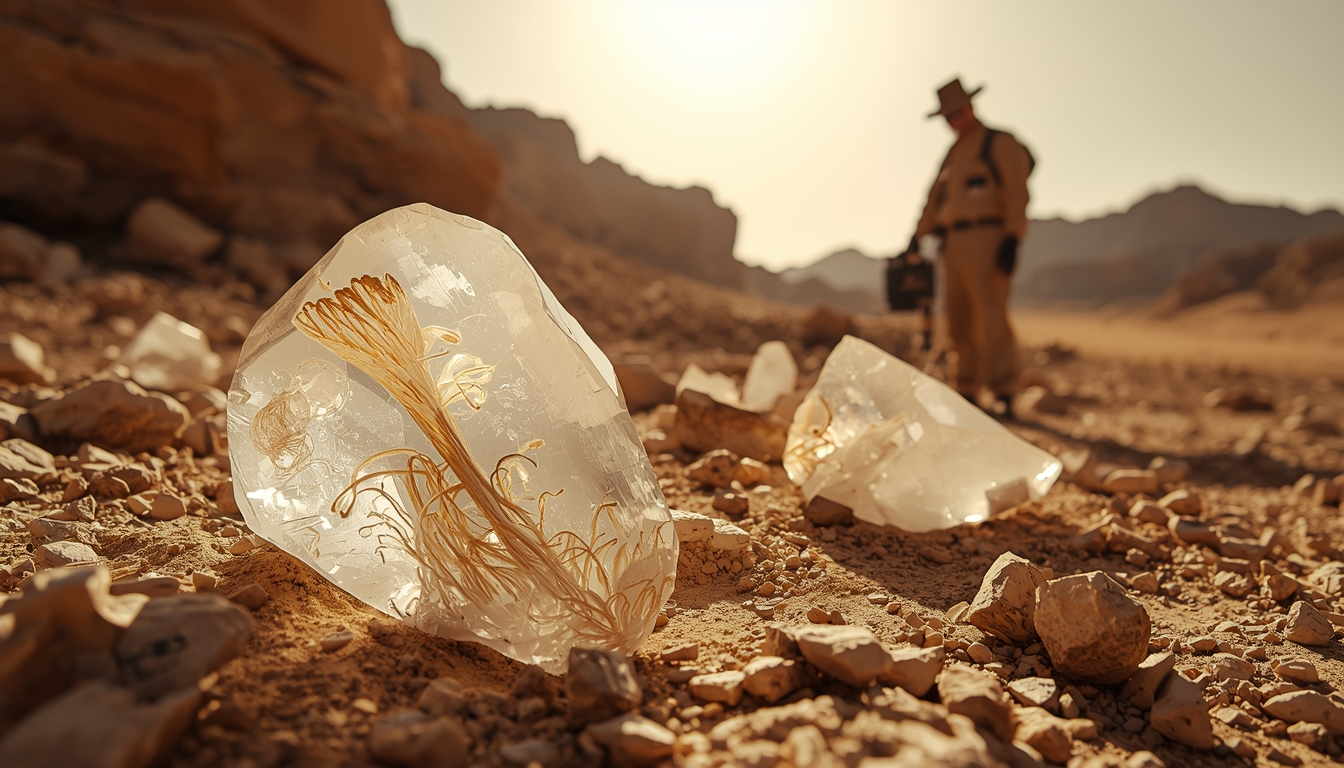
Using the LIMS instrument (Laser Ablation Ionization Mass Spectrometer), developed at the University of Bern and designed for planetary deployment, the team detected fossilized filaments embedded within the gypsum.
These microscopic structures were previously interpreted as algae or cyanobacteria. However, the new analysis suggests they resemble sulfur-oxidizing bacteria similar to Beggiatoa.
The surrounding mineral context strengthens the biological interpretation. The presence of dolomite and associated geochemical markers indicates that microbial activity likely influenced mineral formation.
In short: the rocks bear chemical and structural fingerprints consistent with life.
Why Gypsum Is a Prime Target on Mars
Gypsum forms rapidly when water evaporates. On ancient Mars, where lakes and possibly shallow seas once existed, such deposits could have trapped microorganisms before decay erased their structure.
This makes sulfate-rich terrains prime candidates for astrobiological investigation.
However, identifying true biosignatures on Mars will not be straightforward. Abiotic processes — purely geological reactions — can sometimes produce shapes and chemical patterns that mimic life. Independent verification methods will be critical.
Additionally, Mars’s harsh radiation environment and oxidizing surface conditions may have degraded or altered ancient organic material over billions of years.
The Algerian study provides a testing ground: if scientists can confidently distinguish life-driven structures from mineral lookalikes on Earth, they improve their odds of doing the same on Mars.
A Milestone for Astrobiology
Beyond its scientific implications, the research marks a symbolic milestone. It represents the first astrobiology study of its kind conducted in Algeria, expanding the global footprint of planetary science research.
By demonstrating that gypsum can preserve microscopic life in identifiable ways, the study strengthens the case for equipping future Mars rovers with high-precision spectrometers capable of detecting similar signals.
The next breakthrough may not come from spotting something moving on Mars — but from recognizing the silent mineral traces left behind billions of years ago.
If those traces are confirmed one day, discoveries like the one at Sidi Boutbal will have laid the groundwork.