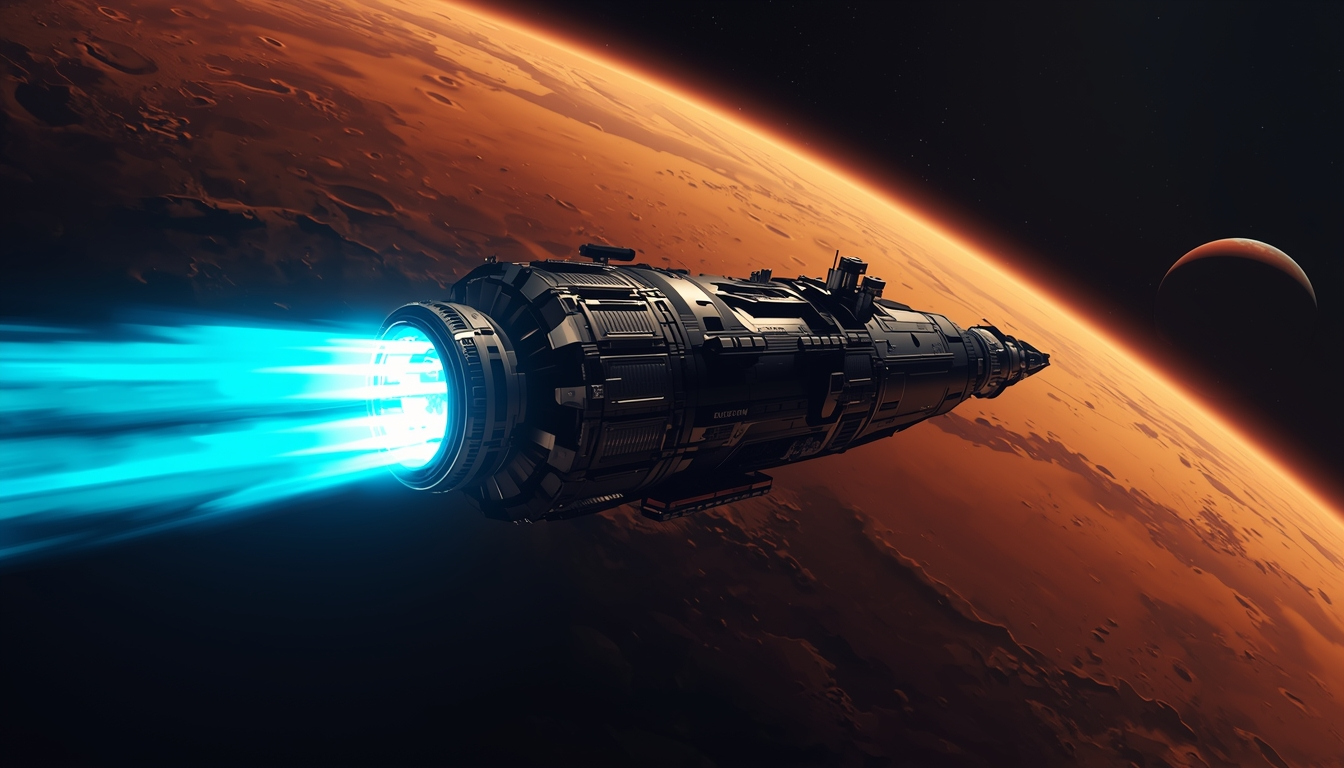
As the next Mars launch window approaches in autumn 2026, a striking announcement from Russia has reignited debate in the global space community. The country’s state nuclear corporation, Rosatom, claims it is developing a plasma propulsion system capable of cutting travel time to Mars from roughly nine months to as little as 30–60 days.
In an era where interplanetary ambition is accelerating, that kind of promise demands attention — and scrutiny.
The Timing: A New Mars Race
Interest in Mars is intensifying. Elon Musk has stated that 2026 could mark the first SpaceX Starship mission toward Mars — though many analysts view that timeline as optimistic.
Against this backdrop, Rosatom’s renewed announcement appears strategically timed. If successful, Russia’s propulsion breakthrough would dramatically reshape expectations for deep space travel.
Conventional chemical rockets require approximately seven to nine months to reach Mars, depending on orbital alignment. Cutting that to one or two months would transform mission design, astronaut safety, and cargo logistics.
But how realistic is the claim?
What Russia Is Proposing
According to reports from Russian media, the propulsion concept involves:
- A magnetic plasma accelerator
- Hydrogen as propellant
- Plasma exhaust velocities of up to 100 km/s
- Approximately 300 kilowatts of power consumption
- Around 6 newtons of thrust
- A nuclear reactor as the onboard power source
The system would first use a conventional rocket to reach orbit. Once in space, the plasma engine would handle the interplanetary journey.
Rosatom reportedly aims to begin flight testing around 2030. For now, the prototype is said to be undergoing ground testing inside a large vacuum chamber.
However, detailed technical specifications remain limited.
Plasma Propulsion: Real Science, Not Fantasy
It’s important to separate hype from physics.
Plasma propulsion is not speculative science fiction. Variants of it are already in use.
For example, NASA equipped its Psyche spacecraft with Hall effect thrusters for its mission to the asteroid Psyche — marking a milestone for solar electric propulsion in deep space.
Meanwhile, Ad Astra Rocket Company has been developing the VASIMR (Variable Specific Impulse Magnetoplasma Rocket) system for years. Its VX-200 prototype requires around 200 kilowatts of power to generate roughly five newtons of thrust.
In theory, scaling plasma engines to multi-megawatt or even 200-megawatt systems could reduce a Mars journey to under 40 days.
The physics works.
The engineering scale is the challenge.
Where Questions Begin
Several uncertainties surround the Russian announcement:
1. Technology Type
It remains unclear whether the engine is:
- Magnetoplasmadynamic (MPD), or
- Hall-effect based
These systems differ significantly in efficiency, scalability, and complexity.
2. Power Source
Rosatom suggests using a nuclear reactor. Solar panels cannot realistically provide 300 kW continuously at Mars-transfer distances without massive arrays.
Space-based nuclear reactors introduce:
- Safety concerns
- Political sensitivity
- Complex heat dissipation challenges
- Additional mass constraints
3. Thrust vs. Travel Time
Six newtons of thrust is modest. While plasma engines achieve very high exhaust velocity (specific impulse), they produce low thrust compared to chemical rockets. Achieving a 30–60 day Mars transfer would require precise trajectory design and sustained acceleration.
4. Institutional Constraints
Russia’s space industry has faced financial strain and organizational challenges in recent years. Scaling an advanced propulsion system to operational readiness by 2030 would require sustained funding and technical coordination.
Why Faster Mars Travel Matters
If travel time to Mars dropped from nine months to two months, the implications would be enormous:
- Reduced astronaut radiation exposure
- Lower life-support mass requirements
- Increased launch flexibility
- Faster cargo delivery cycles
- Greater emergency response capability
Radiation exposure during long-duration spaceflight is one of the biggest barriers to human Mars missions. Shortening travel time directly improves safety margins.
Is It Plausible?
Scientifically? Yes.
Practically? Much harder.
Plasma propulsion has been under development for decades across multiple countries. The real bottleneck has always been power generation and thermal management in space, not theoretical propulsion physics.
Rosatom’s proposal is bold but not physically impossible. The real test will be whether the system moves from laboratory prototype to integrated spacecraft hardware.
Historically, many ambitious propulsion announcements — from multiple countries — have struggled to move beyond demonstration phases.
The Broader Context: Symbolism and Strategy
Mars exploration is as much geopolitical signaling as it is scientific pursuit.
The United States, China, and private aerospace companies are all positioning themselves for the next era of deep space exploration. A credible breakthrough in propulsion would carry both strategic and symbolic weight.
Whether this Russian engine becomes a functional system — or remains a high-profile concept — will depend on measurable technical milestones, not press statements.
The Bottom Line
Reaching Mars in one to three months is not fantasy. The science behind plasma propulsion is established and evolving.
But moving from prototype chamber to interplanetary mission is a monumental leap.
As the 2026 launch window approaches, Mars once again sits at the center of global ambition. Between optimism, rivalry, and engineering reality, the Red Planet continues to test not just rockets — but credibility.
For now, the dream of a 30-day journey to Mars remains tantalizing — technically possible, strategically powerful, and just beyond proven capability.
FAQs
How long does it currently take to reach Mars?
Using conventional chemical rockets, a Mars transfer typically takes between seven and nine months.
What is plasma propulsion?
Plasma propulsion uses electrically accelerated ionized gas (plasma) to generate thrust. It offers much higher fuel efficiency than chemical rockets but produces lower thrust.
Why would a nuclear reactor be needed?
High-powered plasma engines require continuous electricity — potentially hundreds of kilowatts or more. Solar panels alone may not supply enough energy for fast Mars missions.
Is Russia the only country working on this technology?
No. NASA and private companies like Ad Astra Rocket Company are also developing plasma propulsion systems.
Could this reduce radiation risks for astronauts?
Yes. Shorter travel times reduce cumulative radiation exposure during deep-space missions.
When could such a system realistically fly?
Rosatom has suggested flight testing by 2030, but independent verification and technical validation will determine whether that timeline is feasible.