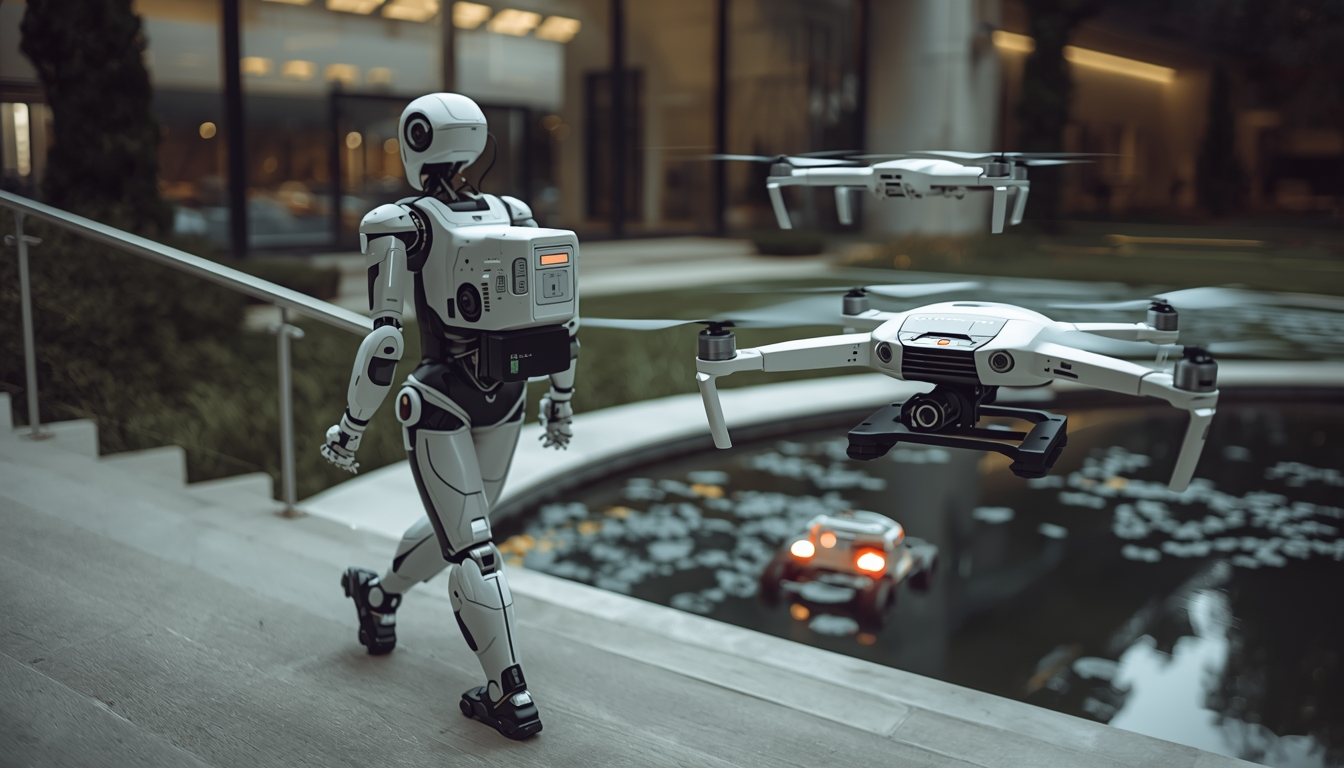
In late 2025, a humanoid robot walked through a library, climbed stairs, stepped outdoors, and then released a drone from its back. The drone flew across a pond, landed nearly 100 feet away, switched to wheels, and drove to a meeting point. The humanoid robot walked there and rejoined it.
No joystick.
No remote operator.
No control room.
Everything ran autonomously.
This breakthrough system, developed at California Institute of Technology, marks a major step forward in multi-modal robotics.
Meet X1: A Hybrid Robotics System
The system, known as X1, combines:
- A modified Unitree G1 humanoid robot
- Caltech’s M4 “Morphobot” — a robot capable of both flying and driving
The project took approximately three years and involved collaboration between:
- California Institute of Technology
- Technology Innovation Institute
- Northeastern University
The objective was ambitious: create a robotic system that can decide independently whether to walk, fly, or roll depending on terrain conditions.
Why Combine Walking, Flying, and Driving?
Most robots are specialists.
- Wheeled robots are efficient but struggle with stairs and debris.
- Drones can fly over obstacles but drain batteries quickly.
- Humanoid robots navigate human spaces but move slowly across large open areas.
X1 distributes tasks intelligently:
- The humanoid handles corridors, stairs, and doorways.
- The M4 drone covers longer distances through the air.
- Once on flat terrain, the drone converts into a wheeled vehicle to conserve energy.
This coordination solves a long-standing robotics challenge: transitioning between locomotion modes autonomously.
The M4 Morphobot: Engineering Versatility
Developed in Professor Mory Gharib’s lab at Caltech, the M4 uses “appendage repurposing.” Its circular propeller guards serve multiple functions:
- Thrusters during flight
- Wheels on the ground
- Stabilizers when needed
For environmental perception, the system integrates lidar and radar technology inspired by systems such as the DJI Matrice.
In research published in Nature Communications, the team detailed multiple movement modes:
- Flying
- Rolling
- Crawling
- Balancing
- Tumbling
The robot can handle slopes of up to 45 degrees and autonomously select the most energy-efficient method of travel.
Autonomous Decision-Making Without Human Input
At the core of X1 is sensor fusion technology. By combining lidar, cameras, and range finders, the system constructs a real-time map of its surroundings.
From there, it makes independent decisions:
- Walk through complex indoor spaces
- Fly across obstacles
- Roll across flat surfaces
According to Aaron Ames, director of Caltech’s Center for Autonomous Systems and Technologies, the humanoid does not rely on motion capture data. Instead, it uses physics-based models enhanced by machine learning.
“The robot learns to walk as the physics dictate,” Ames explained, emphasizing safety-critical control as a core design principle.
Reliability is central to the project. Claudio Tortorici of the Technology Innovation Institute reinforced this priority, stating that widespread robotics deployment requires trustworthy autonomous systems.
Real-World Applications Beyond the Lab
While X1 is currently a research platform, its capabilities align with practical applications such as:
- Disaster response
- Search and rescue missions
- Infrastructure inspection
- Hazardous environment exploration
These environments often include stairs, debris, water, uneven terrain, and long travel distances — conditions that typically defeat single-mode robots.
By coordinating walking, flying, and driving within one system, X1 demonstrates that multi-modal robotics can operate without continuous human supervision.
A Turning Point in Robotics Engineering
X1 does not solve every robotics challenge. However, it addresses a critical one: seamless transitions between movement types under full autonomy.
Walk.
Fly.
Drive.
Not as separate machines — but as a coordinated system making its own decisions.
For robotics research, that represents a significant step toward adaptable machines capable of functioning in real-world complexity.