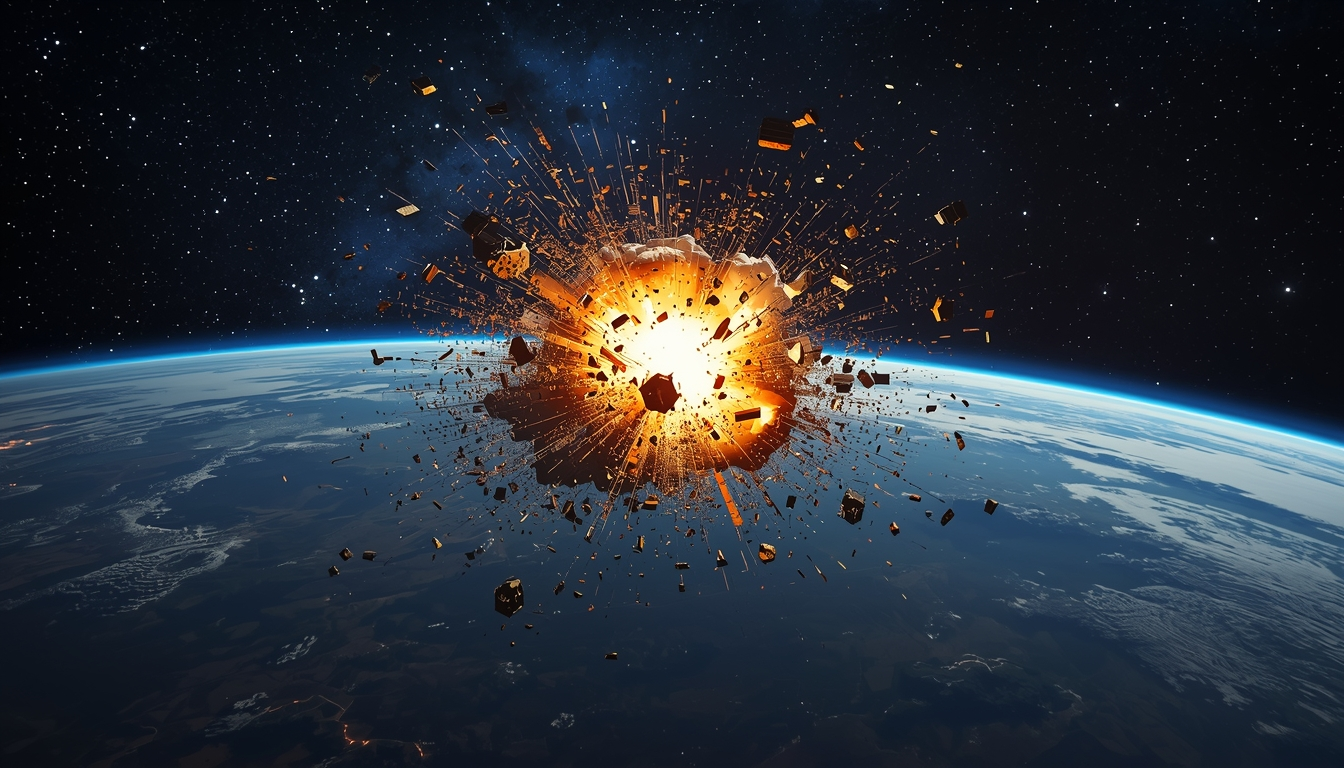
A decommissioned Russian satellite has fragmented in low Earth orbit, generating more than 180 pieces of tracked debris and briefly placing the International Space Station (ISS) on alert. The event has renewed concerns about the escalating space debris crisis and the vulnerability of Earth’s orbital environment.
What Happened to Resurs P1?
On June 26, tracking systems detected a debris cloud linked to Resurs P1, an Earth observation satellite launched in 2013. The spacecraft had been operated by Roscosmos and officially deactivated in 2021.
According to United States Space Command and commercial tracking firm LeoLabs, the breakup occurred at approximately 355 kilometers above Earth’s surface. The satellite had been gradually losing altitude and was expected to re-enter the atmosphere later this year.
More than 180 debris fragments have been cataloged so far, with monitoring efforts still underway.
International Space Station Placed on Alert
The debris cloud formed below the orbit of the International Space Station, which circles Earth at roughly 400 kilometers. Although the altitude difference reduced immediate danger, the proximity was close enough to trigger precautionary safety procedures.
Astronauts aboard the station temporarily moved into their docked spacecraft in case emergency evacuation became necessary. Among them were NASA astronaut Sunita Williams and test pilot Barry Wilmore, assigned to Boeing’s Starliner capsule.
After roughly an hour, mission controllers determined that the immediate collision risk had passed, and normal station operations resumed
What Caused the Satellite Breakup?
The precise cause of the fragmentation remains unknown. However, experts suggest two primary possibilities:
1. Battery Explosion
A leading theory involves improper satellite passivation. Passivation is the process of safely discharging stored energy — such as batteries and pressurized fuel — when a spacecraft is retired. If residual energy remains, it can trigger explosions years later.
Today, inadequate passivation is one of the main drivers of accidental space debris generation. Many industry experts are advocating for stricter international regulations to make safe decommissioning mandatory.
2. Collision With Existing Debris
Another plausible explanation is impact from a small piece of orbital debris. Even fragments just a few centimeters wide can cause catastrophic damage due to extreme orbital velocities exceeding 28,000 km/h.
At this stage, there is no confirmed evidence suggesting deliberate destruction.
Anti-Satellite Weapons Concerns
Speculation briefly surfaced that the breakup could have been linked to an anti-satellite (ASAT) weapons test. While no proof supports this theory in the Resurs P1 case, geopolitical tensions have previously intensified scrutiny of such activities.
Notably, Russia has not ratified international commitments aimed at banning destructive anti-satellite missile demonstrations, a growing area of concern for global space security.
The Expanding Orbital Debris Problem
Each new fragmentation event contributes to an already congested orbital environment. Thousands of inactive satellites, spent rocket stages, and debris fragments now orbit Earth, posing collision risks to:
- Active communication satellites
- GPS systems
- Weather monitoring spacecraft
- Crewed missions like the ISS
Experts warn that cascading collisions — sometimes referred to as the Kessler Syndrome — could make certain orbital regions increasingly hazardous for decades.
A Fragile Space Environment
The Resurs P1 incident highlights a critical reality: Earth’s orbit is no longer vast and empty. It is a shared, finite environment requiring responsible management.
As satellite launches accelerate and megaconstellations expand, strict debris mitigation strategies and responsible end-of-life protocols are becoming essential to protect astronauts, infrastructure, and the future of space exploration.
In orbit, even a small oversight can generate consequences that last for years — or longer.