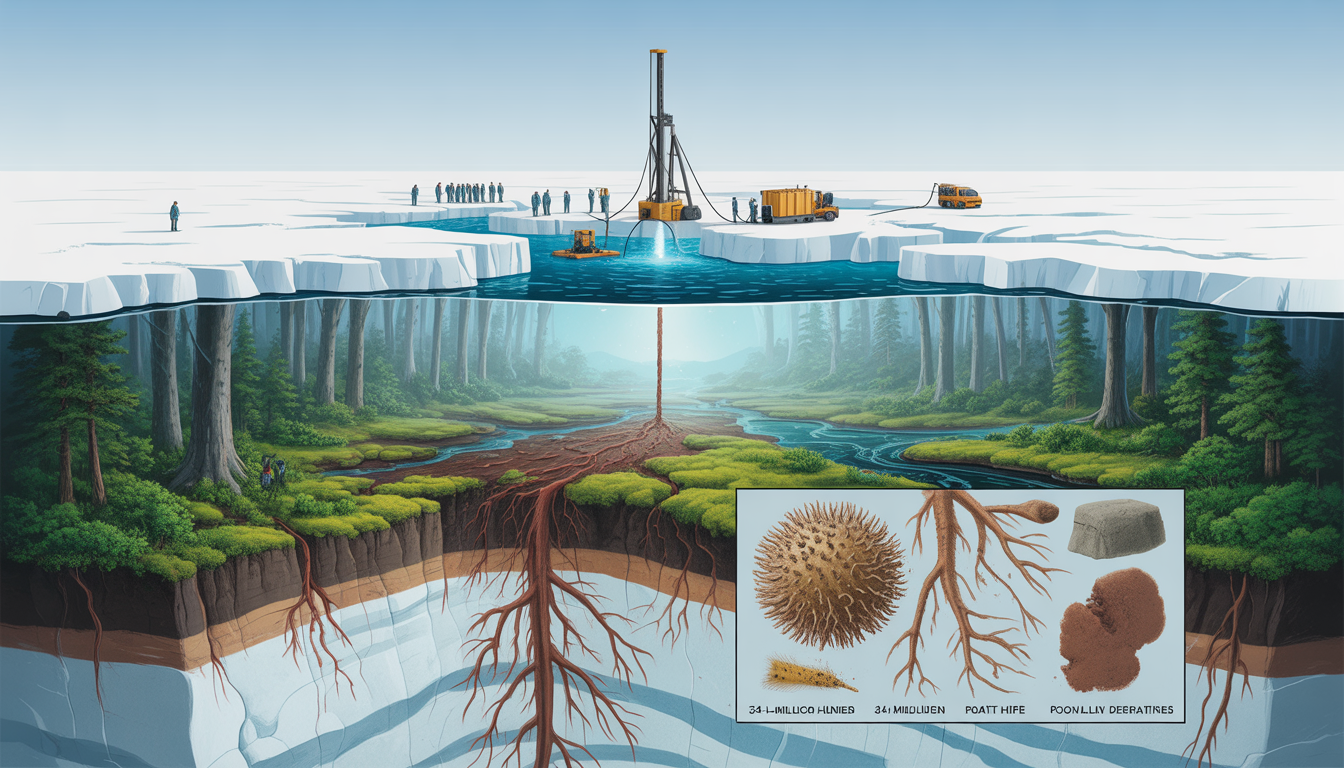
Imagine drilling straight through two kilometers of solid ice and discovering evidence of forests, rivers, and plant life where today there is nothing but frozen desert.
That’s exactly what scientists uncovered beneath East Antarctica — a preserved snapshot of a world that existed 34 million years ago.
And it’s forcing researchers to rethink how stable our planet’s climate really is.
When Antarctica Was Green
Today, Antarctica is defined by endless ice sheets and subzero temperatures. But sediment pulled from deep beneath the ice tells a completely different story.
Microscopic analysis revealed:
- Fossilized pollen
- Leaf wax compounds
- Root fragments
- Chemical traces of ancient soil
- Evidence of flowing freshwater systems
These materials date back to the Eocene–Oligocene transition, a pivotal moment in Earth’s climate history when the planet shifted from a greenhouse state to the icehouse world we recognize today.
During that earlier period, parts of East Antarctica likely experienced summer temperatures between 10–15°C (50–59°F). Instead of glaciers, the landscape supported mossy forests and river valleys.
How the Discovery Happened
Researchers drilled through the East Antarctic Ice Sheet using hot-water drilling technology, creating a narrow shaft nearly two kilometers deep.
The team wasn’t initially searching for ancient forests. They were studying ice dynamics. But when the drill reached sediment trapped between bedrock and ice, everything changed.
Under the microscope, the samples revealed unmistakable plant material from a lost ecosystem.
What Was Found in the Sediment
| Discovery | What It Reveals | Age |
|---|---|---|
| Fossilized pollen | Plant species present | 34 million years |
| Leaf wax compounds | Atmospheric composition | 34 million years |
| Root fragments | Soil and ecosystem structure | 34 million years |
| Isotopic signatures | Temperature and rainfall | 34 million years |
The level of preservation suggests the landscape was rapidly buried as ice sheets expanded — essentially freezing the environment in time.
Why This Changes Climate Science
The ice sheet covering East Antarctica is currently the largest and most stable on Earth. But this discovery proves it wasn’t always there.
At the time this ancient ecosystem thrived, atmospheric carbon dioxide levels were comparable to projections for the coming centuries if emissions continue rising.
If the East Antarctic Ice Sheet were to melt completely today, global sea levels could rise by approximately 60 meters (200 feet).
The discovery doesn’t mean that will happen overnight — but it confirms that dramatic transformations have occurred before under elevated greenhouse conditions.
A Climate Tipping Point in Earth’s Past
The transition from green Antarctica to an ice-covered continent happened during the Eocene–Oligocene boundary — one of the most significant climate shifts in geological history.
It marked the formation of permanent Antarctic ice sheets and a global cooling trend that reshaped ocean circulation, ecosystems, and atmospheric patterns.
By studying this ancient shift, scientists gain critical insight into:
- Ice sheet stability
- Carbon dioxide sensitivity
- Sea-level response times
- Ecosystem adaptation under extreme light cycles
Understanding how quickly Antarctica froze over millions of years ago helps refine projections of how it might respond to modern warming.
What Happens Next
Researchers are continuing to analyze the sediment cores for deeper biological and chemical clues.
Future goals include:
- Determining how rapidly the ice sheet formed
- Identifying specific plant species that once thrived there
- Refining climate model simulations
- Assessing vulnerability of modern Antarctic ice
The discovery reinforces one sobering truth: Earth’s climate system is dynamic. Even regions we consider permanently frozen have undergone radical transformation.
FAQs
How did scientists drill through 2 kilometers of ice?
They used hot-water drilling technology that melts a vertical shaft through the ice, allowing sediment cores to be retrieved from beneath.
What did Antarctica look like 34 million years ago?
It likely featured forests, river systems, and summer temperatures above freezing — dramatically different from today’s frozen landscape.
Why is this important for climate change research?
It shows that even large, stable ice sheets can disappear under higher carbon dioxide conditions, offering a real-world precedent for climate sensitivity.
Were the plant remains well preserved?
Yes. Fossilized pollen, leaf wax, and root fragments were intact enough to analyze chemical and atmospheric signatures.
Could Antarctica become green again?
Not in the near future, but if long-term warming continues and greenhouse gas levels rise significantly, parts of the continent could eventually lose ice coverage over geological timescales.
This frozen continent is not as permanent as it looks.
Buried beneath two kilometers of ice lies proof that Antarctica was once alive — and that Earth’s climate can change in ways we’re only beginning to understand.