For decades, black holes have existed at the edge of human imagination — predicted by equations, inferred from violent cosmic events, and finally imaged one at a time. Now, for the first time in history, astronomers have captured a radio image showing two supermassive black holes orbiting each other.
The breakthrough centers on the quasar OJ 287, located about 3.5 billion light-years from Earth. Hidden within its blazing core lies a colossal cosmic dance that scientists have been tracking for more than a century — and have now finally seen.
A New Era in Black Hole Astronomy
Black hole physics experienced a revolution in the 20th century, driven by theoretical giants like Roy Kerr, who described rotating black holes in 1963, and Stephen Hawking, who later showed they slowly evaporate through radiation.
But the real transformation began in the past decade:
- Gravitational waves confirmed black hole mergers.
- The Event Horizon Telescope collaboration produced the first direct images of individual black holes.
- And now, archived data from RadioAstron has revealed something unprecedented — two black holes in orbit around each other.
We are no longer just theorizing about these monsters of gravity. We are watching them.
Meet OJ 287: A Colossal Binary System
OJ 287 is no ordinary quasar.
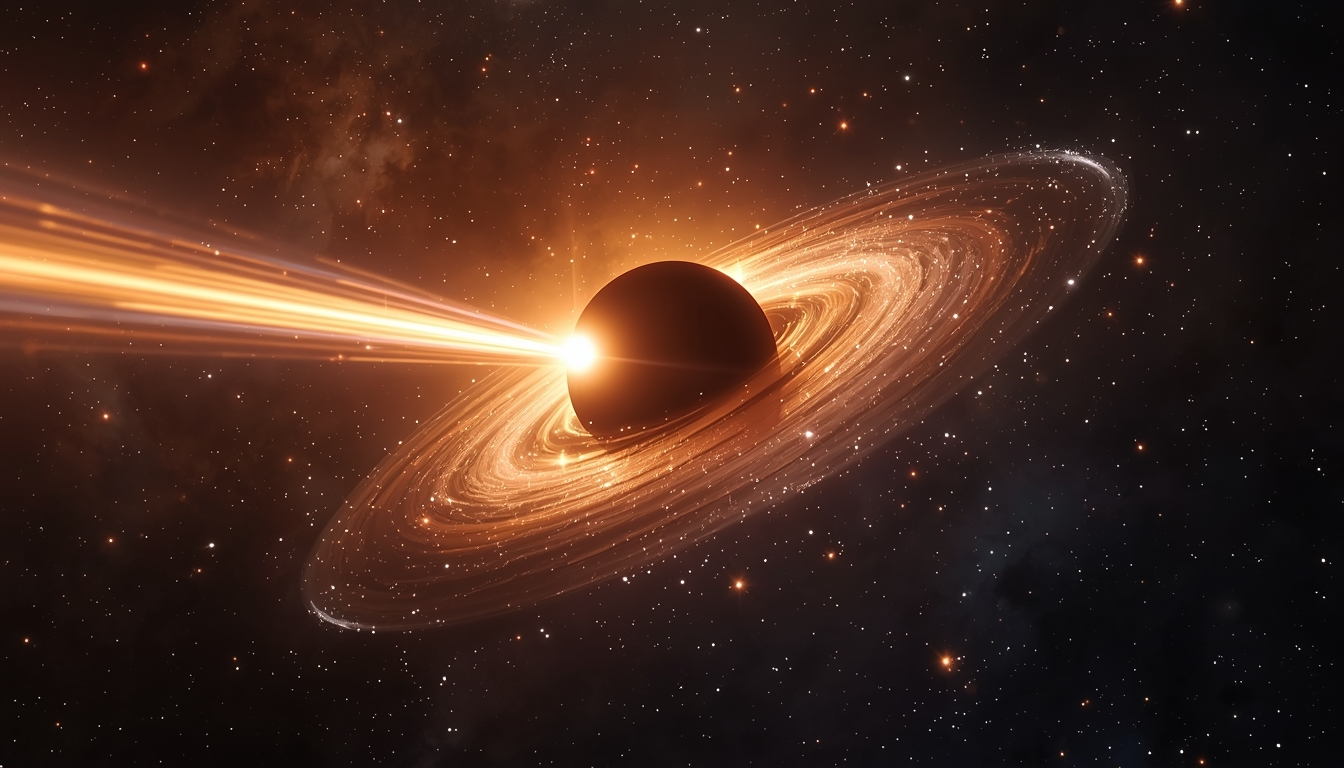
At its center lies one of the most massive black holes ever observed — weighing an astonishing 18 billion times the mass of the Sun. Orbiting it is a smaller (but still enormous) companion black hole with a mass of about 150 million Suns.
This secondary black hole completes an orbit every 12 years.
But here’s where it gets dramatic:
- Its orbit is tilted.
- It crosses the larger black hole’s accretion disk twice per orbit.
- Each crossing triggers a massive flare.
For nearly 140 years, astronomers have recorded sudden bursts of brightness from OJ 287 — events so intense they briefly outshine entire galaxies.
Now we know why.
How the Image Was Captured
The key to this discovery lies in resolution — the ability to distinguish incredibly small details at vast distances.
RadioAstron, launched from the historic Baikonur Cosmodrome, carried a 10-meter antenna into space. At its furthest point, it traveled 360,000 kilometers from Earth — nearly the distance to the Moon.
Working together with ground-based radio telescopes through interferometry, it created a virtual telescope thousands of kilometers wide — effectively larger than Earth itself.
This gave astronomers the sharpness needed to resolve:
- Two bright radio spots — the jets from each black hole
- A third structure — a jet extending from the smaller companion
Black holes themselves emit no light. But their jets — beams of accelerated particles traveling near light speed — betray their presence.
For the first time, scientists could clearly separate two such engines in orbit around one another.
Why This Changes Everything
Binary supermassive black holes are expected to form when galaxies merge. But directly imaging them has remained nearly impossible.
This observation confirms several crucial points:
- Supermassive black holes can exist in tightly bound binary systems.
- Relativistic orbital precession behaves as predicted.
- Long-observed flares in OJ 287 match theoretical disk-impact models.
In short, theory and observation are finally converging.
Even more importantly, these systems are prime sources of future gravitational wave detections — especially for next-generation space observatories expected in the 2030s.
We are witnessing the early stages of a gravitational wave astronomy revolution.
A Quasar with a Story That Spans a Century
OJ 287 belongs to a class of active galaxies known as BL Lacertae objects and is considered a blazar — meaning its jet is aimed almost directly at Earth.
Its flare cycles have been tracked since 1888. For decades, astronomers debated their origin.
Now, thanks to space-based radio interferometry, the mystery has visual confirmation.
What was once a flicker in telescopes is now a mapped cosmic system.
What Comes Next?
Although RadioAstron is no longer operational, the data it collected continues to deliver breakthroughs.
Future missions and improved interferometric networks may:
- Track orbital motion in greater detail
- Measure black hole spin dynamics
- Detect the gravitational waves from eventual merger
And when these two giants finally collide — millions of years from now — the energy released will ripple across the fabric of spacetime itself.
The universe has long hidden its most extreme phenomena in darkness.
Now, for the first time, we have watched two of its darkest objects move together — and history has changed.