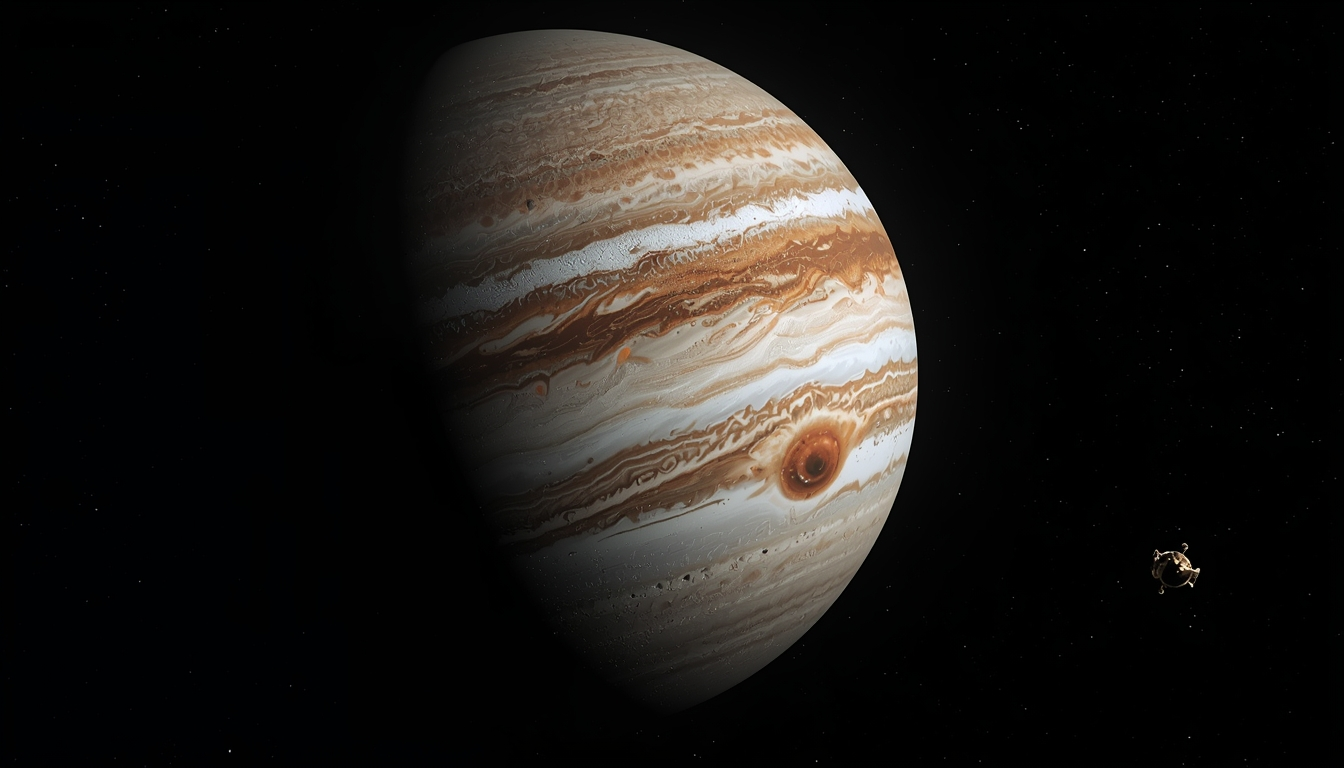
For half a century, textbooks have confidently described Jupiter as the undisputed giant of our Solar System — a massive world capable of swallowing more than 1,300 Earths. But new measurements suggest that even the most familiar planetary facts can shift under closer scrutiny.
Fresh analysis from NASA’s long-running Juno mission indicates that Jupiter may be slightly smaller — and more flattened — than scientists once believed.
It’s not a dramatic downsizing. But in planetary science, even a few kilometers matter.
Measuring a Planet Without a Surface
Unlike rocky worlds such as Earth or Mars, Jupiter has no solid surface. It’s a gas giant composed primarily of hydrogen and helium, with swirling clouds and intense storms dominating its upper atmosphere.
So where exactly does the planet “end”?
Determining the size of a gaseous planet is far more complex than measuring a solid one. Scientists rely on radio signals, orbital dynamics, and models of atmospheric pressure levels to define a consistent boundary — typically where atmospheric pressure equals one bar, similar to Earth’s surface pressure.
For decades, our best measurements came from earlier NASA missions such as Pioneer 10 and Voyager 1, which performed flybys in the 1970s. Those spacecraft transmitted radio signals past Jupiter, allowing researchers to estimate its radius based on signal delay and gravitational influence.
Those figures stood largely unchallenged — until now.
What Juno Discovered
Since entering orbit in 2016, Juno has been repeatedly diving close to Jupiter’s cloud tops, collecting high-precision data on gravity, atmosphere, and magnetic fields.
In the latest study, scientists analyzed 26 instances when Juno passed behind Jupiter from Earth’s perspective. During these occultations, the spacecraft temporarily lost radio contact. By precisely timing the signal disruption and analyzing how Jupiter’s atmosphere bent the radio waves, researchers refined their measurement of the planet’s dimensions.
The updated numbers show that Jupiter’s equatorial radius is about 71,488 kilometers — roughly four kilometers smaller than previous estimates.
Even more interesting, Jupiter appears slightly more flattened at the poles than previously thought. The difference is subtle — on the order of about a dozen kilometers — but significant for planetary modeling.
On a world of this scale, such refinements may seem tiny. Scientifically, they are not.
Why a Few Kilometers Matter
Jupiter rotates incredibly fast, completing one full spin in just under 10 hours. That rapid rotation causes the planet to bulge at the equator and flatten at the poles — a shape known as an oblate spheroid.
Accurate radius measurements directly influence calculations of:
- Internal density distribution
- Gravitational harmonics
- Core structure estimates
- Atmospheric depth and wind modeling
Jupiter’s violent jet streams and colossal storms — including the iconic Great Red Spot — are driven by complex internal dynamics that scientists are still working to fully understand. Even small corrections to the planet’s dimensions help recalibrate these models.
Because Jupiter serves as a reference point for studying gas giants across the galaxy, improving our understanding of its structure also sharpens research on distant exoplanets.
A Benchmark for Planetary Science
Jupiter is not just another planet — it is the standard against which other gas giants are compared.
Whether scientists are modeling planetary formation, magnetic field generation, or atmospheric circulation, Jupiter provides the foundational data set. Refined measurements ripple outward, influencing how researchers interpret giant planets orbiting distant stars.
Although Juno is approaching the final phase of its mission, exploration of the Jovian system is far from over.
The JUICE mission from the European Space Agency is on its way to study Jupiter and its icy moons, including Europa and Ganymede. Future observations may further refine our understanding — not only of the planet’s size, but of its internal structure and long-term evolution.
Science Is Never Finished
What makes this discovery compelling is not that Jupiter has “shrunk.” It hasn’t — at least not in any dramatic sense.
What has changed is our precision.
After fifty years of certainty, improved instrumentation and careful reanalysis have revealed that even the Solar System’s largest planet still holds subtle surprises.
In astronomy, the closer we look, the more the universe reminds us that knowledge is always provisional — and refinement is the essence of progress.