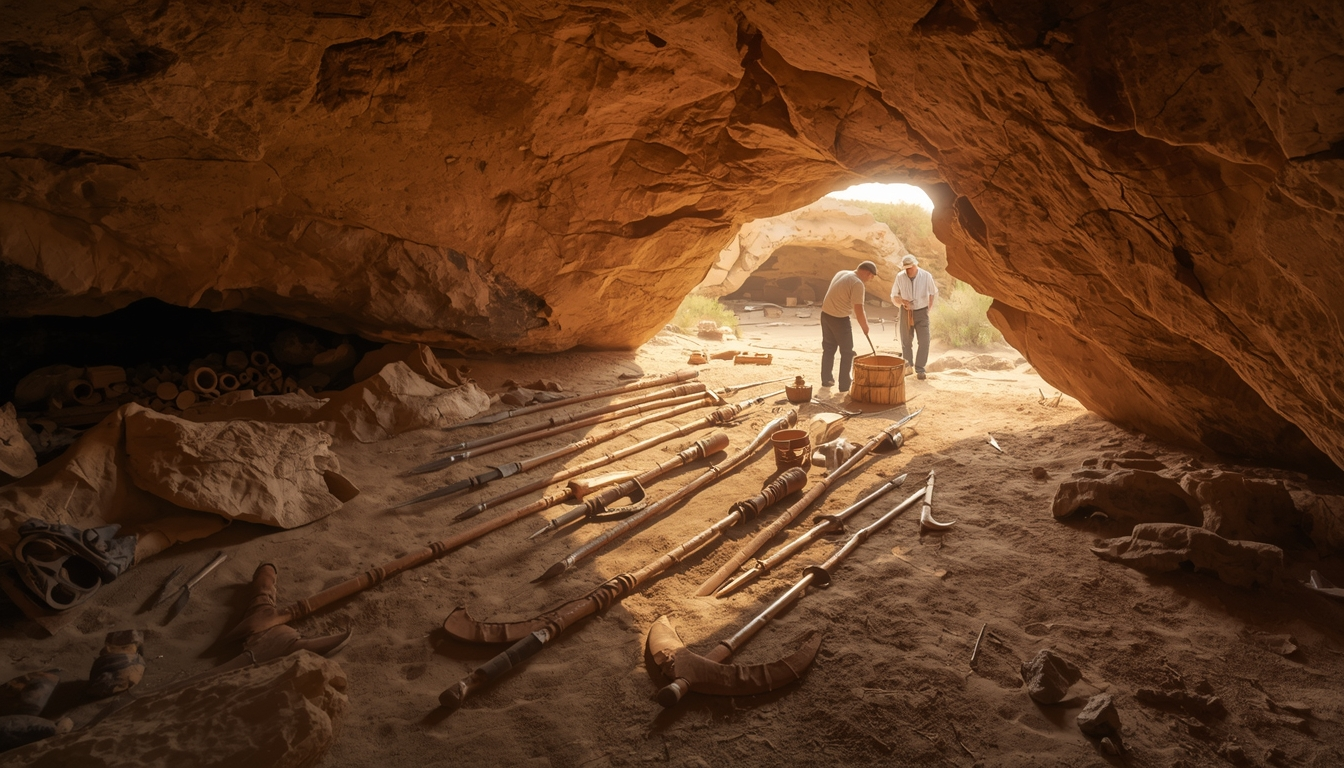
Deep in the rugged landscape of southern Texas, a prehistoric secret lay hidden in stone for thousands of years. Now, archaeologists working near the U.S.–Mexico border have uncovered a remarkably preserved collection of ancient hunting weapons — artifacts so intact that they are reshaping what we know about early life in North America.
The discovery was made at San Esteban, a natural rock shelter near the Rio Grande, inside Big Bend National Park. The site is considered one of the oldest continuously inhabited areas in the United States — and it’s still yielding extraordinary finds.
A Rare Glimpse Into Prehistoric Hunting
Excavations began in 2019 under the guidance of researchers from the Center for Big Bend Studies and the University of Kansas.
What they uncovered was nothing short of remarkable: leather-wrapped wooden shafts, carefully carved stone points, and hunting implements preserved by the dry cave environment for more than 6,000 years.
Among the standout artifacts was a finely crafted spear component designed to be used with an atlatl — a spear-throwing device that predates the bow and arrow. The atlatl acts as a lever, increasing both force and distance. Lighter than traditional spears yet devastatingly accurate, it allowed hunters to strike prey from distances of up to 50 meters.
The craftsmanship suggests a deep understanding of materials. Researchers believe the inhabitants possessed advanced knowledge of local plant life, possibly using botanical toxins to enhance the lethality of their weapons.
The Mystery of the Straight Boomerangs
Even more intriguing were several curved wooden objects resembling straight boomerangs.
Unlike the returning boomerangs commonly associated with Australia, straight boomerangs are designed to travel in a direct path. These tools were thrown to stun birds or small mammals, or to strike prey mid-run. Archaeological evidence shows that similar hunting weapons have existed for tens of thousands of years across different continents.
Aerodynamic analysis of the Texas specimens indicates they were not symbolic objects — they were practical, efficient hunting tools.
Their preservation is exceptional. Organic materials like wood and leather rarely survive this long, making this find particularly valuable to researchers.
Dating Back to 4,500 B.C.
Laboratory analysis and radiocarbon dating place the weapons around 4,500 B.C. — roughly 6,500 years ago.
However, the site itself is far older.
Evidence suggests human occupation at San Esteban may stretch back to the 11th millennium B.C., placing it among the earliest known inhabited locations in North America. The rock shelter likely served as a seasonal base, offering protection from harsh desert conditions while providing access to river resources.
Why This Discovery Matters
Well-preserved prehistoric weaponry is rare in North America, especially artifacts made from perishable materials. Stone tools are common; wooden shafts wrapped in leather are not.
This cache offers a rare, almost intimate look into daily survival strategies — how ancient communities hunted, engineered tools, and adapted to their environment.
It also challenges the lingering assumption that early North American societies relied on rudimentary technology. On the contrary, the San Esteban findings reveal precision craftsmanship, aerodynamic understanding, and material innovation thousands of years before written history.
Each excavation season continues to add pieces to a much larger puzzle: who these early inhabitants were, how they lived, and how they mastered a demanding landscape long before modern civilization emerged.
Sometimes, the most astonishing discoveries aren’t buried in gold — they’re wrapped in leather and waiting quietly in stone.