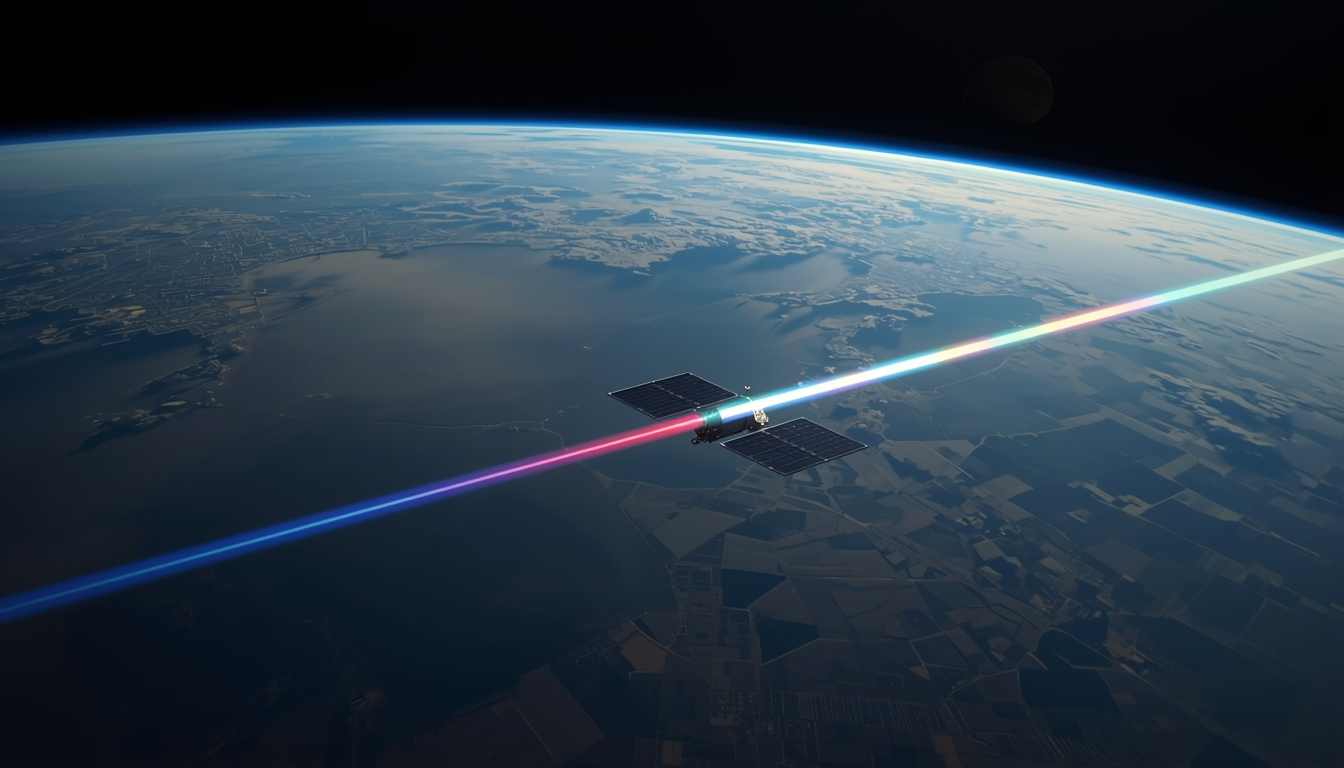
A routine satellite image over Texas has turned into one of the most intriguing orbital “photobombs” ever spotted on Google Earth.
An internet user browsing satellite imagery noticed something unusual: a streak of multicolored light slicing across the frame. It wasn’t a plane. It wasn’t a glitch. It appeared to be a satellite crossing directly in front of another satellite at the exact moment an image was being taken.
What looked like a digital artifact turned out to be a rare orbital encounter — one spacecraft accidentally capturing another in flight.
A Satellite Caught in the Act
The image was taken by a French Earth-observation satellite from the Pléiades constellation, operated by Airbus Defence and Space. These satellites provide the ultra-sharp imagery that feeds mapping services used by millions daily.
Unlike a simple snapshot from a phone camera, a Pléiades satellite captures multiple exposures in rapid succession across different spectral bands: blue, green, red, panchromatic, and near-infrared. Engineers later combine these layers to create a natural-looking composite image.
Normally, this process is invisible to users.
But when an object moves quickly across the field of view during that split-second sequence, each color band captures it in a slightly different position. When merged, the result is a rainbow-like streak.
That’s exactly what happened here.
Why the Colors Are Offset
We’ve occasionally seen airplanes appear in satellite imagery before. Commercial jets travel between 600 and 900 km/h — fast enough to shift slightly between exposures.
Satellites, however, move at staggering speeds. In low Earth orbit, they can exceed 27,000 km/h.
During the brief imaging sequence, the passing object traveled far enough to separate dramatically across color layers. The final composite shows the satellite as a stretched, multicolored trace — almost like a prism slicing through the sky.
Based on its structure and orbit, observers believe the object is part of the Starlink network developed by SpaceX.
Though not formally confirmed, its shape strongly resembles a fully deployed Starlink satellite, complete with extended solar panels spanning roughly 30 meters.
Why This Image Is So Rare
Capturing one satellite from another is extraordinarily unlikely.
Orbital mechanics are precise, and imaging windows are brief. For one spacecraft to pass directly between another and Earth at the exact moment of multi-band exposure requires remarkable timing.
Yet as low Earth orbit grows more crowded, such encounters may become less exceptional.
There are now more than 10,000 active satellites circling the planet. More than 7,000 of them belong to the Starlink constellation alone, operating at roughly 550 kilometers in altitude — below many high-resolution Earth-imaging satellites, which typically orbit between 600 and 800 kilometers.
This vertical stacking increases the probability of visual interference.
A Glimpse of a Crowded Future
Astronomers have already raised concerns about reflected sunlight from satellite megaconstellations contaminating observations from ground-based telescopes and even space observatories like the Hubble Space Telescope.
What this Texas image reveals is not just a coincidence — it’s evidence of a changing orbital landscape.
Low Earth orbit is transforming into a dense infrastructure layer for global communications. The more satellites we launch, the more visible they become — not only to astronomers but to each other.
The image accidentally preserved on Google Earth captures more than a satellite streaking past. It captures a moment in history: the shift from a relatively open orbital environment to one increasingly shaped by commercial megaconstellations.
What was meant to be a quiet photograph of Earth instead became a snapshot of humanity’s growing footprint in space.