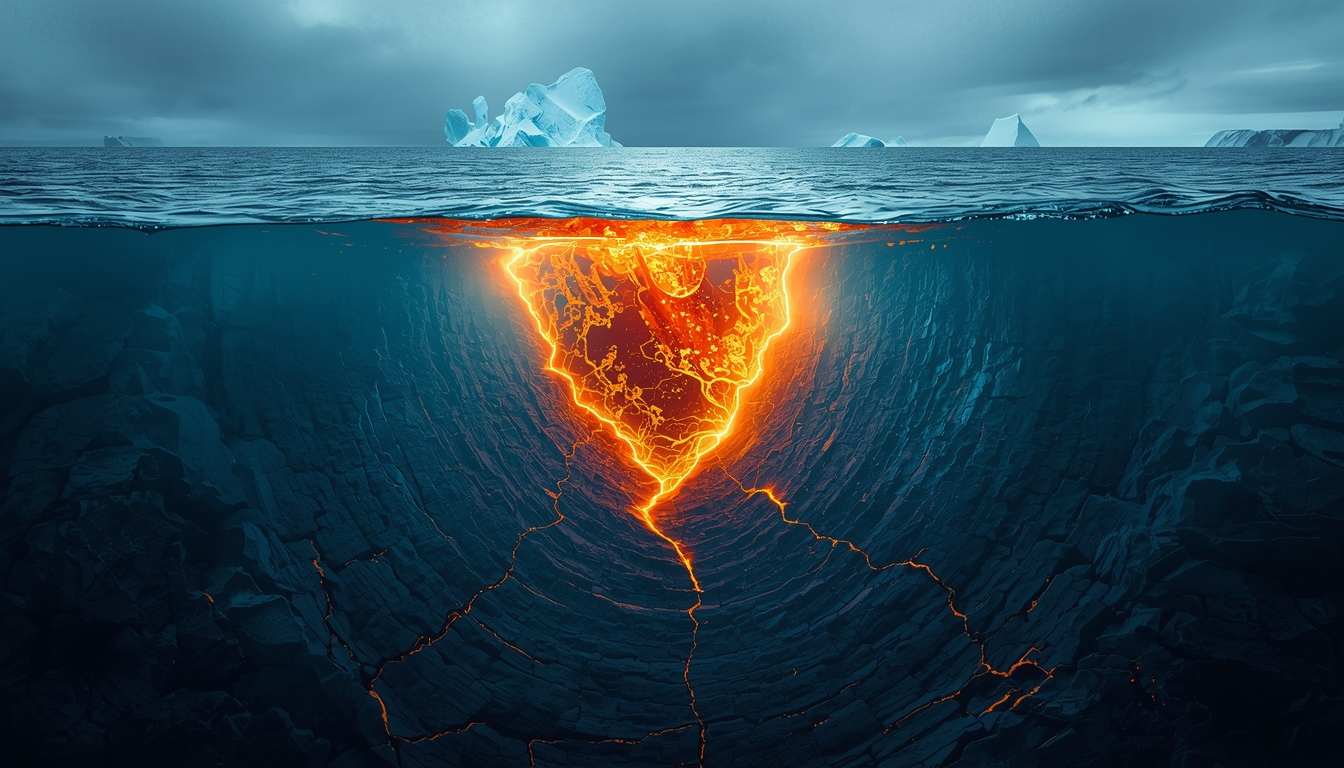
When it comes to climate solutions, the world has heard it all—carbon taxes, renewable energy transitions, direct air capture plants. But one proposal stands far outside conventional thinking: detonating a massive nuclear device beneath the ocean floor to accelerate carbon storage.
It sounds like science fiction. Yet the idea has been seriously explored by a researcher at the Rochester Institute of Technology, who argues that an extreme technological intervention could dramatically speed up one of Earth’s natural carbon-trapping processes.
The question is not just whether it could work—but whether it should even be considered.
The Logic Behind the Explosion
The concept builds on a real scientific mechanism known as enhanced rock weathering. Oceans already absorb a significant share of human-generated carbon dioxide. Part of that process happens when CO₂-rich seawater interacts with alkaline rocks like basalt, which are widespread across the ocean floor. Over time, chemical reactions transform dissolved carbon into stable carbonate minerals that remain locked in the seabed.
It’s slow—but it works.
The proposal suggests using an immense underground nuclear detonation to fracture vast quantities of basalt at once. By dramatically increasing the rock’s exposed surface area, the natural carbon-absorbing process could, in theory, accelerate on a massive scale.
To put numbers on it, the estimated explosive yield required would be around 81 gigatons of TNT equivalent—a figure that dwarfs even the largest nuclear device ever tested.
A Blast Unlike Any Before
For comparison, the most powerful nuclear weapon in history—the Tsar Bomba—had a yield of about 50 megatons. The proposed detonation would be roughly a thousand times more powerful.
The suggested location? Beneath the basalt-rich seabed of the Southern Ocean, specifically under the Kerguelen Plateau. The theory is that the immense water column above and the surrounding rock would contain most of the blast and trap much of the radioactive material locally.
Supporters of the concept argue that if humanity faces catastrophic climate tipping points, bold measures may become unavoidable. They frame the proposal as a last-resort planetary engineering strategy—one aimed at preventing far greater long-term harm.
The Scientific Doubts
Not everyone is convinced that enhanced rock weathering is as efficient as early models suggest. Some recent research points to complex geochemical limitations that may reduce how much carbon can realistically be locked away. Crushing or fracturing basalt does increase surface area, but mineral composition and reaction pathways can create bottlenecks.
There is also the deeper question of unintended consequences. Nuclear detonations, even underground ones, introduce radiation risks, seismic disturbances, and unpredictable ecological impacts—particularly in sensitive marine environments.
Beyond science lies geopolitics. International nuclear nonproliferation agreements exist for a reason. Authorizing such a detonation would require unprecedented global consensus, not to mention billions of dollars in funding.
Risk Versus Risk
Advocates of radical geoengineering often frame the debate as a comparison of dangers. Climate change is already intensifying extreme weather, accelerating sea-level rise, and threatening biodiversity worldwide. Economic estimates place the long-term cost of unchecked warming in the tens of trillions of dollars.
Against that backdrop, proponents argue that a contained deep-sea explosion affecting a limited geographic area could represent a smaller overall risk.
Critics counter that introducing nuclear detonations into climate strategy could normalize hazardous technological shortcuts—and potentially distract from the urgent need to reduce emissions at their source.
A Symptom of Climate Desperation?
Perhaps the most striking aspect of this proposal is not its technical detail but what it represents. As global temperatures climb and mitigation efforts lag, increasingly extreme solutions are entering mainstream scientific discussion.
The idea of detonating a nuclear device under the ocean floor forces a sobering realization: humanity is searching for planetary-scale fixes because planetary-scale damage is already underway.
Whether this particular strategy remains theoretical or sparks deeper research, it highlights a growing tension in climate policy—between transforming how we live and attempting to engineer our way out of the crisis.
One thing is certain: proposals like this ensure that the debate over climate intervention is far from over.