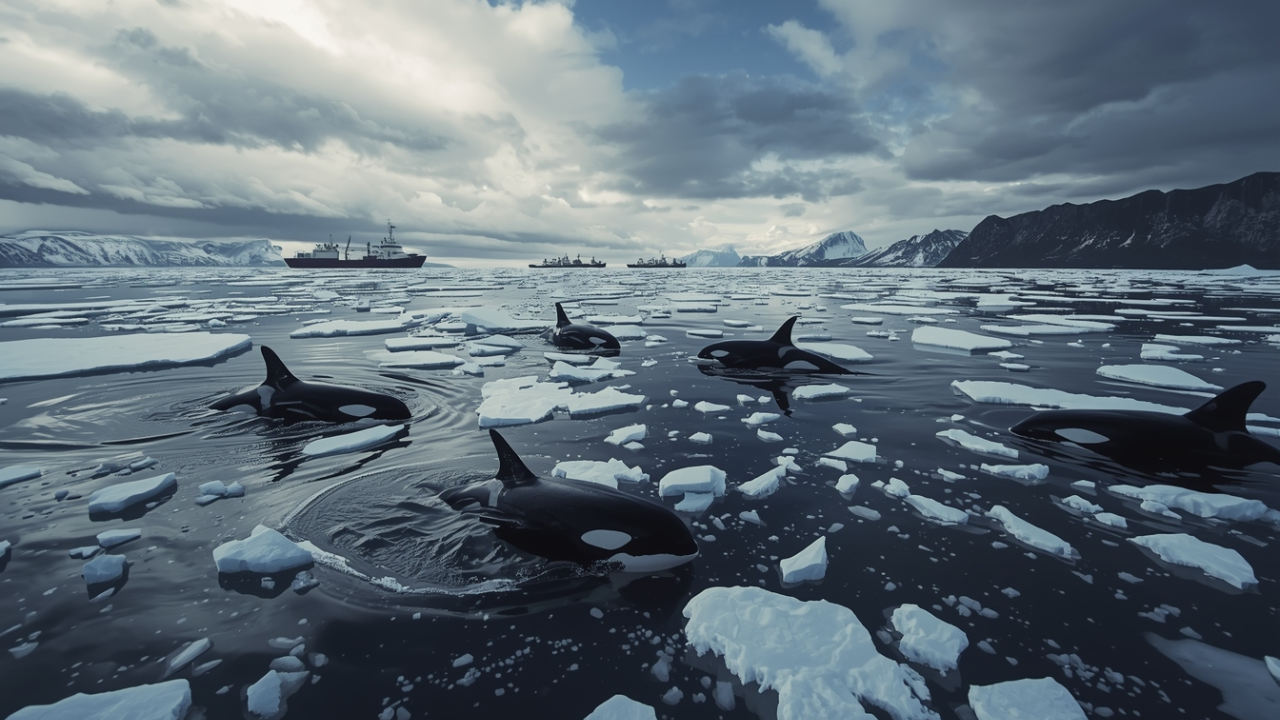
The first dorsal fin appeared just after 3 a.m., slicing through calm Arctic water under a sky that never fully turns dark this far north. On the Nuuk harbor dock, a few fishermen paused mid-conversation, their steaming coffee forgotten in their hands. They leaned forward, squinting toward the shimmering horizon..
Not just a single pod, but an entire procession of black-and-white predators gliding along the fractured ice edge. Only a decade ago, this stretch of water was sealed under thick, unbroken ice. Now, it looks like a floating puzzle of drifting floes and open channels — and the orcas are moving through it like they belong there.
By midday, videos showing orcas chasing halibut through broken ice spread rapidly across social media. The excitement was immediate. Fishermen began talking about record catches and booming opportunities. Meanwhile, climate activists gathered along the shoreline, raising banners demanding emergency fishing restrictions. Hours later, Greenland’s government officially declared a state of emergency, warning of “exceptional marine disruption.”
One ocean, three different futures colliding at once.
A New Arctic Frontier Emerging
From the deck of a small fishing vessel off western Greenland, the sea no longer feels quiet or predictable. Instead, it appears restless — full of sudden movements and shifting ecosystems. Veteran fishermen say they have never witnessed such frequent orca sightings near the coast.
The once-solid ice sheet that separated human fishing zones from whale feeding territories has fractured dramatically. Today, the Arctic sea resembles a mosaic of floating ice pieces, slush, and open water pathways.
For local fishing crews, the transformation has created access to waters that were previously unreachable. For orcas, it has opened an entirely new hunting territory. For scientists, however, it signals a dramatic environmental shift that could permanently reshape Arctic ecosystems.
Marine biologist Ane Petersen, who has monitored orca movements for more than a decade, describes the sudden population surge as alarming. Previously, orca encounters were rare enough to track manually. Today, they require complex data mapping and satellite monitoring.
According to Petersen, orcas are closely following the retreating ice line. Satellite maps now display clusters of sightings along Greenland’s shrinking ice edge, almost outlining the geography of climate change in real time.
Fishing Boom Raises Complex Questions
Local fishermen have quickly noticed a direct impact. Orcas are pushing large schools of fish such as cod and halibut toward coastal waters, making them easier to catch. Many fishing crews report their heaviest catches in years, sparking what some are calling an unexpected “Arctic gold rush.”
For younger fishing captains, the current season has brought unprecedented financial relief. After years of declining stocks and rising fuel costs, some fishermen describe this as the best economic opportunity of their careers. Yet even among those celebrating record hauls, there is an uneasy awareness of what might be causing the surge.
Warmer water temperatures and collapsing ice layers are reorganizing the entire marine food chain. Krill and smaller fish species migrate into newly open waters, followed by larger predators — eventually attracting apex hunters like orcas.
Scientists warn that this shift is not simply about increased whale activity. Instead, it indicates a fundamental ecological transformation that could destabilize long-term fish populations.
Activists Demand Urgent Restrictions
While fishing communities celebrate short-term economic gains, environmental activists are raising urgent warnings. On docks and coastal fences, protest signs now demand strict fishing bans in areas where orcas are heavily feeding.
Many activists are local residents themselves, deeply connected to Greenland’s fishing culture. Their concern is not opposition to fishing but fear of ecological collapse. Climate researchers have repeatedly warned that once fish populations decline beyond recovery thresholds, rebuilding them can take decades — if recovery happens at all.
The government’s emergency declaration has unlocked crisis funding and expanded environmental monitoring. However, it has also intensified pressure on fishermen who fear losing their livelihoods through sudden regulations.
Officials now face a difficult balancing act. Greenland’s coastal communities have depended on fishing for centuries, making marine resources both cultural and economic lifelines. At the same time, ignoring ecological warnings could trigger long-term environmental and financial disasters.
The Science Behind Orca Migration
Researchers explain the phenomenon through a simple but alarming chain reaction. Reduced ice cover allows more sunlight to penetrate Arctic waters, encouraging plankton growth. This attracts small fish, which in turn draw larger species. Orcas, as apex predators, follow this expanding food network.
Historically, dense ice layers blocked orca access to Greenland’s inner fjords. Today, open channels allow them to travel deeper into coastal ecosystems. Scientists believe this new hunting pattern may significantly alter seal populations, fish migration routes, and predator-prey relationships across the Arctic.
Experts emphasize that ecosystems rarely return to their original state once such changes occur. Instead, new biological balances emerge, often unpredictable and sometimes fragile.
Government Measures and Emergency Planning
Greenland’s Marine Research Institute has begun dividing coastal waters into management zones. Areas with intense orca feeding activity are being marked for temporary fishing restrictions. These zones aim to protect vulnerable fish populations during peak migration periods.
Authorities are also developing shared monitoring platforms where fishermen, scientists, and environmental groups can report orca sightings and unusual catch patterns. Patrol vessels have been deployed to track marine activity and enforce emergency regulations.
Financial transition funds are being discussed to support fishermen affected by potential fishing bans. These funds may help crews temporarily suspend operations or invest in sustainable fishing technologies.
However, many fishermen remain skeptical. Some fear international fleets could exploit protected areas in the future, while others worry their children may lose traditional fishing careers altogether.
Communities Divided Yet United by Fear
Public meetings across coastal towns have revealed emotional divisions between environmental advocates and fishing communities. Yet beneath the disagreements lies a shared concern about the Arctic’s uncertain future.
In one community discussion, a young climate activist argued that immediate fishing restrictions are necessary to prevent irreversible damage. A veteran fisherman responded by asking how families would survive if fishing suddenly stopped.
Their debate captured Greenland’s broader dilemma. Economic survival and environmental sustainability are no longer separate conversations — they are now deeply interconnected.
A Global Warning from the Arctic
Standing along Greenland’s melting coastline, the scale of climate transformation feels overwhelming. Orcas swimming through waters that should still be frozen illustrate how quickly ecosystems can shift.
What happens next in Greenland may influence global climate response strategies. Policymakers, scientists, and fishing communities worldwide are watching closely. The Arctic is often considered an early warning system for climate change, revealing environmental shifts long before they become visible elsewhere.
The central question remains difficult but unavoidable: How much can humanity take from nature while ecosystems are already under stress?
Greenland’s unfolding crisis shows that climate change is no longer a distant prediction. It is reshaping economies, wildlife behavior, and community survival in real time. The choices made in these fragile Arctic waters could help determine how societies worldwide respond to a warming planet.
Key Takeaways
Orcas Follow Melting Ice
Retreating ice is opening new hunting grounds, bringing orcas closer to coastal ecosystems.
Fishing Boom Comes with Risk
Record catches may signal ecological imbalance rather than long-term prosperity.
Debate Over Fishing Bans Intensifies
Balancing economic survival with environmental protection remains Greenland’s biggest challenge.
FAQ
Are orcas appearing more frequently near Greenland?
Yes, scientists confirm that orca sightings have increased significantly due to melting sea ice and shifting food chains.
What does the state of emergency mean for residents?
It allows emergency funding, increased environmental monitoring, and potential fishing restrictions in affected regions.
Why do fishermen call this a gold rush?
Orcas are pushing fish closer to shore, leading to unusually high catch rates and temporary economic gains.
Why are activists demanding fishing bans?
They fear overfishing during ecological shifts could permanently damage marine ecosystems.
Could this happen elsewhere?
Yes, similar climate-driven marine changes are already being observed in parts of the Antarctic and northern Atlantic regions.