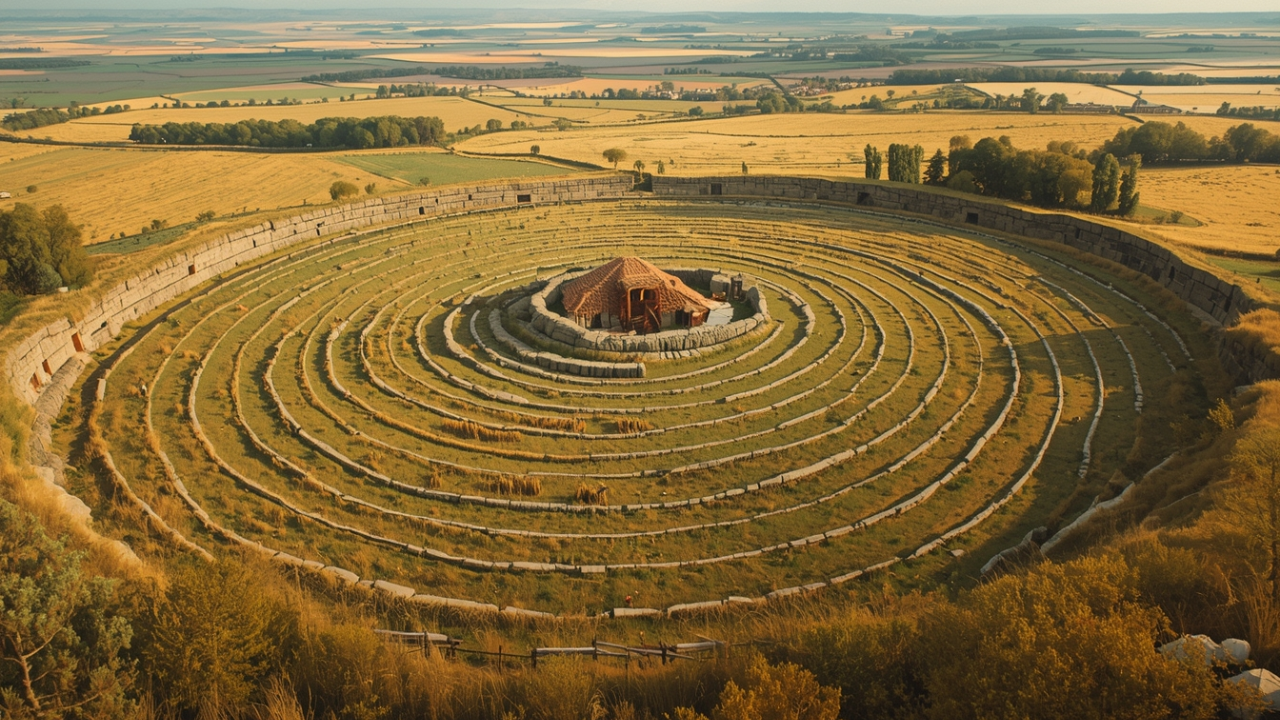
For generations, history books have taught that the world’s first cities emerged in ancient Mesopotamia, between the Tigris and Euphrates rivers. However, new archaeological research is challenging that long-standing belief. Evidence from a large prehistoric settlement in present-day Ukraine suggests that urban life may have developed earlier and in a completely different form than previously thought.
Recent excavations linked to the Cucuteni–Trypillia culture are forcing historians to reconsider how and where cities first appeared. These findings reveal that large, carefully planned communities may have existed in Eastern Europe thousands of years before classic Mesopotamian urban centers fully developed.
A Forgotten Ukrainian Site Is Changing Ancient History
In central Ukraine, archaeologists have been studying a massive prehistoric settlement that was first discovered more than 50 years ago. Early excavations revealed large clusters of burned houses and unusual pottery, but researchers initially struggled to understand the site’s importance.
Modern dating techniques, satellite mapping, and advanced excavation tools have now revealed the true scale of these settlements. Some archaeologists believe they represent one of humanity’s earliest experiments with city living, possibly predating well-known urban centers in Mesopotamia by several centuries.
The settlement is part of the Cucuteni–Trypillia culture, which existed between approximately 5400 BCE and 2700 BCE across modern Ukraine, Moldova, and Romania. Instead of scattered farming villages, this culture built enormous, densely populated communities.
Challenging the Mesopotamian “Cradle of Cities”
For decades, the concept of early urban civilization has been closely linked with cities like Uruk in ancient Mesopotamia. These cities displayed many features associated with urban development, including monumental temples, administrative systems, and early forms of writing.
However, discoveries in Eastern Europe suggest that city development may not have followed a single path. Instead, different societies around the world may have independently experimented with large, organized settlements.
The Ukrainian mega-settlements show evidence of advanced planning. Houses were built in standardized sizes, streets followed recognizable patterns, and communities expanded in organized layouts over generations. These characteristics strongly suggest structured social organization, which is considered a key feature of urban life.
Inside the Massive Trypillia Settlements
Planned Cities on the Steppe
The Trypillia settlements were not random clusters of homes. Archaeologists discovered a distinct design pattern repeated across multiple sites. Houses were typically arranged in circular or spiral formations, surrounding central open spaces used for communal activities.
Some key characteristics of these settlements include:
- Area: Certain sites covered between 250 and 300 hectares
- Population: Estimated between 5,000 and 20,000 residents
- Housing: Standard rectangular buildings, often two stories high
- Economy: Farming, livestock raising, and craft production
These population sizes placed the settlements among the largest known human communities of their time, rivaling early Mesopotamian cities.
The Mystery of the Burned Houses
One of the most unusual features of Trypillia settlements is the repeated evidence of intentionally burned buildings. Archaeologists have found that many houses were deliberately set on fire at the end of their use.
Researchers debate the purpose of this practice. Some believe it was part of religious or ritual traditions marking the end of a building’s life. Others suggest burning helped maintain settlement organization by clearing space for reconstruction.
Regardless of the reason, this recurring pattern suggests strong communal decision-making and shared cultural traditions.
A Different Type of Early City
When researchers compare Trypillia settlements with Mesopotamian cities, they notice important differences. Mesopotamian cities featured clear signs of social hierarchy, including temples, palaces, and administrative bureaucracy.
Trypillia settlements, on the other hand, show fewer signs of centralized political authority. Instead of monumental buildings or royal tombs, archaeological evidence suggests a more community-focused social structure.
Comparison Between Early Urban Models
| Feature | Mesopotamian Cities | Trypillia Settlements |
|---|---|---|
| Monumental structures | Temples and palaces | Large houses and shared spaces |
| Writing systems | Present | No confirmed writing |
| Settlement layout | Dense city centers, often fortified | Circular or spiral patterns, mostly unfortified |
| Social structure | Strong hierarchical elites | More community-based organization |
These differences suggest that urban development did not follow a single universal model. Instead, early societies developed unique approaches to organizing large populations.
Rethinking the Concept of the First City
Modern archaeologists increasingly view urbanization as a gradual process rather than a sudden “urban revolution.” The idea that cities originated exclusively in one region is being replaced by a broader perspective showing multiple independent experiments with large-scale human settlement.
Evidence from Eastern Europe, the Near East, South Asia, and East Asia suggests that urban life developed in several locations simultaneously, shaped by local environmental conditions and cultural practices.
How Large Communities Thrived Without Writing
Today, cities are often associated with written laws, records, and bureaucratic systems. However, Trypillia settlements demonstrate that complex social organization can exist without written communication.
Large populations can coordinate through shared traditions, oral agreements, and cultural rituals. Anthropologists often compare this to temporary modern settlements such as festivals or refugee camps, where thousands of people live together with structured organization despite minimal documentation.
This challenges traditional assumptions that writing is essential for urban civilization.
Why These Discoveries Matter Today
The Trypillia findings reshape how historians understand Europe’s role in early civilization. Rather than simply adopting urban ideas from the Near East, Eastern European societies may have developed their own sophisticated community systems thousands of years earlier.
These discoveries also provide valuable lessons for modern city planning. The ring-shaped settlement design may have helped reduce fire spread and promoted shared public spaces. Researchers studying sustainable urban development are increasingly interested in how early communities managed large populations using local resources and cooperative social systems.
Archaeology Faces Modern Challenges
Despite the importance of these discoveries, much of the Trypillia archaeological record remains buried beneath modern farmland. Political instability and regional conflicts also threaten preservation efforts.
Advances in satellite imaging, geophysical surveys, and improved dating methods are helping researchers map these ancient settlements more accurately. As new sites are uncovered, historians expect further evidence supporting the idea that early cities developed across multiple regions.
Conclusion
The growing body of evidence from Ukraine suggests that the story of urban civilization is far more complex than previously believed. The Cucuteni–Trypillia mega-settlements reveal that large, organized human communities may have emerged in Eastern Europe alongside, or even before, the famous cities of Mesopotamia.
Rather than a single birthplace of cities, human history may reflect a network of early societies experimenting with new ways of living together. These discoveries not only rewrite ancient history but also provide valuable insights into how communities can develop sustainable and cooperative urban environments in the future.