In a groundbreaking engineering development, construction has officially started on a massive underwater rail tunnel designed to connect entire continents through deep-sea infrastructure. What once sounded like futuristic science fiction is now slowly transforming into a real-world transportation revolution.
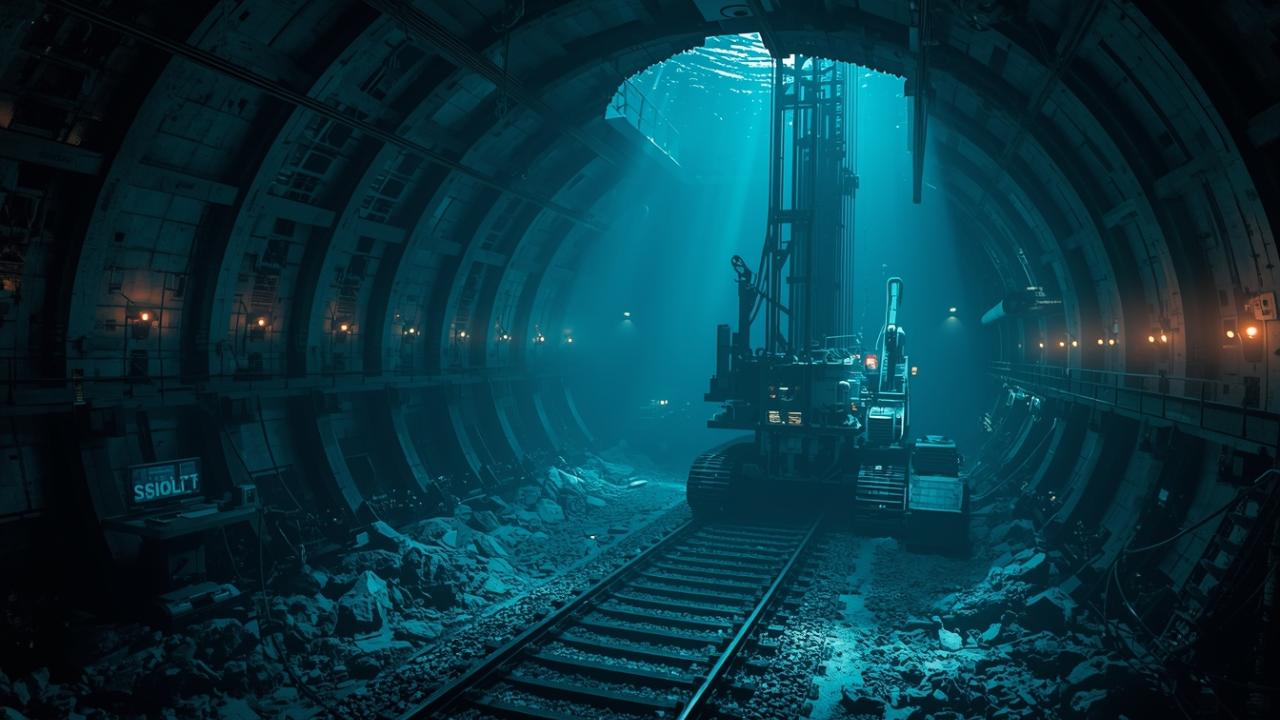
Far beneath the surface of the Atlantic Ocean, massive drilling machines are actively shaping the ocean floor to lay the foundation for this ambitious project. Engineers and technicians operate in pressure-controlled command stations, monitoring advanced equipment that is slowly carving tunnels thousands of meters below sea level.
While the ocean above appears calm and silent, below lies one of the most complex construction projects ever attempted by humanity.
From Concept to Reality: How the Underwater Rail Vision Was Born
Like many revolutionary ideas, this project began as a theoretical concept. Early planning sessions involved engineers exploring whether it would be possible to physically connect continents through underground rail corridors.
Today, those early sketches have evolved into fully designed and partially constructed tunnel segments, marking a significant milestone in global infrastructure development.
Currently, engineers are focusing on a pilot section spanning approximately 60 kilometers of twin-bore tunnels positioned along deep-sea continental shelves. These tunnel sections are constructed on land before being transported offshore and carefully placed on pre-prepared seabed routes.
Each tunnel segment is enormous — roughly the length of a football field — and weighs thousands of tons. Specialized robotic systems join and seal these sections, ensuring structural stability in extreme underwater conditions.
How Engineers Are Building Rail Lines at the Ocean Floor
Constructing an underwater railway thousands of meters below sea level requires extraordinary precision and advanced engineering techniques. Surprisingly, much of the process begins on land before shifting operations to the ocean.
Step-by-Step Construction Process
1. Land-Based Manufacturing
Massive reinforced concrete tunnel sections are created at coastal shipyards. These segments include:
- Steel-reinforced pressure-resistant shells
- Built-in railway tracks and vibration dampers
- Emergency evacuation passages
- Insulated layers to handle extreme temperature and pressure changes
2. Offshore Transportation
Once completed, these hollow tunnel capsules are sealed and transported using large tugboats to designated construction zones in the ocean.
3. Controlled Submersion
Engineers carefully flood the tunnel sections to sink them into trenches previously carved into the seabed by specialized dredging ships.
4. Robotic Assembly
Advanced underwater robots and remotely operated vehicles align, weld, and seal each segment with extreme precision, ensuring long-term durability.
Despite advanced automation, engineers continue conducting manual inspections and emergency simulations to minimize long-term risks such as leaks or structural failures.
Why the Underwater Rail Tunnel Could Transform Global Travel
The primary objective of this project is to drastically reduce long-distance travel times between continents. Engineers believe that underwater high-speed rail corridors could allow passengers to travel between major global hubs in under six hours.
Potential Passenger Benefits
- Reduced travel time compared to long-haul flights
- Comfortable overnight journeys similar to luxury train travel
- Stable connectivity including high-speed internet
- Reduced airport congestion and flight delays
Instead of navigating airports and time-zone fatigue, travelers could board evening trains and arrive on another continent by morning.
The Hidden Logistics Revolution: Freight Transportation
While passenger travel captures headlines, cargo transportation may experience the most significant transformation. The tunnel will include dedicated freight corridors designed to move shipping containers at near high-speed rail efficiency.
Economic Advantages
- Faster global supply chain movement
- Reduced dependence on long ocean freight routes
- Development of new logistics hubs near coastal rail interchanges
- Job creation and infrastructure growth in connected cities
However, regions that are not integrated into the main rail network could face economic disadvantages, potentially increasing regional inequality.
Environmental Concerns Surrounding Deep-Sea Construction
Despite its technological promise, the underwater rail project raises significant environmental concerns. Marine scientists and environmental engineers are actively monitoring the project’s impact on deep-sea ecosystems.
Environmental Monitoring Measures
- Tracking underwater noise levels affecting marine species
- Controlling sediment disturbance during seabed excavation
- Limiting artificial lighting to protect deep-sea habitats
- Implementing strict waste disposal regulations
- Conducting emergency environmental risk simulations
Project teams have also incorporated independent scientific oversight to ensure construction meets environmental safety standards.
Experts emphasize that building infrastructure within ocean environments requires long-term ecological responsibility and careful monitoring.
Safety Challenges of Building in Extreme Ocean Depths
Constructing infrastructure between 1,000 to 4,000 meters below sea level presents unique challenges. Engineers must account for:
- Intense water pressure
- Geological instability
- Long-distance maintenance accessibility
- Structural durability for decades of continuous operation
To address these risks, the tunnel includes multiple redundant safety systems, emergency escape routes, and continuous monitoring technology.
How This Project Could Change Humanity’s Relationship with Oceans
For centuries, oceans have served as natural barriers separating continents. This underwater rail project represents a significant psychological and technological shift, turning ocean floors into global transportation corridors.
Some experts view this development as a historic advancement similar to the construction of transcontinental railways. Others express concern that expanding infrastructure into untouched marine environments could permanently alter fragile ecosystems.
Both perspectives highlight the project’s global significance.
When Could Underwater Rail Travel Become Reality?
Although construction has begun, large-scale intercontinental rail connectivity remains a long-term project. Current projections suggest the first operational corridors could become available by the 2040s, depending on construction progress and regulatory approvals.
Key Project Highlights
| Key Point | Details | Reader Benefit |
|---|---|---|
| Construction Status | Pilot underwater tunnel sections under active construction | Confirms project feasibility |
| Engineering Method | Modular tunnel segments built on land and assembled underwater | Simplifies understanding of complex construction |
| Travel Impact | Potential intercontinental travel in under six hours | Highlights future transportation benefits |
| Economic Influence | Faster freight movement and logistics expansion | Explains global economic advantages |
| Environmental Focus | Continuous monitoring of marine ecosystems | Demonstrates sustainability considerations |
Frequently Asked Questions (FAQs)
1. Is the underwater rail tunnel project officially under construction?
Yes, engineers have begun constructing pilot sections of the tunnel, with several segments already assembled on the ocean floor.
2. How deep will the tunnel be located?
Most sections will be constructed at depths ranging between 1,000 and 4,000 meters, depending on ocean geography and safety considerations.
3. Will passengers be able to see the ocean during travel?
No. The railway will operate inside sealed pressure-resistant tunnels, providing a travel experience similar to modern high-speed trains.
4. Is underwater rail travel safer than flying?
The project aims to achieve safety standards comparable to high-speed rail networks, including multiple emergency and monitoring systems.
5. When will commercial underwater rail services begin?
Initial passenger services are expected to become operational sometime in the 2040s, depending on project completion timelines.
Conclusion
The construction of a deep-sea underwater rail tunnel marks a historic milestone in global transportation and engineering innovation. By potentially connecting continents through high-speed rail infrastructure, the project could reshape international travel, global trade, and economic development.
However, alongside technological progress comes environmental responsibility and long-term safety challenges. The success of this ambitious project will depend on balancing infrastructure expansion with sustainable ocean preservation.
As construction progresses, the underwater rail tunnel may redefine how humanity travels across the planet, transforming oceans from natural barriers into interconnected transportation networks.