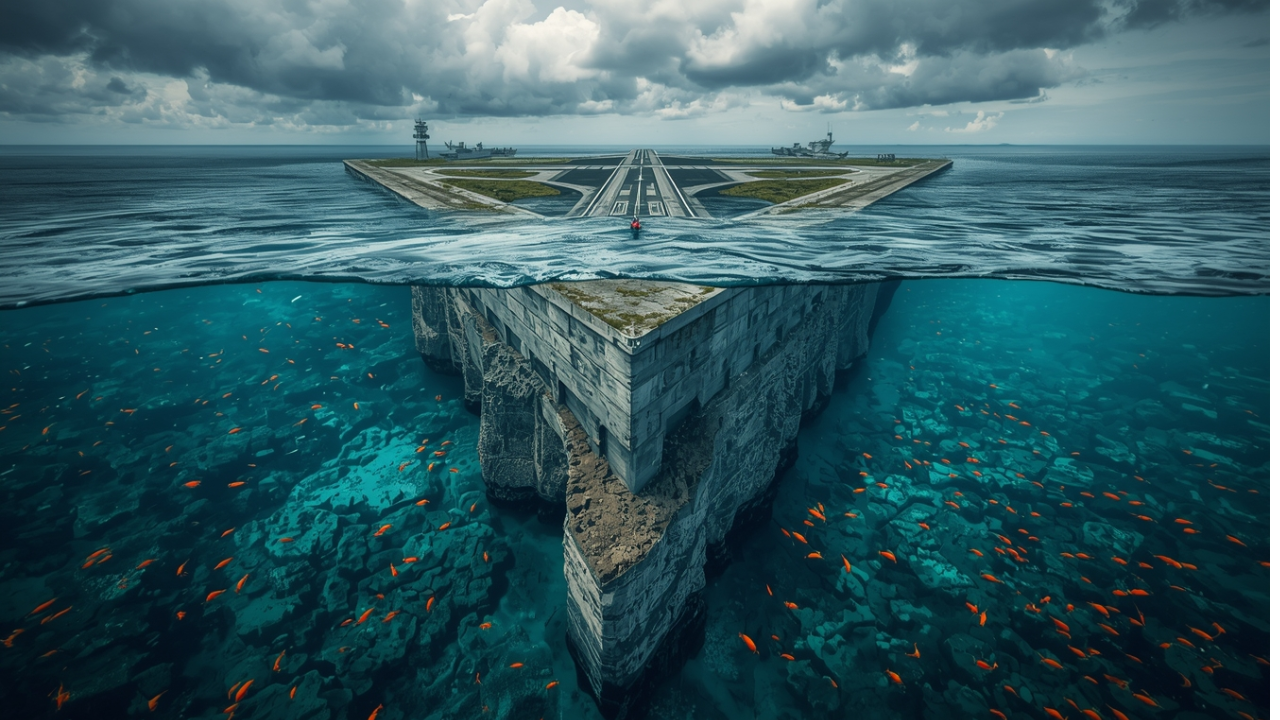
At low tide, parts of the South China Sea look deceptively peaceful. From above, turquoise water glimmers around pale rings of coral that once sat quietly beneath the waves. But today, some of those rings no longer belong to nature.
They have been reshaped into military-grade islands — complete with runways, radar towers, docks, and fortified defense systems.
Ships now move cautiously around these artificial strongholds. Fishermen who once sheltered near coral reefs must avoid restricted military zones. And perhaps the most unsettling part of this transformation is not just how fast it happened — but how little resistance it faced globally.
From Living Coral Reefs to Strategic Military Bases
Fiery Cross Reef Transformation
Over the past decade, several reefs in the South China Sea have been dramatically altered. One of the most prominent examples is Fiery Cross Reef.
Once a shallow coral formation barely visible during high tide, it has now been expanded into a massive artificial island featuring a 3,000-meter runway, aircraft hangars, radar installations, and missile defense systems.
Similar construction patterns have occurred on Subi Reef and Mischief Reef, transforming fragile ecosystems into heavily fortified maritime outposts.
This transformation follows a simple but effective geopolitical strategy:
- Occupy disputed territory
- Expand physical infrastructure
- Establish military and logistical presence
- Strengthen territorial claims through permanent construction
These artificial islands now allow rapid military deployment across one of the world’s most critical maritime trade routes.
Why These Islands Matter Strategically
The South China Sea is not just a regional waterway. It is one of the busiest global shipping corridors, carrying trillions of dollars in trade annually. Control over this region provides enormous economic and military advantages.
Artificial island bases allow extended aircraft range, surveillance capabilities, and naval deployment flexibility. From these locations, military forces can monitor or potentially influence regional shipping and defense operations.
For neighboring countries such as Vietnam, the Philippines, and Malaysia, these developments raise significant territorial and security concerns.
How Artificial Islands Are Built
China’s island-building projects rely on large-scale dredging operations. Specialized vessels extract sand and coral sediment from the seabed and deposit it onto reef structures.
Once the reef surface rises above sea level, engineers construct sea walls, roads, airfields, and defense infrastructure. Within months, previously submerged ecosystems become permanent land structures.
By the time international concerns gain attention, construction is often too advanced to reverse.
The Environmental Cost Beneath the Concrete
Coral Reef Destruction and Marine Habitat Loss
Coral reefs are among the most biodiverse ecosystems on Earth. They support fish populations, protect coastlines, and contribute to global marine health.
Dredging operations destroy reef structures that took centuries to develop. Sediment clouds suffocate marine life, while habitat loss disrupts breeding and feeding cycles for numerous species.
Marine researchers warn that coral destruction in disputed regions may cause long-term damage to regional fisheries and ocean biodiversity.
For coastal fishing communities, reef destruction directly impacts food supply and economic survival.
Why Global Response Has Been Limited
Several countries and international organizations have protested the construction, and a 2016 international arbitration ruling rejected China’s broad territorial claims in the South China Sea.
However, enforcement remains challenging.
Economic partnerships, trade relationships, and diplomatic priorities often prevent stronger international action. Many nations rely on stable economic relations with China, making aggressive responses politically and financially complicated.
Experts suggest this has allowed gradual normalization of artificial island militarization.
A Strategy Built on Speed and Global Distraction
Observers often describe the construction strategy as “build first, negotiate later.” By rapidly completing infrastructure, artificial islands become established realities before diplomatic processes can influence outcomes.
Other common tactics include:
- Presenting facilities as civilian research or maritime safety centers initially
- Gradually introducing military equipment afterward
- Framing development as defensive rather than expansionist
- Relying on global political divisions to limit coordinated opposition
This slow but consistent strategy has shifted maritime control dynamics across the region.
How Local Communities Are Affected
While geopolitical discussions dominate headlines, local fishermen experience direct consequences. Traditional fishing grounds have become restricted zones, forcing longer travel distances and increased operational costs.
Marine scientists returning to long-studied reef locations sometimes discover military installations replacing research sites entirely.
For coastal populations, these changes affect livelihoods, food security, and cultural traditions tied to the ocean.
What This Means for Future Ocean Governance
The expansion of artificial islands raises complex questions about international maritime law and environmental protection. If similar strategies spread globally, territorial disputes could increasingly involve physical environmental transformation rather than diplomatic negotiation alone.
Global maritime policies may eventually need stronger enforcement mechanisms to protect fragile marine ecosystems from geopolitical competition.
Why This Issue Matters Beyond Regional Politics
Although these events occur in distant waters, their impact extends worldwide. The South China Sea influences global shipping efficiency, seafood supply chains, and environmental sustainability.
The transformation of coral reefs into military installations highlights broader concerns about balancing economic development, national security, and environmental preservation.
It also demonstrates how technological capability can reshape geography faster than international law can respond.
Key Takeaways
- Several South China Sea coral reefs have been transformed into artificial military islands
- These installations strengthen strategic maritime control and surveillance capabilities
- Coral reef destruction has severe environmental and economic consequences
- International protests have struggled to halt construction
- Artificial island expansion may influence future global territorial disputes
Frequently Asked Questions
What does turning reefs into concrete fortresses involve?
It involves dredging sand onto reefs to create artificial land, followed by construction of military and logistical infrastructure.
Why are these islands strategically important?
They allow extended military presence, improved surveillance, and control over major global shipping routes.
Did international courts oppose these claims?
Yes. A 2016 arbitration ruling rejected several territorial claims, but enforcement remains limited.
How do artificial islands affect marine ecosystems?
Dredging destroys coral habitats, reduces biodiversity, and disrupts regional fishing industries.
Can global communities influence this issue?
Supporting marine conservation policies and sustainable seafood practices can indirectly reduce environmental pressure on ocean ecosystems.