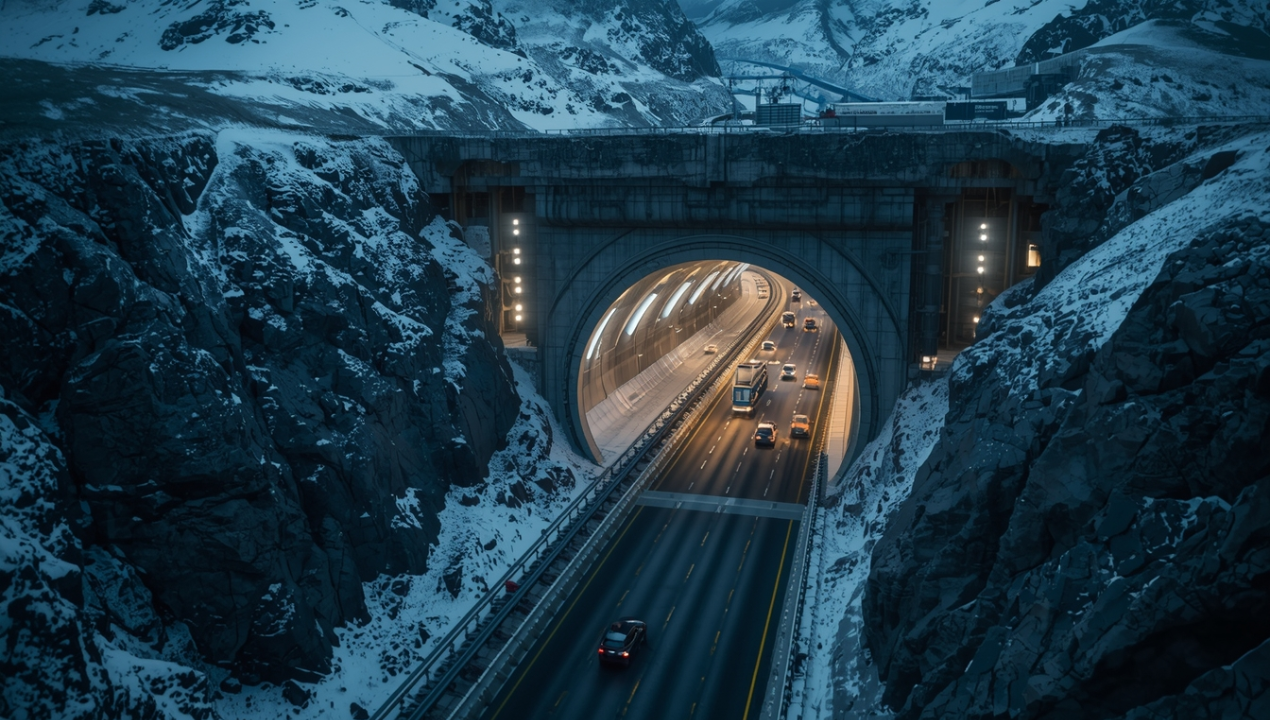
Deep beneath one of Asia’s most challenging mountain ranges, China has completed a massive underground highway tunnel that is rewriting transportation possibilities in the region. Hidden under the harsh terrain of the Tian Shan mountains in Xinjiang, this enormous structure is not just another infrastructure project — it represents a major leap in engineering, logistics, and regional connectivity.
Stretching an astonishing 22.13 kilometers, the Tianshan Shengli Tunnel is now recognized as the longest operational highway tunnel in the world, marking another milestone in China’s growing list of mega construction achievements.
But beyond the record-breaking numbers, this tunnel is expected to transform daily travel, boost trade networks, and reshape how remote regions connect with economic hubs.
A Record-Breaking Highway Beneath the Mountains
The Tianshan Shengli Tunnel forms a crucial section of the Ürümqi–Yuli expressway, linking northern and southern Xinjiang through the towering Tian Shan mountain range. Historically, this mountainous barrier forced drivers to navigate long, dangerous routes exposed to heavy snowfall, landslides, and extreme weather.
Now, what once required several hours of risky travel can be completed in just 20 minutes.
For long-distance drivers, emergency responders, and freight companies, this time reduction changes how transportation works across the region. Deliveries become more reliable, emergency medical transport becomes faster, and commuters gain easier access between cities.
The tunnel includes two separate traffic tubes, each carrying two lanes, allowing smooth traffic flow in both directions. Engineers also installed multiple emergency passages between the tunnels to improve safety during accidents or evacuations.
Advanced ventilation systems regulate air quality, while thousands of sensors constantly monitor temperature, smoke levels, traffic movement, and geological stability inside the tunnel.
Engineering in One of the Harshest Natural Environments
Constructing a tunnel under the Tian Shan mountains was far from simple. The region is known for extreme climate conditions, including freezing temperatures, unstable permafrost layers, and unpredictable groundwater movements.
These environmental challenges often cause severe risks during deep tunnel construction. Sudden rock pressure shifts or water leakage can destabilize excavation work.
To overcome these challenges, China deployed advanced geological monitoring technologies alongside large engineering teams. Tunnel boring machines equipped with high-precision radar systems helped detect weak rock zones before excavation progressed further.
Instead of relying solely on heavy drilling, engineers closely monitored how the surrounding mountain responded to excavation. This method allowed teams to adjust support structures, waterproofing layers, and drainage systems in real time.
The project also used automated machinery and machine-learning models to predict potential rock deformation, improving construction accuracy and safety.
Smart Technology Powers Modern Tunnel Safety
Unlike older tunnels built decades ago, the Tianshan Shengli Tunnel relies heavily on digital monitoring systems. A central control room operates around the clock, analyzing data from thousands of sensors placed throughout the structure.
Operators can instantly adjust ventilation airflow, control traffic movement, or activate emergency response protocols when necessary.
Smart lighting systems also help reduce driver fatigue by adjusting brightness levels based on traffic density and time of day. These features ensure safer driving conditions, especially during long underground journeys.
Transforming Xinjiang’s Connectivity
For decades, Xinjiang remained geographically isolated due to its vast deserts, mountains, and limited infrastructure. Travel between northern and southern parts of the region often required lengthy detours or seasonal road closures.
The Tianshan Shengli Tunnel dramatically reduces travel barriers. Shorter journey times improve access to healthcare, education, and employment opportunities for residents.
Businesses also benefit from improved logistics efficiency. Freight companies can now maintain predictable delivery schedules, helping industries such as agriculture, manufacturing, and e-commerce expand operations.
New commercial hubs, warehouses, and distribution centers are expected to develop near major highway connections created by the tunnel.
Economic and Political Importance of the Project
The tunnel also holds strategic importance beyond regional transportation. It strengthens China’s long-term development plans for Xinjiang by improving trade routes and economic integration with the rest of the country.
Improved transportation encourages tourism, trade expansion, and workforce mobility. However, experts note that mega infrastructure projects sometimes raise concerns about environmental impact and long-term economic balance.
Large construction activities in fragile mountain ecosystems may disrupt groundwater flow, wildlife migration, and local vegetation. Chinese authorities argue that concentrating traffic within tunnels could reduce road-related landslides and decrease fuel consumption caused by steep mountain driving.
The real environmental impact will become clearer over time through monitoring and environmental audits.
A Key Link in China’s Global Trade Strategy
The Tianshan Shengli Tunnel also supports China’s Belt and Road Initiative, which aims to strengthen trade connections across Asia and Europe. Xinjiang serves as a major gateway connecting Chinese transport networks with Central Asian countries.
The new tunnel improves highway reliability, complementing railway freight systems already operating in the region. Faster and more flexible transportation routes allow exporters to reduce shipping delays and diversify supply chains.
For international logistics companies, the tunnel offers a valuable alternative to sea-based shipping routes that may face geopolitical or weather-related disruptions.
How the Tunnel Compares Globally
With its 22.13-kilometer length, the Tianshan Shengli Tunnel currently leads the world among operational highway tunnels. However, Norway’s Rogfast project, expected to open in the future, may eventually surpass it in size.
Still, tunnel performance cannot be measured by length alone. Geological difficulty, safety technology, and traffic management systems all play critical roles in evaluating infrastructure success.
China’s achievement demonstrates its increasing ability to execute complex engineering projects in extreme environments.
What It Means for Drivers and Freight Transport
Driving through a tunnel that stretches over 22 kilometers is a unique experience. Engineers carefully designed visual guidance systems to prevent driver anxiety or fatigue during the underground journey.
Emergency exits, firefighting systems, and strict vehicle safety regulations help reduce risks associated with heavy traffic or hazardous cargo transportation.
Freight companies may need to follow additional rules such as speed limits and spacing requirements, ensuring safer travel conditions inside the tunnel.
A Blueprint for Future Infrastructure Projects
The technologies and construction methods used in the Tianshan Shengli Tunnel are likely to influence future infrastructure developments worldwide. Countries with mountainous terrain, including Pakistan, Iran, and Turkey, are already exploring similar engineering collaborations.
However, maintaining such massive infrastructure will require long-term investment in safety inspections, repair work, and environmental monitoring.
For Xinjiang residents, the tunnel represents more than a construction milestone. It shortens travel distances, expands economic opportunities, and improves daily mobility across the region.
For global engineers and policymakers, it showcases how modern infrastructure can reshape geography, economies, and political connectivity.
Key Highlights
| Feature | Details |
|---|---|
| Tunnel Name | Tianshan Shengli Tunnel |
| Location | Xinjiang, China |
| Length | 22.13 Kilometers |
| Travel Time Reduction | Hours reduced to approximately 20 minutes |
| Structure | Dual tunnel tubes with two lanes each |
| Safety Features | Advanced sensors, ventilation systems, emergency passages |
| Strategic Importance | Supports Belt and Road Initiative and regional economic growth |