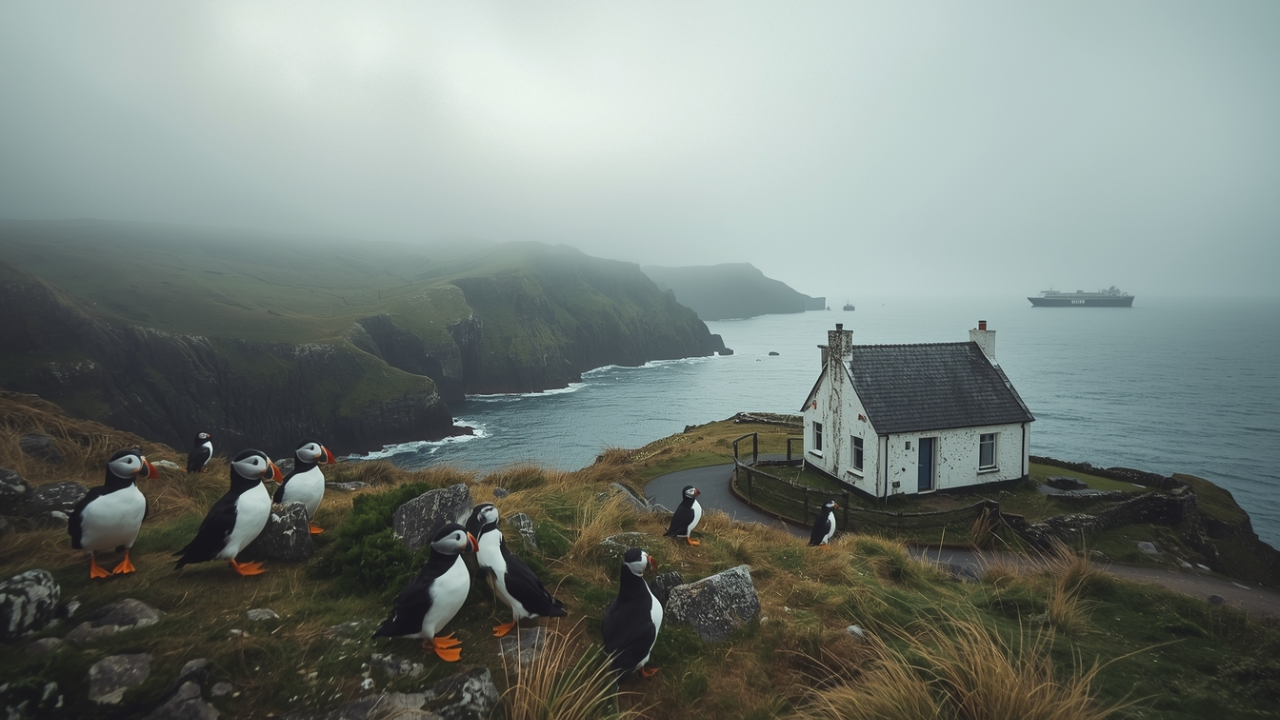
The ferry slices through dull, pewter-coloured water as the mainland fades into mist. A few passengers lean on the rail, wrapped in that half-awake quiet unique to early mornings at sea. Someone points toward the horizon — a dark fin breaks the surface before vanishing again.
Another passenger grips a printed job advert, reading it for the fifth time.
Six months on a remote Scottish island.
Free housing.
Around €5,000 a month, once pay and allowances are counted.
No traffic lights. No shopping centres. Just cliffs, seabirds, and the occasional whale passing offshore.
As the signal drops to zero on your phone and the island rises ahead — green, rough, unexpectedly inviting — a flicker of panic appears.
What if this isn’t a fantasy?
What if it’s a door?
Yes, the offer is real — and it exists for a reason
Stories like this sound like clickbait, but they’re rooted in real recruitment drives across remote parts of Scotland, particularly in the Hebrides and Orkney.
Small island communities face a simple but serious problem: people leave, schools shrink, ferries lose passengers, and essential services become harder to justify. To counter that, local councils and community trusts do something unusual.
They invest directly in people.
Recent adverts have sought seasonal wardens, conservation workers, and community support staff willing to live on-island for a fixed period — often around six months. The roles are hands-on: wildlife monitoring, visitor management, maintaining paths, helping run community facilities.
The incentive is strong because the commitment is real.
Pay, once salary and allowances are combined, can reach the equivalent of €5,000 a month, and housing is often provided rent-free — a small stone cottage or converted staff accommodation close to the sea.
You don’t visit.
You move in.
Why the internet can’t stop talking about it
When one of these adverts circulates, it spreads fast.
Office workers forward it “as a joke,” then quietly bookmark it. Freelancers imagine trading sirens for seabirds. Burnt-out professionals picture logging off to the sound of waves instead of notifications.
For a few days, it feels like a shared daydream — the kind nobody quite dares to say out loud.
But the offers aren’t accidents. Remote islands sit on a fragile balance: spectacular nature on one side, demographic decline on the other. Paying well and providing housing isn’t generosity — it’s survival strategy.
The island gives you money and a roof.
You give it your time, skills, and presence.
What daily life actually looks like
The brochure image is easy: tea by the window, puffins bobbing like wind-up toys on the cliffs, stars thick enough to feel close.
Reality is richer — and rougher.
A typical day might include checking storm-damaged footpaths, logging bird counts in drizzle, answering the same wide-eyed tourist questions, and doing a shift in the tiny community shop. Waterproofs never fully dry. Wind has opinions.
Then, suddenly, magic interrupts everything.
Someone shouts from the pier — a whale offshore. Within minutes, half the island is there, hands shading eyes, scanning grey water. For a few seconds, the world shrinks to a dark shape moving just beneath the surface.
Then everyone goes back to work.
Out here, wonder doesn’t cancel responsibility. It lives alongside it.
The salary isn’t a prize — it’s compensation
€5,000 a month sounds like freedom. In practice, it reflects what you give up.
You’ll be far from major hospitals, late-night shops, and reliable high-speed internet. Ferries shape your social life and your emergencies. Storms can decide your plans more often than your calendar.
Community life is intense. On an island of a few hundred people, you’re visible. If you withdraw, it’s noticed. If you help, it’s remembered. Some people feel more seen in six months here than in a decade in a city.
Others realise that what they mistook for peace also comes with echoes they weren’t ready to hear.
How to know if this is actually for you
Before applying, try a small honesty test.
Write out an ordinary island day, hour by hour — not the Instagram version. Include bad weather, limited shops, shared gossip, and the reality of missing the last ferry.
If reading it back makes you feel quietly excited rather than trapped, you might be a good fit.
Many people dream of disappearing. Then they arrive and discover the opposite happens — you become more visible. Names are known by week two. Your mood shows. Your effort matters.
As one former island warden put it:
“People come for the puffins and the whales. They stay — or come back — for the people and the silence between storms.”
Practical advice from those who’ve done it
- Ask locals before “improving” anything — they’ve likely tried it already
- Bring serious waterproofs, not city raincoats
- Learn a few words of Scots Gaelic; small efforts go a long way
- Bring hobbies that don’t need Wi-Fi: knitting, sketching, journaling, fixing things
- Accept that sometimes the sea, not your schedule, decides
Treat the island as a living place, not a backdrop, and it slowly opens itself to you.
Why this idea grips us right now
Being paid well, housed for free, and placed at the edge of the map speaks to something deep in our overstimulated lives. It’s an escape — but a structured one. Still a job. Still responsibility. Just wrapped in a slower world where the biggest news might be the season’s first puffin or a whale sighting before lunch.
It turns vague burnout into a concrete possibility: six months, not forever.
You can almost feel your hand hovering over the application button.
Key Takeaways
| Point | Detail | Why it matters |
|---|---|---|
| Pay + housing | Around €5,000/month equivalent with rent-free accommodation | Shows the offer is financially serious |
| Wildlife immersion | Puffins, seals, whales, dramatic coastlines | Sets realistic expectations beyond photos |
| Community reality | Small, tight-knit societies where attitude counts | Helps you judge personal fit honestly |
FAQ
Is the €5,000 a month figure real?
Yes — it usually combines salary and allowances from official job adverts. Exact amounts vary by role.
What kind of jobs are these?
Mostly fixed-term roles in conservation, wardening, tourism support, or community services.
Can I bring family or pets?
It depends on housing availability and wildlife rules. Many roles are single-occupancy.
Will I have reliable internet?
Connectivity can be slow and weather-dependent. Light remote work may be possible, but not guaranteed.
What happens after six months?
Most contracts end then. Some people extend or seek long-term options, but that requires separate arrangements.