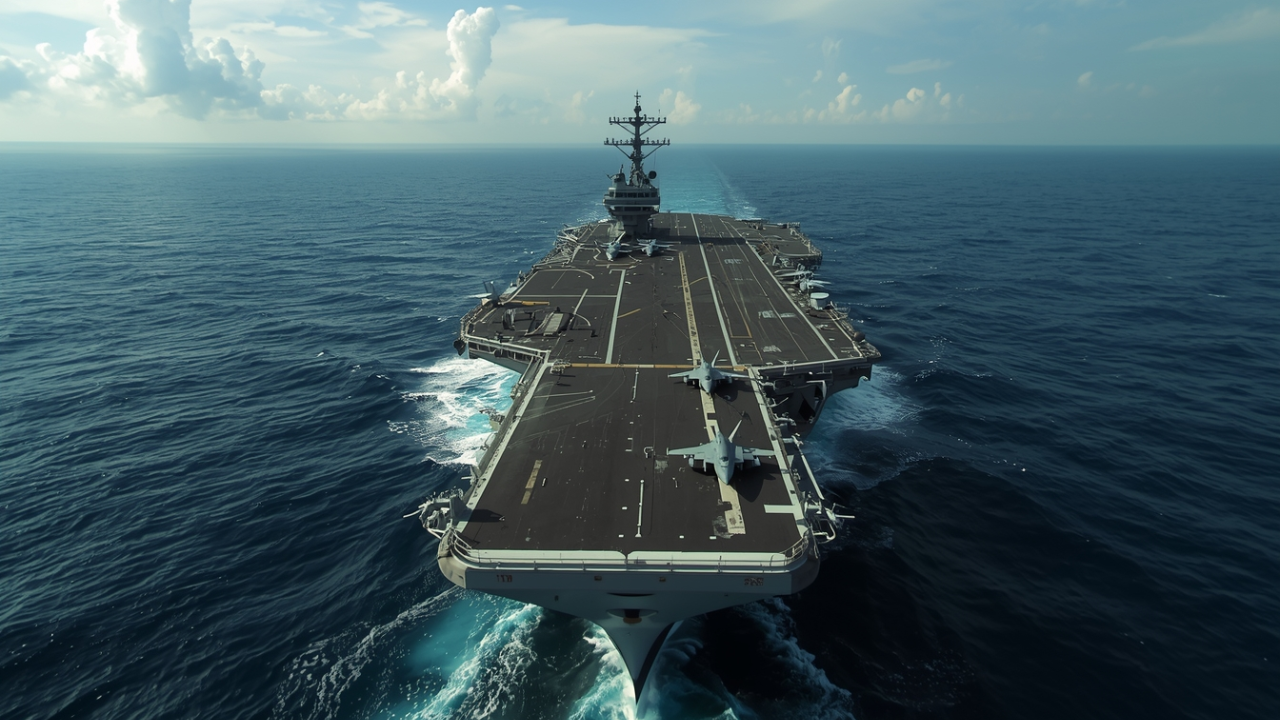
At first glance, it looks less like a ship and more like a moving city.
Steel stretches to the horizon, aircraft crowd the deck like parked birds of prey, and thousands of people live and work within a structure that never truly sleeps. At 337 metres long and weighing around 100,000 tonnes, the largest aircraft carrier ever built represents the absolute edge of modern naval engineering.
This is not just a warship.
It is a floating airbase, a nuclear-powered stronghold, and a global symbol of military reach.
The floating city that carries an air force
Aircraft carriers exist for one central reason: to project power far from home.
Rather than relying on overseas air bases and diplomatic permissions, a carrier brings its own runway, fuel supply, maintenance crews, and command centre directly to the sea. Wherever it sails, air power follows.
The concept is more than a century old. In 1910, a fragile aircraft took off from the deck of the USS Birmingham, proving for the first time that planes and ships could work together. What began as an experiment reshaped warfare across two world wars and the Cold War.
Today, that idea has reached its most extreme expression.
Meet the giant: USS Gerald R. Ford
Commissioned in 2017 after more than a decade of construction, the USS Gerald R. Ford is the lead ship of a new generation of American supercarriers. Built at a cost of roughly $13 billion, it is the largest warship ever deployed.
The scale is difficult to visualise:
- Length: 337 metres — longer than the height of the Eiffel Tower
- Flight deck width: about 78 metres
- Displacement: roughly 100,000 tonnes
- Top speed: around 30 knots (≈55 km/h)
Despite its mass, nuclear propulsion allows the ship to move rapidly between regions without refuelling for years at a time.
A small town at sea
During operations, nearly 4,500 people live aboard the carrier.
Pilots, engineers, deck crews, doctors, cooks, IT specialists, intelligence officers — all operate on rotating shifts that keep the ship active 24 hours a day. Beneath the flight deck are workshops, hospitals, storage areas, command centres, and living quarters designed for deployments lasting months.
In every practical sense, the ship functions like a medium-sized town — one that happens to launch fighter jets.
How many aircraft can the largest carrier carry?
The true power of a carrier lies not in its size, but in what it can put into the air.
USS Gerald R. Ford is designed to operate close to 90 aircraft, including:
- Fighter jets such as F/A-18 Super Hornets
- Future F-35C stealth fighters
- Electronic warfare aircraft
- Airborne early-warning planes
- Helicopters for transport, rescue, and anti-submarine missions
For comparison, France’s flagship carrier, the Charles de Gaulle, typically carries around 40 aircraft and a crew of about 1,900. Substantial by European standards — but less than half the scale of the American supercarrier.
Why aircraft carriers matter strategically
A carrier rarely sails alone. It is usually surrounded by destroyers, frigates, submarines, and supply ships, forming a carrier strike group capable of defence, surveillance, and sustained combat operations.
This mobility changes strategic calculations. A carrier can move into international waters near a crisis zone, launch aircraft within hours, and operate without relying on local infrastructure.
In military terms, an aircraft carrier is less a single vessel and more the hub of an entire naval ecosystem.
Technology built for relentless operations
The Ford-class introduces systems designed to increase the tempo of flight operations:
- Electromagnetic catapults replace steam systems, launching aircraft more smoothly and frequently
- Advanced arresting gear reduces stress on planes and pilots during landings
- Modern reactors generate vast electrical power for sensors, weapons, and future upgrades
These changes aim to increase sortie rates while lowering long-term maintenance demands.
A ship designed to stay at sea for decades
Because it is nuclear-powered, USS Gerald R. Ford does not need traditional fuel refuelling for many years. Only food, spare parts, and aviation fuel are replenished during deployments.
Its internal layout reflects that endurance: medical bays, desalination systems, repair facilities, and storage areas allow the ship to remain operational across multiple regions without returning home.
Key specifications at a glance
| Feature | USS Gerald R. Ford |
|---|---|
| Length | 337 m |
| Flight deck width | ≈78 m |
| Displacement | ≈100,000 tonnes |
| Speed | ≈30 knots (≈55 km/h) |
| Crew capacity | ≈4,500 people |
| Aircraft capacity | ≈90 |
From engineering marvel to political signal
When an American carrier appears near a coastline, it sends an unmistakable message. Allies often see reassurance. Rivals take notice.
At the same time, these ships face criticism. Their cost is immense, and modern threats — including hypersonic missiles and advanced submarines — raise questions about vulnerability. The same size that makes the carrier impressive also makes it impossible to hide.
Supporters argue that no other platform combines mobility, air power, endurance, and humanitarian capacity in a single vessel.
What this scale means in real situations
In a regional crisis with limited air bases, a carrier like USS Gerald R. Ford can position itself offshore and begin continuous air operations within days. Fighters patrol, surveillance aircraft gather intelligence, and helicopters stand ready for rescue or evacuation.
The same capabilities can shift to humanitarian roles. After natural disasters, carriers have provided fresh water, medical care, and airlift support — using systems originally designed for war.
For nations without carriers, understanding them still matters. Their presence can reshape regional balance, influence trade routes, and alter diplomatic calculations.
One ship on the horizon may look distant — but with 337 metres of steel, thousands of people aboard, and nearly 90 aircraft ready to launch, it quietly redefines what power at sea really means.