The drill judders, then suddenly goes still.
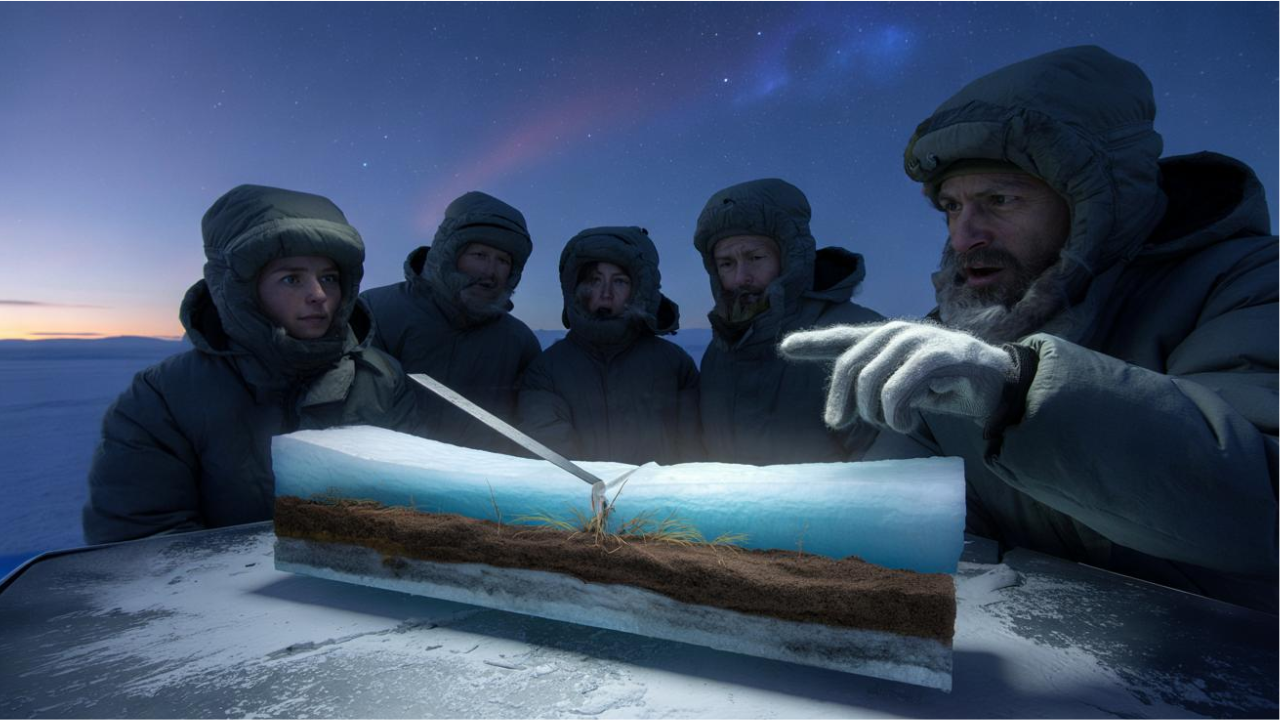
Inside a cramped field lab on the Antarctic plateau, a small group of scientists gathers around a steel cylinder freshly hauled from the ice. Frost crystals cling to its surface. Parkas brush together. Breath hangs in the air. Someone steadies the core with gloved hands that shake just enough to give the moment away.
Outside, the wind howls across a white landscape that feels eternal.
Inside, they are about to open a piece of Earth that has not seen daylight for 34 million years.
A blade slides along the core. The ice splits cleanly — and then it ends.
What appears beneath is mud. Dark, layered, unmistakably real soil.
That’s when the room goes silent.
A world beneath the ice that should not exist
More than two kilometers below East Antarctica, the ice gives way to something no one expected to find intact: clear evidence of a long-lost ecosystem.
Not scattered debris. Not random sediment.
But finely layered soil containing fossil pollen, ancient spores, microscopic remains of plants, and even faint impressions left by roots. Signs of streams. Wet ground. Vegetation.
This wasn’t a frozen desert.
It was once a living landscape.
The core itself wasn’t large — barely the length of a forearm — yet it functioned like a sealed message from another Earth. One that existed before Antarctica became synonymous with ice.
How scientists stumbled onto the buried world
The discovery began at Dome C, one of the coldest and most isolated places on the planet. An international research team had gone there to do something seemingly routine: drill deep ice cores to reconstruct ancient climates.
But radar surveys hinted at something strange beneath the deepest ice — a layer that reflected signals differently than solid bedrock.
When the drill finally reached it, the resistance changed.
Instead of grinding against rock, the bit slipped into something softer.
That transition — from ice to sediment — marked the boundary between the modern frozen continent and a world that had vanished tens of millions of years ago.
What the mud revealed in the lab
Back in ultra-clean laboratories far from Antarctica, scientists sliced the sediment millimeter by millimeter. Under microscopes, a remarkable story emerged.
They found pollen from plants that cannot survive in extreme cold. Traces of wetlands. Evidence of flowing water. Chemical signatures of soils that form only when land is exposed to air, rain, and biological activity.
Using radiometric dating and molecular analysis, the team pinned the age of this buried landscape to around 34 million years ago — precisely when Antarctica crossed a climatic tipping point.
The core captures the exact moment when an entire continent changed fate.
When Antarctica flipped from green to white
To understand how a forest ended up under kilometers of ice, you have to rewind Earth’s climate.
Thirty-four million years ago, Antarctica sat roughly where it does today, but the planet was warmer. Ocean currents flowed freely around the continent. There was no permanent ice sheet smothering the land.
Then tectonic shifts opened deep ocean passages, allowing a powerful ring of cold water — the Antarctic Circumpolar Current — to encircle the continent.
That current acted like a thermal moat.
Antarctica cooled rapidly.
The sediment core records this transformation in chilling detail. Layers rich in plant material fade away. Signs of flowing water vanish. Crushed rock fragments appear — the calling card of advancing glaciers.
The change wasn’t instant. It unfolded step by step. But once it began, it became self-reinforcing.
Ice reflected sunlight. Cooling intensified. More ice formed.
The lost world was sealed away.
Why this ancient collapse matters now
This discovery is not just a geological curiosity.
It is a stress test for modern climate models.
If scientists can accurately reproduce how Antarctica froze 34 million years ago — including how fast ice expanded once CO₂ levels dropped — they gain confidence in predictions about how today’s ice sheets may respond as temperatures rise.
The sediment suggests something unsettling: ice sheets do not always respond slowly. Once certain thresholds are crossed, change can accelerate — and then lock in for millions of years.
The physics driving that ancient shift is the same physics quietly operating today.
From a buried forest to modern coastlines
Understanding when Antarctica last held forests helps scientists estimate how sensitive ice sheets are to small temperature changes. Those estimates feed directly into sea-level projections that affect cities worldwide — from Mumbai to Miami, Amsterdam to Kolkata.
Researchers combine this Antarctic data with ancient shorelines, coral records, and deep-sea cores to reconstruct past sea levels. Each layer improves forecasts used by urban planners, insurers, and governments.
This isn’t abstract science. It shapes where homes can be built, which neighborhoods face long-term flood risk, and how societies plan for the next century.
A slower story than headlines — and more dangerous
Climate news often feels overwhelming: charts, deadlines, catastrophe language. The Antarctic core tells a quieter story.
A world didn’t disappear in a single disaster.
It faded through small, compounding changes.
That’s the uncomfortable parallel.
The lesson isn’t that “Earth always changes.” It’s that Earth can lock into radically different states for unimaginably long periods — and the transition can begin with shifts that feel manageable at the time.
One glaciologist put it bluntly:
“Antarctica is speaking to us from 34 million years ago. The question is whether we’re listening — or just scrolling past.”
How to think about this discovery
- Think in centuries, not headlines
Climate decisions echo far beyond election cycles. - Use stories, not just numbers
A buried forest makes future loss tangible. - Connect remote science to daily life
This data feeds into flood maps, insurance costs, and housing security. - Avoid all-or-nothing thinking
The lost world vanished gradually. Every fraction of a degree matters.
A mirror under the ice, pointed at us
There’s something deeply unsettling about knowing that an entire living landscape can vanish — and yet remain perfectly preserved, waiting for a drill bit to uncover it.
The Antarctic core is both archive and warning.
It doesn’t tell us exactly how many centimeters the sea will rise by 2100. What it shows instead is more fundamental: the climate system has levers, and when they’re pulled far enough, continents are reshaped.
The lost world beneath Antarctica isn’t only about what scientists uncovered.
It’s about what kind of world we are slowly locking in — through choices that still feel ordinary when we make them.
Key Takeaways
| Key Point | Detail | Why It Matters |
|---|---|---|
| Antarctica was once green | Soil, pollen, and root traces found beneath ice | Shows the continent is dynamic, not eternally frozen |
| Ice sheets can change fast | Sediment records rapid transition to ice | Warns of threshold-driven climate shifts |
| Past informs future | Ancient data calibrates climate models | Improves sea-level and risk predictions |
FAQ
Did scientists really find a “lost world” under Antarctic ice?
They uncovered ancient soil and microscopic fossils beneath two kilometers of ice, showing the area was once a vegetated landscape.
How old is this buried environment?
Dating points to around 34 million years ago, during Antarctica’s transition to a permanently ice-covered continent.
Why does this matter for climate change today?
It reveals how ice sheets respond to CO₂ and temperature thresholds, improving predictions for future sea-level rise.
Does this mean climate change is just natural?
No. Earth has changed naturally, but today’s warming is far faster and driven by human greenhouse gas emissions.
Will more hidden landscapes be found?
Very likely. Radar surveys suggest many preserved terrains beneath Antarctic ice, with future drilling already planned.