What was meant to be a bold leap into London’s digital future has become a cautionary tale about how the smallest design decisions can undo the biggest ambitions. Beneath some of the busiest streets in Europe, a silent enemy has been at work — teeth first, balance sheets later.
Rats, it turns out, were not impressed by glossy investor decks or promises of gigabit speeds. They simply found parts of the network edible.
When rodents finish what debt started
London-based G.Network once positioned itself as a disruptor. The company promised to blanket parts of the capital with ultra-fast full-fibre broadband, challenging bigger incumbents by moving quickly and digging less.
To do that, it borrowed heavily. By the time market conditions tightened, reports suggested the firm was carrying close to £300 million in debt, with around 25,000 customers still connected to its network.
As pressure mounted, management began looking for a buyer — someone willing to take on the customers, the cables, and the long-term infrastructure play. On paper, the prize looked attractive. A ready-made fibre footprint in London is gold dust.
That’s when Community Fibre entered the picture.
Due diligence uncovers a gnawed-away network
Community Fibre began the usual acquisition checks: technical surveys, asset reviews, cost modelling. Very quickly, something alarming surfaced.
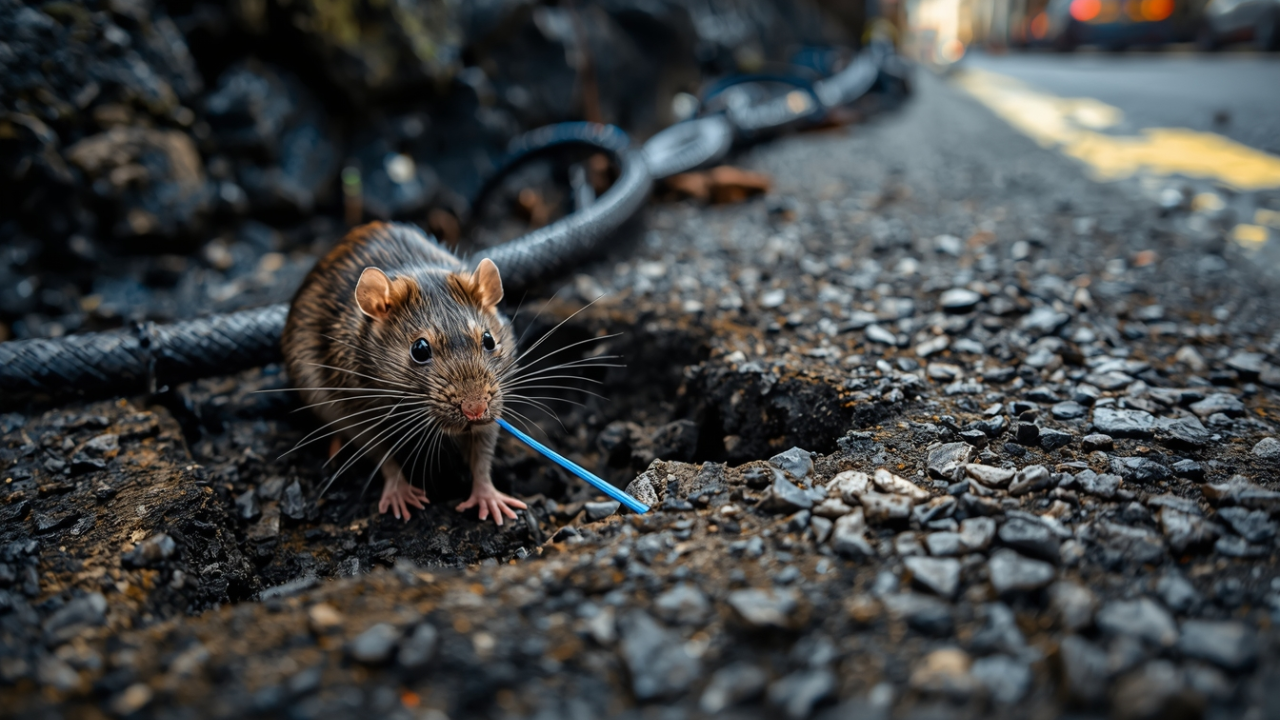
Large sections of G.Network’s underground fibre had suffered extensive rodent damage. Not isolated nicks or one-off breaks, but repeated chewing across multiple locations.
In telecoms, animal damage is annoying but normally manageable. A break is found, a cable is pulled through a duct, service is restored. But this network was different.
Engineers realised that repairing what rats had destroyed would not be a technical inconvenience — it would be a civil engineering nightmare.
The takeover talks collapsed.
Why these cables were uniquely expensive to fix
Rats have always been a fact of life for urban infrastructure. They chew electrical wiring, gnaw wooden beams, and occasionally bring down local services. Telecom firms design around that reality.
Normally, fibre runs through ducts under pavements, where access points allow damaged cable to be replaced relatively quickly. Crews open a small section, pull new fibre, reseal, and move on.
G.Network made a different call.
Micro-trenching: fast to build, brutal to maintain
To roll out quickly and cheaply, much of the network was installed using micro-trenching.
This method involves cutting a narrow slot directly into the road surface, laying fibre inside, and sealing it back up. Compared to traditional digging, it looks elegant:
- smaller cuts
- faster installation
- less upfront disruption
- lower initial cost
For a startup racing to scale, it makes sense — at least at first.
But once something goes wrong, the picture flips.
Every repair becomes a roadworks project
When rats chewed through cables laid in the carriageway:
- engineers had to cut into live roads again
- traffic diversions were required
- borough permits slowed timelines
- repeated cuts weakened road surfaces
- residents and councils grew frustrated
As Community Fibre’s leadership reportedly pointed out, a one-day cable repair could turn into weeks of planning and resurfacing.
Buying G.Network meant inheriting not just fibre — but London’s roads.
Why rats found these cables especially appealing
The obvious question followed: why were rodents targeting these cables so aggressively?
Rats chew almost anything. Their front teeth never stop growing, so gnawing is instinctive. Plastic cable sheaths offer ideal resistance.
But in this case, engineers suspect there was something more.
The soy and corn problem hiding in “green” plastics
In recent years, manufacturers have responded to environmental pressure by reducing fossil-based plastics. Some cable sheaths now include bio-based compounds, often derived from soy or corn.
From a sustainability standpoint, this looks positive:
- lower reliance on petroleum
- greener branding
- better end-of-life degradation
From a rat’s perspective?
It may smell like food.
Rodents have extremely sensitive noses. Even faint organic odours can draw them in. Once a rat identifies a path that smells edible — especially in warm, sheltered underground spaces — it tends to return.
In narrow micro-trenched cuts, these cables were also harder to inspect, giving rats more time to chew before faults were detected.
The result: repeated failures, escalating costs, and a network that scared off potential buyers.
Sustainability versus resilience: a hard trade-off
The story exposes a growing tension in infrastructure design.
| Design choice | Short-term gain | Long-term risk |
|---|---|---|
| Micro-trenching | Faster, cheaper rollout | Extremely costly repairs |
| Bio-based plastics | Greener image | Greater rodent attraction |
| Pavement ducting | Slower build | Easier access, lower repair cost |
| Light cable protection | Lower materials cost | Higher failure rates |
None of these decisions are inherently “wrong”. But combined — in a dense city with a large rat population — they proved lethal to the business case.
Telecom infrastructure isn’t built for five years. It’s expected to last decades. A material choice that saves money today can quietly multiply costs tomorrow.
Could this happen elsewhere?
Absolutely.
London’s rat problem is famous, but not unique. Cities like New York, Paris, Tokyo and Berlin all battle growing rodent populations fuelled by food waste, warmth, and underground shelter.
Any city where these factors align faces similar risks:
- dense urban layout
- heavy use of micro-trenching
- limited inspection access
- softer or bio-based cable sheaths
Some operators are already adapting:
- adding bitter-tasting additives to cable coatings
- using tougher or hybrid armouring
- routing fibre through accessible ducts where possible
- installing monitoring systems that detect light loss early
The lesson is spreading fast — especially among investors.
What “full fibre” really means on your street
For customers, phrases like full fibre or FTTH sound abstract. But they translate into very real choices under the pavement.
Fibre-optic cables carry data as pulses of light through strands of glass thinner than a human hair. The glass itself is strong — but the entire system depends on its outer protection.
One clean bite is enough to:
- disrupt service
- knock buildings offline
- trigger expensive emergency works
Micro-trenching speeds up installation, but it leaves little room for error later.
For councils, landlords, and housing associations approving new builds, this case raises uncomfortable but necessary questions:
- Where exactly are cables placed?
- How easy is access for future repairs?
- What materials protect them?
- Who pays when roads must be reopened?
The final straw for a weakened company
It’s important to note: rats didn’t single-handedly kill G.Network.
The firm was already under strain from:
- high borrowing costs
- intense competition
- slower-than-expected customer growth
But infrastructure fragility turned a difficult situation into an impossible one. What might have been a salvageable acquisition became a financial sinkhole.
Sometimes, failure doesn’t arrive as a market crash or regulatory shock. Sometimes, it arrives on four feet with sharp teeth.
A reminder buried beneath the tarmac
The episode unfolding under London’s streets is a powerful reminder that even the most advanced digital systems depend on stubbornly physical realities.
No amount of marketing can protect fibre from biology. No spreadsheet can fully model the behaviour of rats in a warm, food-scented tunnel.
As cities race to digitise, the lesson is clear: speed and sustainability matter — but so does resilience.
Because in the end, the future of broadband can hinge on something as ordinary, and as hungry, as a rat.