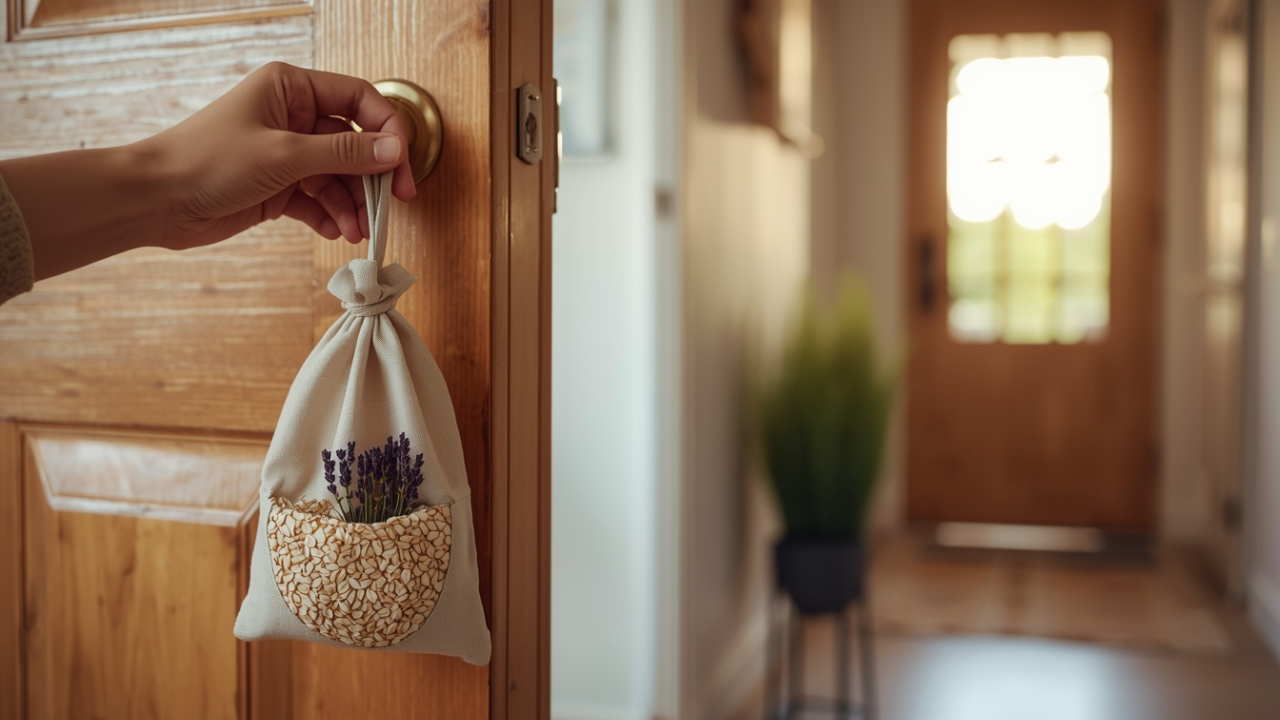
At first glance, it looks almost comically simple. A small cloth pouch. A handful of oats. Hung quietly from the inside handle of a front door, or tucked beside the frame where only residents really notice it. No incense, no candles, no elaborate symbols. Just oats — the same ones that usually end up in a breakfast bowl.
Yet for many households, this modest object has become a ritual. People touch it when they leave for work. They glance at it when they come home after a difficult day. Some even replace the oats on a specific date each month, as if tending to something alive.
Ask why they do it, and the answers are surprisingly consistent:
“It calms the house.”
“It helps with money worries.”
“It stops arguments from following us inside.”
So what’s really going on with this curious habit?
From pantry staple to front-door symbol
Oats have always been practical food. Cheap, filling, long-lasting. For centuries, they fed entire regions through harsh winters and poor harvests. Unlike luxury ingredients, oats symbolise survival, steadiness, and “having enough”.
In recent years, that symbolism has drifted out of the kitchen and into the hallway.
The idea gained traction through a mix of folk traditions, social media rituals, and modern Feng Shui interpretations. In these belief systems, the front door is not neutral. It is the place where energy, mood, opportunities, and tensions enter the home. What crosses that threshold is believed to shape what happens inside.
Hanging a small bag of oats at the entrance is meant to act as a filter — not physically, but symbolically.
Less chaos in.
More stability inside.
Why oats, specifically?
If the goal is calm or prosperity, why not crystals, coins, or herbs?
The answer lies in how people emotionally read oats.
Across cultures, grains have always represented continuity and abundance. Rice is thrown at weddings. Wheat appears in harvest festivals. Corn, barley, and millet have similar roles elsewhere. Oats are simply the most humble version of that idea.
They don’t scream wealth.
They whisper sufficiency.
That subtlety is part of the appeal in a time when many people feel financially stretched and emotionally exhausted. A bag of oats doesn’t promise riches. It promises enough — enough food, enough patience, enough stability to get through the month.
The three meanings most often attached to the oat bag
1. A buffer against negative energy
People describe the oats as absorbing stress, envy, and tension before it enters the living space. After a bad day, the door becomes a boundary rather than a funnel.
2. A symbol of financial steadiness
Oats are filling, affordable, and reliable. Hanging them near the entrance is seen as an intention: to avoid waste, manage money carefully, and keep basic needs covered.
3. A reminder of family cohesion
Oats are often shared food. One pot feeds many. For some households, the bag becomes a quiet reminder to prioritise cooperation over conflict.
No one claims the oats work miracles. Even those who swear by the practice usually admit the same thing: the effect is more psychological than mystical.
How to make and hang an oat bag (the simple way)
One reason this ritual spread so easily is that it’s almost impossible to overcomplicate.
Most people already have everything they need.
Step-by-step
- Choose a small cloth bag
Natural fabrics like cotton or linen are preferred. Some people repurpose an old handkerchief or fabric scrap. - Add the oats
A small handful of rolled oats or whole oat grains is enough. There’s no “correct” amount. - Optional: add a calming element
Many include dried lavender, bay leaf, or chamomile for scent and symbolic calm. - Tie it securely
Use string, ribbon, or thread. The bag should be closed tightly so nothing spills. - Hang it near the entrance
Most people hang it on the inside door handle, a hook near the frame, or just beside the door at hand level.
Before hanging it, some pause for a few seconds, mentally setting an intention related to money, peace, or family life. Others skip this step entirely.
The ritual works — if it works at all — because of attention, not complexity.
Why the entrance matters so much
In Feng Shui and related traditions, the entrance is often called the “mouth of the house”. It’s where the outside world meets private life.
That’s why entrances are traditionally kept:
- Clear
- Well-lit
- Free of clutter
- Calm in appearance
Adding a symbolic object at this point is meant to influence the emotional transition from outside to inside. Even skeptics often admit that simply noticing something gentle and intentional at the door can change how they feel when they walk in.
After a long day, that small pause matters.
The oat bag becomes a signal:
“Work stays out here. Home begins now.”
Keeping the ritual from turning stale
Ironically, a ritual about care can backfire if neglected.
People who follow this practice recommend refreshing the oats regularly, not because of superstition, but because old, dusty pouches lose meaning.
| Action | Suggested timing | Why it matters |
|---|---|---|
| Replace oats | Every 1–2 months | Prevents dampness, odour, neglect |
| Check herbs | Every 2–3 months | Keeps scent light and pleasant |
| Clean the bag | As needed | Avoids dust and grime |
| Dispose of old oats | Never reuse | Symbolically “release” old energy |
If the oats clump, darken, or smell musty, they’re thrown away or composted — never eaten.
Refreshing the bag often becomes a moment to reflect on finances, household tension, or upcoming plans. The oats are an excuse to pause.
What this trend says about modern life
The popularity of oat bags says less about superstition and more about stress.
Rising living costs, unstable work, constant notifications, and blurred boundaries between home and outside life leave people craving simple control points. The oat bag is cheap, non-threatening, and deeply ordinary — which makes it approachable.
There’s also a strong psychological effect at play. Small rituals:
- Reduce anxiety
- Create routine
- Offer a sense of agency
Touching the bag before leaving or arriving can act like a mental switch, separating roles and expectations.
It’s not magic. It’s habit.
Benefits — and clear limits
Possible benefits
- Emotional grounding at transitions
- A visible reminder of priorities
- A conversation starter about boundaries
- A gentle prompt to check finances or mood regularly
Clear limits
- It won’t increase income
- It won’t resolve serious family conflict
- It won’t replace planning, communication, or help
At worst, it’s just a quirky decoration. At best, it’s a tool for mindfulness disguised as folklore.
Pairing the oat bag with practical entrance habits
Interestingly, people who adopt this ritual often improve their entrance area in other ways too:
- A mat to catch dirt
- A plant to soften the space
- A tray for keys and wallets
- Better lighting
These practical changes probably do more for daily wellbeing than the oats themselves. The bag then becomes a symbolic layer, not the foundation.
When a trend becomes personal
Like many viral habits, the oat bag works only when it stops being performative. People who truly stick with it rarely talk about it. The bag becomes background — something only noticed in moments of stress or transition.
Whether you see it as superstition, mindfulness, or gentle domestic theatre, the oat bag reflects a very human desire: to believe that the boundary between chaos and calm can be marked, even lightly, by our own hands.
Sometimes, that’s enough.