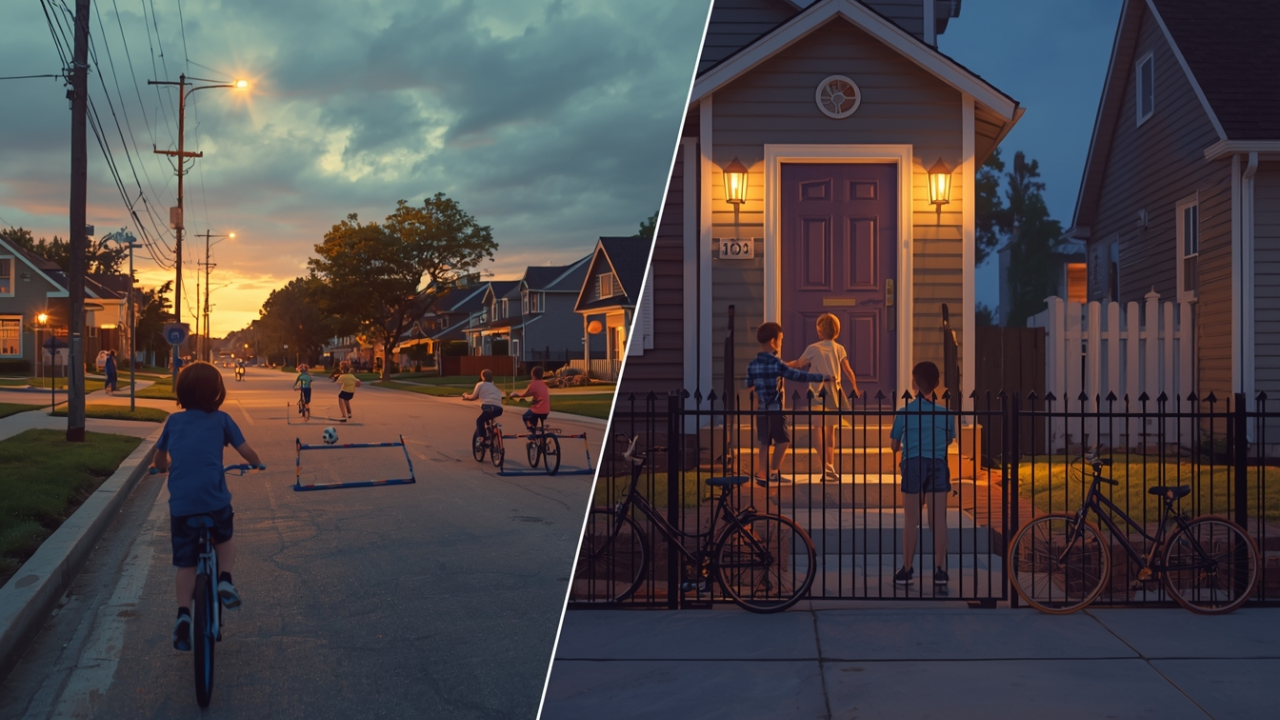
There was a time when the sound of the school bell didn’t mean homework or structured activities. It meant freedom. Pavements turned into racetracks, empty lots became kingdoms, and parents often had only a vague idea of where their children were. For kids growing up in the 1980s and 1990s, this wasn’t considered unusual — it was simply childhood.
Looking back now, that level of independence feels almost mythical. Parenting norms have shifted, cities have changed, and digital technology has filled every spare moment. Many everyday experiences that once shaped resilience, creativity, and confidence are now rare or actively discouraged.
Here are seven childhood activities from the 80s and 90s that are nearly impossible today — not because children wouldn’t enjoy them, but because the world around them no longer makes room for them.
Vanishing freedoms of an analog childhood
For children of the late 20th century, freedom was woven into daily life. There were risks, mistakes, and scraped knees — but also deep learning. Trust was assumed until broken, not constantly verified.
Today’s childhood is safer in many ways, yet far more supervised. What once felt normal now feels reckless, even dangerous, through a modern lens.
1. Disappearing for hours with no way to be reached
Before mobile phones, leaving the house meant being unreachable. A quick shout of “I’m going out!” from the hallway was often the only notice parents received.
Once kids turned the corner, they were off the grid.
Parents usually knew just enough:
- “Somewhere near the park”
- “At a friend’s place”
- “Probably on their bike”
That uncertainty created anxiety — but also competence. Children learned to fix broken chains, find their way home when lost, and manage time using the sun instead of a clock.
There was one golden rule: be home by dark. Everything in between was improvised.
Today, a child being “somewhere outside” without a phone would trigger frantic calls, tracking apps, and possibly a neighborhood search. The gap between leaving the house and returning has shrunk dramatically — and with it, a major training ground for independence.
2. Going places alone from a surprisingly young age
Walking to school alone was once a rite of passage. In the early 1970s, most children in Europe and North America traveled independently by age seven or eight. By the 1990s, that number had collapsed — and today it’s even lower.
For kids of the 80s and 90s:
- Walking to school solo was normal
- Riding bikes across town felt routine
- Taking public buses in early secondary school wasn’t unusual
- Helmets were optional, confidence wasn’t
A bicycle felt like a passport. Supermarkets, video rental stores, friends’ houses miles away — all were reachable without adults.
This constant roaming built an internal map of streets, shortcuts, and landmarks. Children learned traffic judgment, spatial awareness, and risk assessment through repetition.
Today, GPS has replaced that mental geography. Routes are followed, not learned.
3. Knocking on doors instead of sending messages
Social plans once began with a physical act: knocking on a door and asking, “Can they come out?”
Sometimes it worked. Sometimes it didn’t.
Children walked from house to house, piecing together information:
- “They were here earlier”
- “I think they went to the park”
- “Try the blue house down the street”
This analog system taught:
- How to handle rejection face-to-face
- How to negotiate plans in real time
- How to cope when plans fell apart
There were no typing bubbles, no read receipts, no curated responses. Disappointment was immediate and processed quickly.
Today, plans are pre-arranged, tracked, and adjusted digitally. The messy, human improvisation of doorstep social life has largely disappeared.
4. Watching whatever happened to be on TV
Entertainment was scarce — and that scarcity mattered.
Most households had:
- 3 to 5 TV channels
- Fixed schedules
- No replays, no catch-up
If you missed your favorite show, you missed it. Cartoons lived in narrow time slots. Once they ended, the TV reverted to adult programming — news, documentaries, or silence.
| Then (80s–90s) | Now |
|---|---|
| Limited channels | Endless streaming libraries |
| Fixed broadcast times | On-demand, anytime |
| Shared viewing moments | Personalized algorithms |
| Frequent boredom | Constant stimulation |
This limitation created shared culture. Everyone watched the same shows, the same matches, the same films. Classrooms buzzed the next day because experiences overlapped.
When TV stopped entertaining kids, they went outside — or invented something else.
5. Playing outside until the streetlights came on
Unstructured outdoor play defined entire childhoods.
There were no coaches, no schedules, no adults refereeing every argument. Games formed organically:
- Football with jumpers as goalposts
- Chalk drawings on cracked pavements
- Hide-and-seek across entire neighborhoods
- Knock-and-run pranks that felt thrilling and harmless
Rules were flexible. Arguments were loud but brief. Compromises happened because there was no authority to appeal to.
The curfew wasn’t a notification — it was the streetlights flicking on or a parent shouting from an open window.
Weather didn’t cancel plans. It simply changed them.
That constant physical engagement built coordination, resilience, and confidence — along with a tolerance for discomfort that’s rarer today.
6. Creating games out of almost nothing
Without streaming, apps, or massive game libraries, boredom forced creativity.
A single object could fuel hours of play:
- One tennis ball against a wall
- A stick turned into a sword or fishing rod
- Chalk transformed pavement into game boards
- Empty lots became fortresses or BMX tracks
Collections mattered:
- Football stickers
- Trading cards
- Marbles
- Bottle caps
These became miniature economies with trades, alliances, and occasional scandals over cheating.
Unstructured boredom wasn’t a problem to solve — it was a starting point. Children learned to push past “there’s nothing to do” into invention. Many projects failed spectacularly, but those failures became lifelong stories.
7. Sorting out conflicts without adult referees
Playgrounds and streets doubled as social laboratories.
Children navigated:
- Arguments over rules
- Shifting friendships
- Teasing that crossed lines
- Physical scuffles that ended as quickly as they began
There were serious downsides, including bullying that went unchecked. But there was also constant practice in:
- Negotiation
- Boundary-setting
- Apologizing sincerely
- Walking away when needed
Without immediate adult intervention, children learned social repair through experience.
Today, conflicts are more visible, more documented, and more often escalated through adults or digital channels. This reduces harm — but also removes chances to practice independent problem-solving.
Why these experiences faded
This shift didn’t happen because parents suddenly became overprotective.
Several forces collided:
- Increased traffic and urban density
- Legal and social pressure to supervise constantly
- Fear of blame if something goes wrong
- Digital entertainment competing with outdoor play
- Cultural emphasis on optimization and safety
At the same time, modern children gain skills their parents never had: navigating online spaces, managing information overload, and collaborating globally.
The trade-off is real — and still unfolding.
What might replace these lost freedoms
Some families and communities are experimenting with managed risk — controlled environments that reintroduce autonomy:
- Screen-free afternoons with defined roaming zones
- Gradual independence on school routes
- Letting children handle minor disputes without immediate adult involvement
- Printed-map scavenger hunts to rebuild spatial awareness
- Temporary street closures for neighborhood play
These activities involve small risks: scraped knees, arguments, wrong turns. But those manageable risks once shaped entire generations.
A childhood lit by streetlamps, not screens
The childhood of the 80s and 90s wasn’t perfect — but it was spacious. It allowed children to test themselves against the world with minimal buffering.
Today’s children grow up safer, more connected, and more supervised — yet often with less room to wander, fail, and self-correct.
The nostalgia isn’t just about the past. It’s about the skills that freedom quietly built — and the question of how we might make space for some of them again.