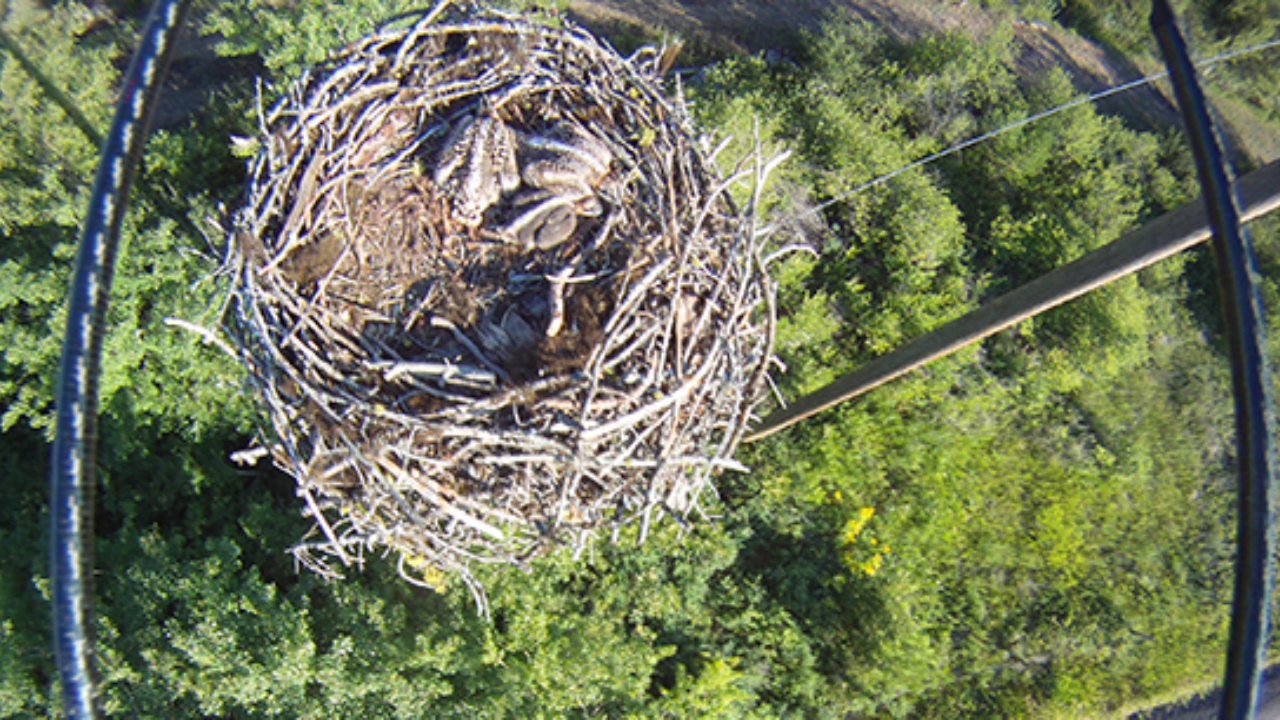
Under the relentless Pantanal sun, a single nest perched high above the wetlands has become the focus of global attention, cautious optimism, and scientific urgency. In early January 2026, researchers confirmed what many had feared might no longer be happening in this pressured landscape: a living harpy eagle chick, safely settled in a nest on the rugged slopes of the Urucum Massif near Corumbá.
For conservationists, this was not just a biological curiosity. It was proof of life—clear evidence that one of Brazil’s rarest and most powerful raptors is still breeding in the Pantanal, despite decades of habitat loss, hunting, and disturbance.
A Nest Found After Years of Uncertainty
The confirmation followed more than a decade of searching. Harpy eagles are notoriously difficult to monitor. They nest high in emergent trees, often in remote terrain, and may go years without being seen even where they still exist.
The Pantanal population had long been a mystery. Occasional sightings since around 2012 suggested harpies still passed through the region, but no one could say with confidence that they were nesting and raising young.
That changed in July 2025, when researchers finally located an active nest in the Urucum Massif, a rugged mosaic of preserved forest, mining scars, and steep ravines. Continuous monitoring began soon after. By November 2025, observers recorded activity consistent with breeding. In January 2026, the evidence became undeniable: a chick was alive in the nest.
Brazilian biologist and wildlife photographer Gabriel Oliveira, who led the confirmation, describes the moment as both exhilarating and sobering. “It tells us the species hasn’t given up on the Pantanal,” he noted, “but it also shows how fragile that presence has become.”
Why This Chick Matters So Much
For large raptors, reproduction is slow, costly, and risky. Harpy eagles are among the slowest breeders of all birds of prey. A single chick represents years of investment and years of vulnerability.
Unlike smaller birds, harpy eagles do not produce clutches of eggs every season. They raise one chick at a time, and that chick may remain dependent on its parents for up to two and a half years. During that entire period, the adults hunt constantly, defend territory, and avoid disturbance.
This makes every successful breeding attempt extraordinarily valuable. One confirmed chick can mean the difference between a population that still functions—and one that is quietly disappearing.
Life in the Urucum Massif: A Risky Refuge
The Urucum Massif is not untouched wilderness. It is a patchwork of intact forest, exposed rock, and areas altered by mining and infrastructure. Access is difficult, which has helped preserve some nesting habitat—but also complicates protection.
Field teams observed that the breeding pair alternated between two nests, likely using one as a reserve. This behaviour suggests an adaptive strategy to spread risk, but it also highlights how few suitable nesting sites remain.
For a species that requires very tall, old trees and large, continuous hunting grounds, every nest site is precious. Losing even one can erase years of reproductive potential.
How a Giant Eagle Raises a Single Chick
Harpy eagles are often called “royal eagles” in Brazil, a name that reflects both their size and presence. Adults can reach wingspans of more than two metres, with talons powerful enough to seize large arboreal prey such as monkeys and sloths.
That physical dominance comes with heavy ecological demands.
For the first 60 days after hatching, the female remains almost constantly at the nest. She shields the chick from heat, rain, and predators, leaving only briefly. During this phase, the chick is entirely dependent and extremely vulnerable.
As the chick grows and feathers develop, the pattern shifts. The female begins to hunt alongside the male more often, though parental vigilance remains high. Feeding visits must be regular and undisturbed.
What makes harpy eagle reproduction especially fragile is its duration:
- Female chicks may remain under parental care for up to 2.5 years
- Male chicks may depend on adults for around 1.5 years
This means a breeding pair may invest several years in a single offspring. If that chick is lost—or if one adult is killed—the population cannot quickly recover.
Conservation Status: Hope Within a Narrow Margin
Nationally, Brazil’s environmental authorities classify the harpy eagle as near threatened. In Mato Grosso do Sul, the species is already considered formally threatened.
The main pressures are well known:
- Large-scale deforestation and habitat fragmentation
- Loss of tall nesting trees
- Illegal shooting, often driven by fear, curiosity, or conflict with hunters
Large predators are usually the first to vanish when landscapes are broken up. Harpy eagles need not just forest, but mature forest, with structure, height, and connectivity.
The discovery of a chick does not erase these threats—but it provides a rare, concrete opportunity to protect a functioning breeding site rather than a theoretical one.
Science, Tourism, and the Risk of Attention
The first images of the chick and the attending female came during a controlled wildlife tourism outing run by Icterus Ecoturismo in partnership with Planeta Aves, a group dedicated to science communication and environmental education.
This collaboration highlights a delicate balance.
On one hand, responsible wildlife tourism can:
- Generate local income
- Build pride in native species
- Fund monitoring and logistics
- Turn visitors into conservation advocates
On the other hand, active nests are extremely sensitive. Excessive noise, repeated visits, drones, or vehicles can alter adult behaviour, disrupt hunting routines, or even cause nest abandonment.
For a species that invests years in one chick, a few weeks of disturbance can undo everything. That is why strict protocols, distance limits, and scientific oversight are essential.
A Decade-Long Search Finally Pays Off
The confirmed nest closes a major knowledge gap. For years, scientists could not determine whether harpy eagles in the Pantanal were merely passing through or truly reproducing there.
Now, researchers can track:
- Chick growth and development
- Feeding frequency and prey types
- Parental roles and time investment
- Nest reuse and longevity
- Responses to weather, visitors, and nearby land use
This single family offers insights that could shape conservation policy for the entire region.
Why Harpy Eagles Matter Beyond Themselves
Harpy eagles function as a flagship species. Where they survive, forests are usually tall, connected, and rich in wildlife. Where they disappear, ecosystems are often deeply degraded.
Protecting harpy eagle habitat helps protect:
- Monkeys, sloths, and other arboreal mammals
- Large tracts of forest needed by countless birds and plants
- Watersheds and ecological stability
Simple, practical measures can make a difference:
- Preserving the tallest emergent trees
- Maintaining forest corridors
- Limiting noise, fires, and heavy machinery near nests
- Enforcing bans on hunting large raptors
Possible Futures for the Pantanal Chick
Conservationists often outline three broad scenarios:
Positive:
The chick fledges successfully, survives its early years, and the pair breeds again—proving the Pantanal can still support a small, stable harpy population.
Stagnant:
The chick survives, but habitat pressure or disturbance prevents further breeding.
Negative:
The chick or one adult is lost, and the breeding territory collapses, leaving only transient individuals.
Which future unfolds will depend on decisions made now—by authorities, landowners, tour operators, and communities living near the nesting cliffs.
A Hopeful Sign—and a Warning
The chick in the Urucum Massif is both a symbol of resilience and a reminder of limits. Harpy eagles have not vanished from the Pantanal, but they are hanging on by a thread.
For a species that may take years to raise a single offspring, the margin for error is vanishingly small. Every felled tree, every gunshot, every careless approach to a nest carries weight far beyond the moment.
As this young eagle grows, its survival will reflect not just natural forces, but human choices. In that sense, the chick is more than a rare discovery—it is a test of whether Brazil’s great wetlands can still make room for one of their most powerful inhabitants.