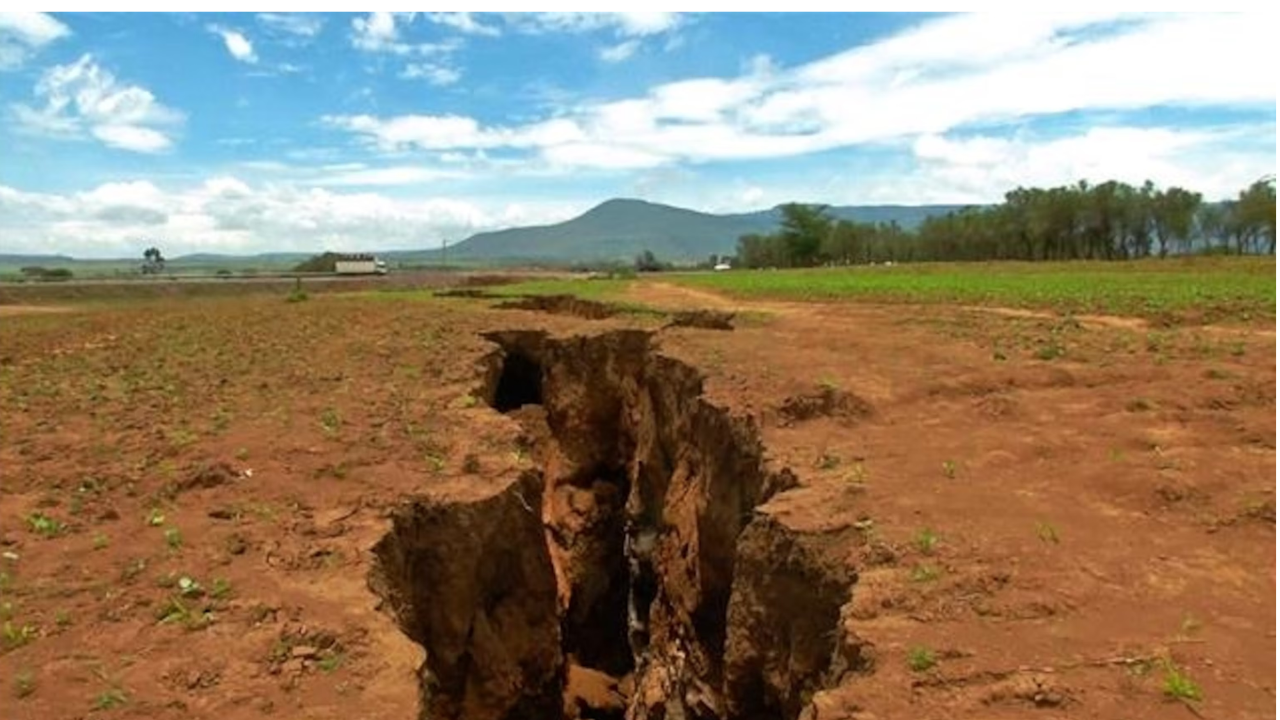
Out in the Afar Desert, in northern Ethiopia, the heat makes the air shimmer and the ground looks strangely wounded. Long cracks trace through the baked earth like veins on an old hand. A shepherd walks past them with his goats, barely looking down. For him, this is simply how the land is—harsh, restless, alive beneath his feet.
For geologists watching from satellites and dusty field camps, this place is something else entirely.
It is a continent in the act of tearing itself apart.
Africa’s “Invisible” Wound You Can Actually See
Scroll through social media long enough and you’ll find the video: a jagged chasm ripping through a road in Kenya, swallowing asphalt as stunned onlookers film from the edge. It looks unreal, like a movie set disaster dropped into real life.
That crack, filmed near Mai Mahiu in the Rift Valley, went viral worldwide. Some called it proof that Africa was “breaking apart.” Others dismissed it as simple erosion after heavy rain.
The truth sits somewhere more precise—and far more fascinating.
The fracture appeared in a region that lies directly on the East African Rift, a vast zone where the Earth’s crust has been stretching for millions of years. Heavy rain exposed and widened the crack, but the weakness was already there. What people saw wasn’t a random accident. It was a stress line in a continent under tension.
For once, a geological process that usually hides in data charts and seismic graphs became visible to the naked eye.
The Rift That’s Pulling Africa Apart
The East African Rift runs for thousands of kilometers, from the Red Sea down toward southern Africa. Beneath it, hot material from deep inside the Earth rises and pushes against the crust, thinning and stretching it like dough pulled too far.
As this happens, Africa is slowly dividing into two major pieces:
- One block to the west
- Another to the east
Between them, the land sinks, fractures, and in some places fills with lava. Valleys form. Volcanoes erupt. Earthquakes ripple quietly through the ground.
This isn’t science fiction. It’s plate tectonics doing exactly what it has done before—only this time, humans are around to watch it.
How a New Ocean Begins (Very Slowly)
Geologists often describe continental breakup as a process with stages.
First, the crust stretches and cracks, creating long valleys bounded by faults.
Next, magma rises into those cracks, forming new rock and thinning the land even more.
Finally—if the process continues long enough—seawater flows in and floods the low-lying region.
All three stages are already happening along parts of the East African Rift.
In the Afar region, where Ethiopia, Eritrea, and Djibouti meet, the land is so thin and low that it already resembles the floor of a future ocean. In 2005, a dramatic event made this clear: a 60-kilometer-long crack opened in just days as magma forced its way upward, physically prying the crust apart from below.
That wasn’t erosion. It was tectonic plates shifting in real time.
The Numbers Behind the Drama
Today, GPS stations scattered across East Africa quietly measure the movement of the land. Some sections of the rift are widening by a few millimeters per year.
That sounds insignificant—until you stretch it across millions of years.
Geologically speaking, this is fast.
By comparing the East African Rift with older features like the Red Sea and the Atlantic Ocean, scientists believe the same outcome is likely here. If spreading continues, a long, narrow ocean could eventually open, separating eastern Africa from the rest of the continent.
The timeline? Roughly 5 to 10 million years.
Far beyond any human lifespan—but close enough that we are witnessing the opening act.
Viral Videos vs. Quiet Science
When clips of ground cracking race across the internet, fear spreads faster than facts. It’s tempting to think Africa is suddenly splitting apart right now, this year, this week.
That’s not how geology works.
The rift has been developing for tens of millions of years and will continue long after us. What makes these moments shocking is that something normally too slow to notice suddenly jumps into human view—a road collapses, a field splits, a house cracks.
To separate hype from reality, scientists suggest a simple filter:
- Check location: Is it within known rift zones?
- Check triggers: Was there heavy rain, seismic activity, or volcanic unrest?
- Check sources: Are geologists or geological surveys commenting?
Most dramatic surface cracks are a mix of long-term tectonic stress and short-term surface events like rain or erosion.
What This Means for People Living There
For communities along the rift, this isn’t just a headline. Ground movement affects roads, buildings, farms, and water systems. Earthquakes and volcanic activity are real risks that require planning and monitoring.
But scientists are careful with their words. This is not an imminent continental disaster. It’s a slow transformation—one that unfolds on a timescale that allows adaptation, not panic.
As one geophysicist put it:
“Rifting looks dramatic up close, but on human timescales, it’s more about resilience than apocalypse.”
A Continent in Motion
Once you see Africa as a moving continent, the story changes. A shepherd stepping over a crack and a researcher analyzing GPS data become part of the same narrative. One sees the land daily. The other measures it millimeter by millimeter.
We are watching the same kind of process that once split Africa from South America and opened the Atlantic Ocean. The difference now is that there are satellites overhead and smartphones in every hand.
Africa isn’t breaking apart overnight.
It’s slowly, patiently reshaping itself—just as it always has.
Key Takeaways
| Key Point | Detail | Value for the Reader |
|---|---|---|
| East African Rift | A massive zone where Africa’s crust is stretching | Explains where and why the continent is splitting |
| Future ocean | Continued rifting could allow seawater to flood in | Puts viral claims into a realistic timeline |
| Viral clips | Often real, but incomplete | Helps readers avoid panic and misinformation |
FAQ
Is Africa really splitting into two continents?
Yes. The East African Rift is gradually separating two major tectonic blocks, a process already well documented by scientists.
Will a new ocean actually form?
Most geologists believe so—but only over millions of years as the rift continues to widen and thin.
Does the viral crack in Kenya prove the split is happening now?
It shows surface failure in a rift zone, often worsened by rain, within a much larger and slower tectonic process.
Should people living there be worried right now?
Not about a sudden continental breakup, but they do face real risks like earthquakes and volcanism that need ongoing monitoring.
Can scientists predict exactly when the new ocean will appear?
No. They can only estimate broad timelines based on current spreading rates and comparisons with older rift systems.