It’s late. The street is quiet. Payday has just hit your account.
You slide your card into the ATM, punch in your PIN, and wait for that familiar mechanical hum.
Instead, the screen freezes.
A second later, a blunt message appears:
“Technical problem. Your card has been retained.”
The slot stays shut.
The machine goes silent.
And your stomach drops.
The bank branch is closed. There’s no one inside. Someone behind you exhales impatiently. You tap the keypad. Nothing happens. You tug gently at the card slot, as if it might open like a stubborn drawer. It doesn’t.
Most people stop right there—confused, frustrated, already imagining phone calls, blocked accounts, and days without access to money.
But there’s something many don’t realize: in the first few seconds after an ATM retains a card, the situation isn’t always final.
And reacting quickly—very quickly—can sometimes change the outcome.
When an ATM Suddenly Swallows Your Card
The moment your card disappears, panic kicks in. Your mind races through worst-case scenarios.
- Did you enter the PIN wrong?
- Did the machine glitch?
- Is the card blocked now?
- Was someone watching?
The ATM suddenly feels hostile, like a locked metal box holding something essential to your daily life.
Stories like this are everywhere.
A student whose card vanished the night before rent was due.
A traveler who lost access to money hours before a flight.
A delivery driver stuck mid-shift without payment access.
Banking associations estimate that thousands of cards are retained by ATMs every day, often due to:
- Timeouts
- Reading errors
- Network interruptions
- Security protocols after failed PIN attempts
In most cases, people step back, sigh, and walk away—assuming nothing can be done until the bank opens.
But technically speaking, those first seconds matter more than most people think.
What’s Actually Happening Inside the ATM
When an ATM keeps a card, it doesn’t always lock it away instantly.
In many cases, the machine is still:
- Completing the transaction
- Communicating with the bank’s authorization system
- Waiting for the session to end properly
During that short window, the ATM still “expects” the card to be returned.
Once the card is mechanically moved into the internal security box, it’s gone for the night.
But before that final step, the system may still respond to one last command.
That’s where a fast, controlled reaction comes in.
The Fast Technique That Can Sometimes Release Your Card
This is not a guarantee—and it won’t override a card that has been deliberately blocked by the bank.
But in cases of timeouts, glitches, or overloaded machines, it can work.
What to do immediately (within the first 5–10 seconds):
- Do not step away from the ATM.
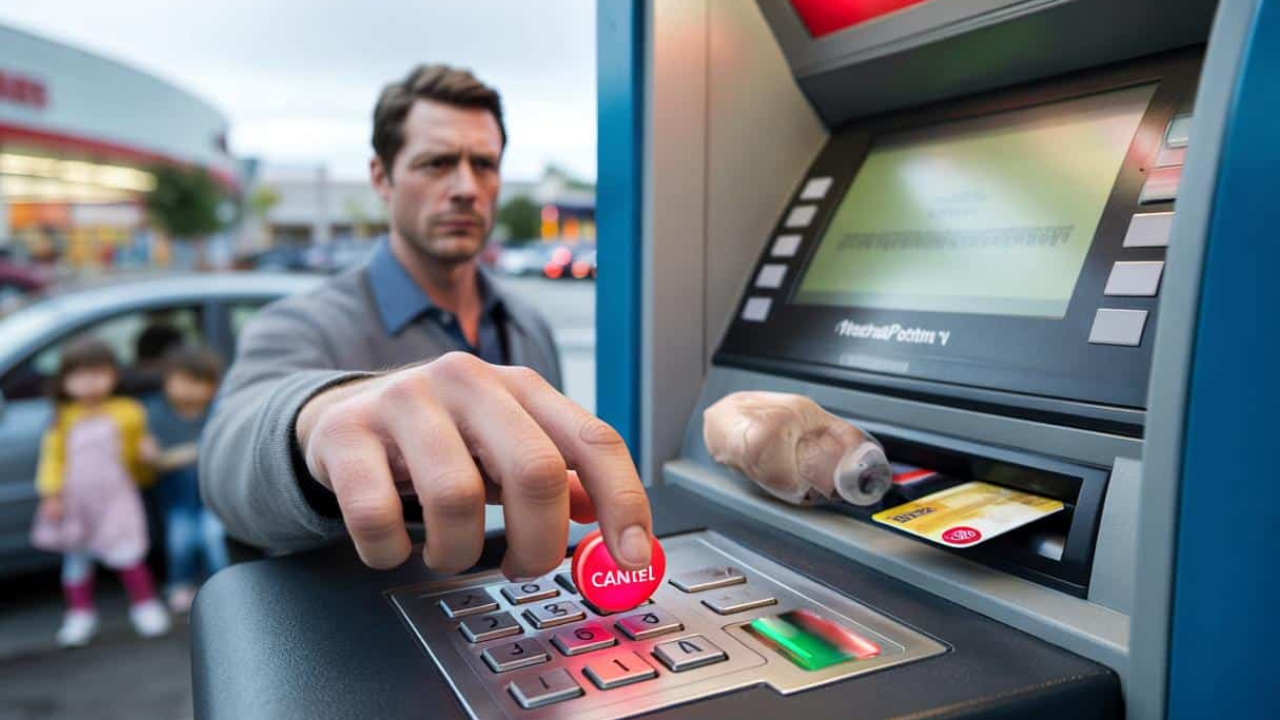
Stay exactly where you are. - Press the “Cancel” button firmly and repeatedly
Do this for 3 to 5 seconds.
Not frantic smashing—just clear, deliberate presses. - Watch the screen closely
If it offers an option like:- “End transaction”
- “Return card”
- Language selection
Choose it immediately.
- Keep your eyes on the card slot
Do not touch or pull at it.
Listen for motor sounds.
On some ATM models—especially older or heavily used ones—this sequence can trigger a last mechanical attempt to eject the card before the system fully closes the session.
Why This Sometimes Works
ATM technicians describe it simply:
As long as the internal session isn’t fully terminated, the system still treats the card as “active.”
Pressing Cancel tells the machine you want a clean exit.
In certain error states, that’s enough to prompt one final release attempt.
But the window is short.
Once the card moves into the secured compartment, nothing—not even staff—can retrieve it until servicing.
That’s why speed and calm matter more than force.
Mistakes That Make Things Worse
In that stressful moment, people often do exactly the wrong things.
❌ Hitting every key
This can trigger security locks or error escalation.
❌ Pulling or forcing the slot
This risks damaging the reader and guarantees the card won’t come back.
❌ Walking away immediately
Some card-trapping scams rely on people leaving too quickly. Staying put protects you and prevents theft.
A bank technician once put it bluntly:
“The difference between a lost card and a recovered one is often ten seconds of calm.”
If the Card Doesn’t Come Back
Stay in front of the ATM for at least one to two minutes.
Sometimes the ejection is delayed.
If nothing happens:
- Call the emergency number displayed on the ATM
- Contact your bank immediately
- Block the card to prevent misuse
- Make a note of:
- ATM location
- Time
- Error message
This limits risk and speeds up replacement.
What You’ll Remember Next Time
People who experience this once often say the same thing afterward:
“If only I’d known there was something I could try.”
That helpless feeling lingers. But knowing this reflex changes the moment entirely.
You notice things you ignored before:
- The emergency number on the ATM
- The faint sound when the card is read
- The timing between prompts
And if it happens again, your fingers won’t freeze.
They’ll already be hovering over Cancel—not in panic, but in control.
Key Takeaways
| Situation | What to Do | Why It Helps |
|---|---|---|
| Card retained message | Press Cancel immediately | Keeps session alive |
| Panic moment | Stay in front of ATM | Prevents scams, missed ejection |
| No response | Wait 1–2 minutes | Some machines delay release |
| Card not returned | Call bank & block card | Limits financial risk |