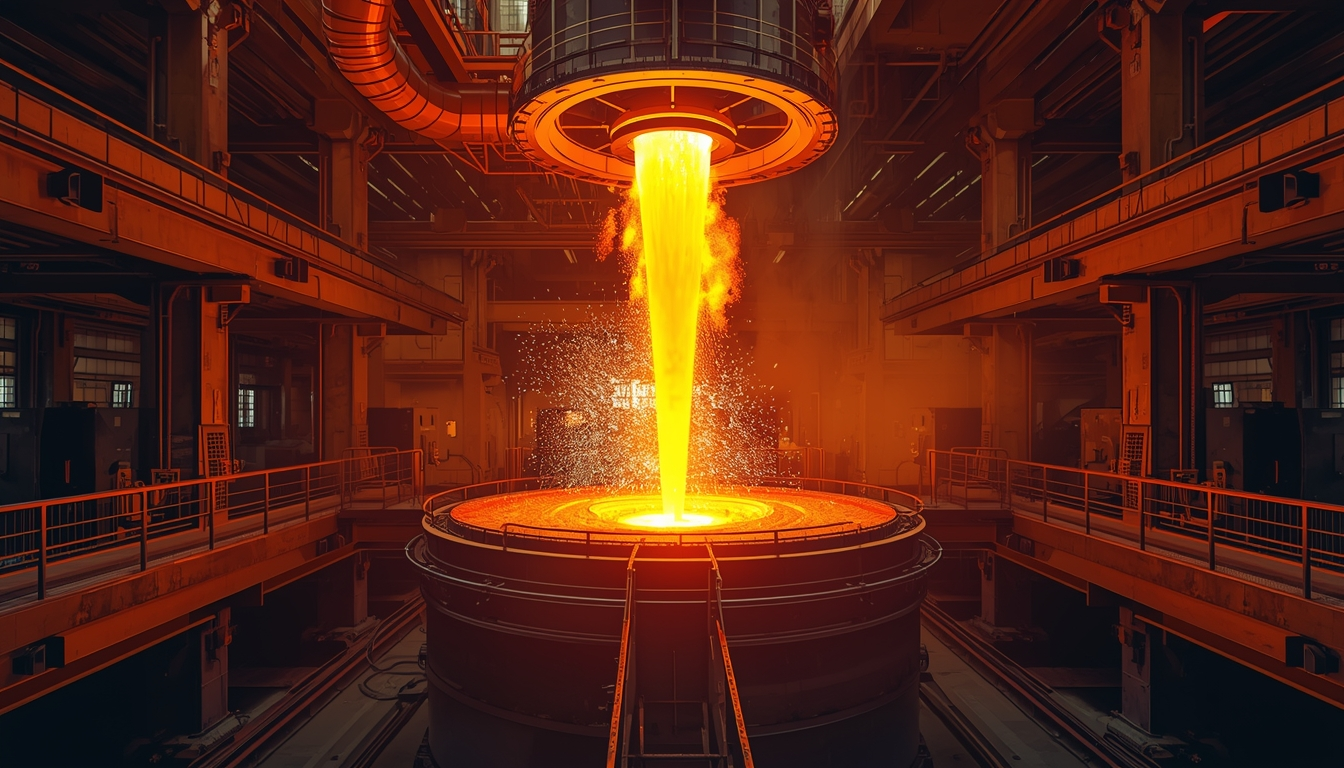
For more than a century, steel production has relied on the same basic formula: iron ore, coal (in the form of coke), extreme heat, and hours inside a blast furnace. Now, a Chinese research team claims it has compressed that multi-hour process into just three to six seconds.
The breakthrough is called flash ironmaking, and as of February 2026, it is already moving beyond the lab toward early commercial production.
Why Traditional Steelmaking Is So Carbon-Intensive
Conventional blast furnace steelmaking involves:
- Heating iron ore with coke at about 1,600°C (2,900°F)
- Multi-stage reduction and melting
- Several hours of processing time
The environmental cost is significant. Producing one tonne of steel generates approximately 1.9 tonnes of CO₂, making the industry responsible for roughly 6–7% of global greenhouse gas emissions.
Despite decades of research, no industrial-scale method had meaningfully improved the speed or emissions profile — until now.
What Is Flash Ironmaking?
According to Chinese reports, Professor Zhang Wenhai of the Chinese Academy of Engineering described the new method in a 2024 Nonferrous Metals publication.
The process works by:
- Injecting finely ground iron ore powder into a superheated reactor.
- Using a specially engineered vortex lance to create an ultra-fast reduction reaction.
- Producing molten iron droplets within 3–6 seconds.
- Allowing the molten iron to fall directly to the furnace base for casting.
Instead of moving through coke production, pelletizing, and staged reduction, the entire process happens in a single high-intensity reaction.
Speed and Scale: What the Numbers Suggest
Zhang’s team reports:
- One vortex lance can inject ~450 tonnes of iron ore per hour.
- Three lances combined could produce ~7.1 million tonnes of iron annually.
- Energy costs reduced by more than one-third.
- CO₂ emissions reportedly near zero.
Unlike experimental lab prototypes, the lance system has reportedly entered early commercial production, suggesting the technology is being industrialized rather than remaining theoretical.
Not Entirely a Chinese Invention
The concept of flash ironmaking originated at the University of Utah, where Professor H.Y. Sohn pioneered early research.
Between 2012 and 2018, the American Iron and Steel Institute, ArcelorMittal USA, and U.S. Steel explored similar methods. However, they did not achieve full commercial viability.
China secured a related patent in 2013 and reportedly spent a decade refining materials, reactor durability, and injection engineering before achieving this breakthrough.
Strategic Implications: Why This Matters for China
China currently produces around 56% of global steel and imports roughly 80% of its high-grade iron ore, largely from Australia and Brazil.
Flash ironmaking could:
- Operate using lower-grade domestic ores
- Reduce reliance on imported high-grade ore
- Strengthen supply-chain resilience amid geopolitical tensions
According to analysts at the Jamestown Foundation, the technology may function more as a strategic hedge than an immediate market overhaul.
Market Reality in 2026
While technologically impressive, flash ironmaking faces economic headwinds:
- China’s crude steel output fell 4% in 2025.
- Another 1% decline is projected in 2026.
- Domestic construction demand remains soft.
- Iron ore prices sit around $95 per tonne, down from $105–110 a year earlier.
Meanwhile, the Simandou iron ore project in Guinea began operations in late 2025, increasing global supply and placing further downward pressure on prices.
In short, the innovation changes how steel is made — not necessarily how much steel is needed.
Could Flash Ironmaking Reshape Global Steel?
If large-scale deployment proves viable, the implications are significant:
- Near-zero-emission steel production
- Faster throughput and lower energy use
- Reduced dependence on coking coal
- More flexible use of lower-grade ores
- Smaller, potentially modular production facilities
However, challenges remain:
- Scaling reactors safely at full industrial output
- Proving durability under continuous operation
- Competing against existing blast furnace infrastructure
- Navigating weak global demand
The Bottom Line
Flash ironmaking represents one of the most ambitious attempts to modernize steel production in decades. By compressing hours into seconds and potentially eliminating coal from the process, China may have achieved a technological milestone with far-reaching implications.
Whether it reshapes global supply chains or remains a strategic efficiency upgrade will depend on market conditions, cost competitiveness, and how quickly large-scale deployment can occur.
For now, one thing is clear: a process unchanged for over a century may finally be entering a new era.